
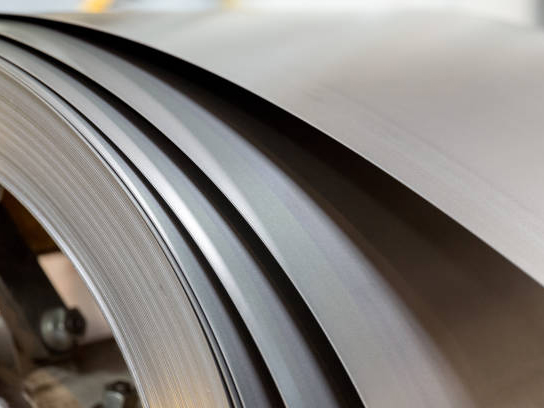
Gr1 titanium foil works well for stamping. It is the most ductile commercial pure titanium grade. Elongation ≥24%, tensile strength ≥240 MPa (ASTM B265 standard). These mechanical properties make it ideal for stamping, bending and deep drawing. Its single alpha phase gives good room-temperature formability. Proper die design and process parameters support stamping of 0.02–1.0 mm thick foil into complex shapes. Pure titanium has a low yield-to-tensile ratio. It reduces springback risk. Strict surface quality keeps die contact even. It cuts scratches and cracking. Understanding Gr1 titanium foil stamping is key for aerospace, medical devices, electronic shielding and precision manufacturing.
1. Material Properties of Gr1 Titanium Foil and Stamping Feasibility
1.1 Excellent Ductility Supports Complex Forming
Gr1 titanium foil elongation ≥24% (ASTM B265). Higher than most titanium alloys. High ductility lets it stretch more without breaking. Critical for deep drawing and bulging. Titanium alpha phase has good slip systems at room temperature. Dislocations move easily between atomic layers. It has flexible forming ability.
1.2 Moderate Strength Ensures Structural Stability
Gr1 titanium foil tensile strength ≥240 MPa, yield strength ≥138 MPa (annealed, ASTM B265). It keeps enough strength after forming. Not too strong for processing. Not too weak for use. Fits thin parts like battery tabs and shielding covers. Stamped parts eject easily. They meet assembly and service needs.
1.3 Single-Phase Structure Reduces Anisotropy
Industrial pure titanium has uniform single alpha phase. No property differences from multi-phase alloys. Consistent microstructure. Mechanical properties similar in all directions. Stamped parts keep size and shape. Continuous argon annealing makes grain size even. It improves deformation under multi-directional stress.
2. Key Technical Points for Gr1 Titanium Foil Stamping
2.1 Die Material and Surface Treatment
Titanium is chemically active. It bonds to dies under heat and pressure. This causes sticking. Use carbide or hard chrome-plated die steel. Add proper lubrication. Clean Gr1 titanium foil surface. Reduce die friction. Use graphite or molybdenum disulfide lubricants. Cut sticking and scratches.
2.2 Match Stamping Speed and Deformation
Pure titanium is sensitive to strain rate. Fast stamping causes adiabatic shear. Local temperature rises. Material softens. Control speed by thickness: ultra-thin (0.02–0.1 mm) ≤60 strokes/min; standard (0.1–1.0 mm) 50–100 strokes/min. Adjust deformation for part complexity. Use multi-pass deep drawing. Keep single deformation ≤60% of measured elongation. Avoid cracking and wrinkling.
2.3 Springback Control and Dimensional Accuracy
Gr1 titanium foil elastic modulus 110 GPa (110–115 GPa range). Lower than steel (~200 GPa). Higher than aluminum (~70 GPa). Has slight springback. Less than high-strength titanium alloys. Low yield-to-tensile ratio cuts springback. Calculate springback compensation. Optimize die surface. Use precision rolling for tight thickness tolerance. Keep dimensional error within design limits.
Recommended Stamping Process Parameters
| Parameter | Recommended Range | Control Purpose |
| Stamping speed (ultra-thin 0.02–0.1 mm) | ≤60 strokes/min | Avoid adiabatic shear and overheating |
| Stamping speed (standard 0.1–1.0 mm) | 50–100 strokes/min | Balance efficiency and quality |
| Single deformation | ≤60% of material elongation | Prevent cracking and wrinkling |
| Lubricant type | Graphite / molybdenum disulfide | Reduce friction and sticking |
| Die hardness | ≥HRC 58 | Ensure wear resistance and die life |
3. Stamping Adaptability for Different Thicknesses
3.1 Ultra-Thin Foil (0.02-0.1 mm): Precision Stamping
Ultra-thin Gr1 titanium foil fits microelectronics and sensor diaphragms. Low strength. Use precision progressive dies. Positioning accuracy ≤0.01 mm. Use air cushion or rubber pad as flexible blank holder. Avoid tearing. Die gap 3%–5% of foil thickness. Control vibration and gap tightly.
3.2 Medium Foil (0.1-0.5 mm): General Stamping
Most common stamping range. Used for battery tabs, shielding covers and heat exchanger fins. Enough rigidity for complex shapes. Use single or compound dies. Manual or automatic feeding. Bend first then punch holes. Avoid hole deformation and shift.
3.3 Thick Foil (0.5-1.0 mm): Heavy-Duty Stamping
Thicker foil needs higher press tonnage. Higher strength. Larger springback. Add springback compensation in dies. Use intermediate annealing for deep drawing: 650–700°C short hold. Remove work hardening. Restore ductility. Use hydraulic or nitrogen spring for even blank holder force. Control material flow. Avoid wrinkling and tearing.
Stamping Adaptability by Thickness
| Thickness | Typical Uses | Process Challenges | Solutions |
| 0.02-0.1 mm | Microelectronics, sensor diaphragms | Easy tear, hard positioning | Precision progressive die + flexible blank holder + low speed |
| 0.1-0.5 mm | Battery tabs, shielding covers | Complex shape, tight tolerance | Compound die + auto feed + bend before punch |
| 0.5-1.0 mm | Heat exchangers, structural parts | Large springback, work hardening | Springback compensation + 650–700°C annealing |
4. Gr1 Titanium Foil Stamping in Typical Industries
4.1 New Energy Battery: Tab Stamping
Battery tabs need good conductivity and corrosion resistance. Gr1 titanium foil conducts better than Gr2. Fits low-resistance tabs. Use high-speed progressive dies. Hundreds of strokes per minute. Wide foil with precise slitting meets different battery sizes. Consistent thickness ensures stable welding resistance. Improves battery performance.

4.2 Electronic Shielding: Shield Cover Stamping
5G and high-frequency circuits need seamless shielding. Ultra-wide Gr1 titanium foil (max 670 mm) reduces welds. Less signal leakage. Multi-position progressive dies punch, bend and form in one step. High efficiency. Consistent size. Non-magnetic. No interference with electronics.

4.3 Aerospace: Lightweight Parts Stamping
Aircraft skins and clamps need high strength-to-weight ratio and corrosion resistance. Gr1 titanium foil density 4.51 g/cm³ (57% of steel). Lightens structures. Precision stamping and welding make complex thin parts. Meets lightweight needs. Complies with international standards. Full material certification and traceability.

Industry Applications and Gr1 Titanium Foil Advantages
| Industry | Part Type | Key Requirements | Gr1 Titanium Foil Advantages |
| New Energy Battery | Tabs, connectors | Conductivity, corrosion resistance, precision | Better conductivity than Gr2, stable thickness, low resistance |
| Electronic Shielding | Shield covers, barriers | Seamless forming, non-magnetic | Wide width, no magnetic interference, complex shapes |
| Aerospace | Skins, clamps | Lightweight, strength, traceability | High strength-to-weight ratio, certified |
| Medical Devices | Implants, tools | Biocompatibility, easy sterilization | Non-toxic, non-magnetic, heat-resistant |
5. Production Control for Better Stamping Quality
5.1 Raw Material Control
Gr1 titanium foil purity ≥99.5%. Strict impurity limits: O ≤0.18%, Fe ≤0.20%. Ensure ductility. Multi-pass precision rolling. Even thickness. No surface defects. Ultrasonic + alkaline cleaning. Remove oil and oxide. High surface cleanliness.
5.2 Full-Automation and Inspection
High automation reduces human error. Online checks for thickness, surface and mechanical properties. Continuous argon annealing furnace. Temperature fluctuation ±5°C. Even grain size. Precision slitting. Auto correction and tension control. No burrs. Tight width tolerance.
5.3 Custom Processing and Support
Custom thickness, width and surface finish (bright, matte, sandblasted). Technical team optimizes stamping parameters. Die design advice and sample testing. Supports automotive, electronics, aerospace supply.
Conclusion
Gr1 titanium foil has ductility ≥25%, moderate strength and uniform single-phase structure. It fits all stamping processes. Choose proper dies. Optimize parameters. Control deformation and springback. Make high-precision parts. Different thicknesses suit new energy, electronics, aerospace and medical industries. Strict raw material control, automation and custom service ensure quality and consistency.
FAQ
1. Why does Gr1 titanium foil stick during stamping? How to fix it?
Titanium is chemically active. It bonds to dies under heat and pressure. Use carbide or hard chrome-plated dies. Apply graphite/molybdenum disulfide lubricant. Lower stamping speed. Keep surface clean. Clean dies regularly.
2. How to avoid tearing when stamping 0.02 mm ultra-thin foil?
Use precision progressive dies. Die gap 3%–5% of thickness. Use air cushion/rubber pad for soft blank holding. Low tension feeding. Speed ≤60 strokes/min. Tight thickness tolerance. Avoid stress concentration.
3. Does Gr1 titanium foil have large springback? How to compensate?
Gr1 has low yield-to-tensile ratio. Springback smaller than high-strength alloys. Elastic modulus 110 GPa. Predict springback via simulation. Add compensation in dies. Use over-bend or sizing. Anneal if needed.
Find a Reliable Gr1 Titanium Foil Supplier?
Baoji Titanium Valley Titanium Nickel Zirconium Material Processing Co., Ltd. has advanced 20-high rolling mills. Annual output 3,000 tons. Offers 0.02–1.0 mm thick, 350–670 mm wide Gr1 titanium foil. Meets stamping, welding and coating needs. Supports OEM and technical development. Contact sales@titaniumvalleys.com for samples and quotes.
References
1. Li M. Titanium and Titanium Alloy Sheet Stamping Technology[M]. Beijing: Metallurgical Industry Press, 2019.
2. Zhang W. Plastic Deformation of Commercial Pure Titanium[J]. The Chinese Journal of Nonferrous Metals, 2021, 31(6): 1523-1530.
3. Wang J. Precision Titanium Foil Rolling and Surface Control[J]. Rare Metal Materials and Engineering, 2020, 49(12): 4215-4222.
4. Liu X. Titanium Alloy Stamping Die Design and Springback Compensation[J]. Journal of Plasticity Engineering, 2022, 29(3): 78-85.