
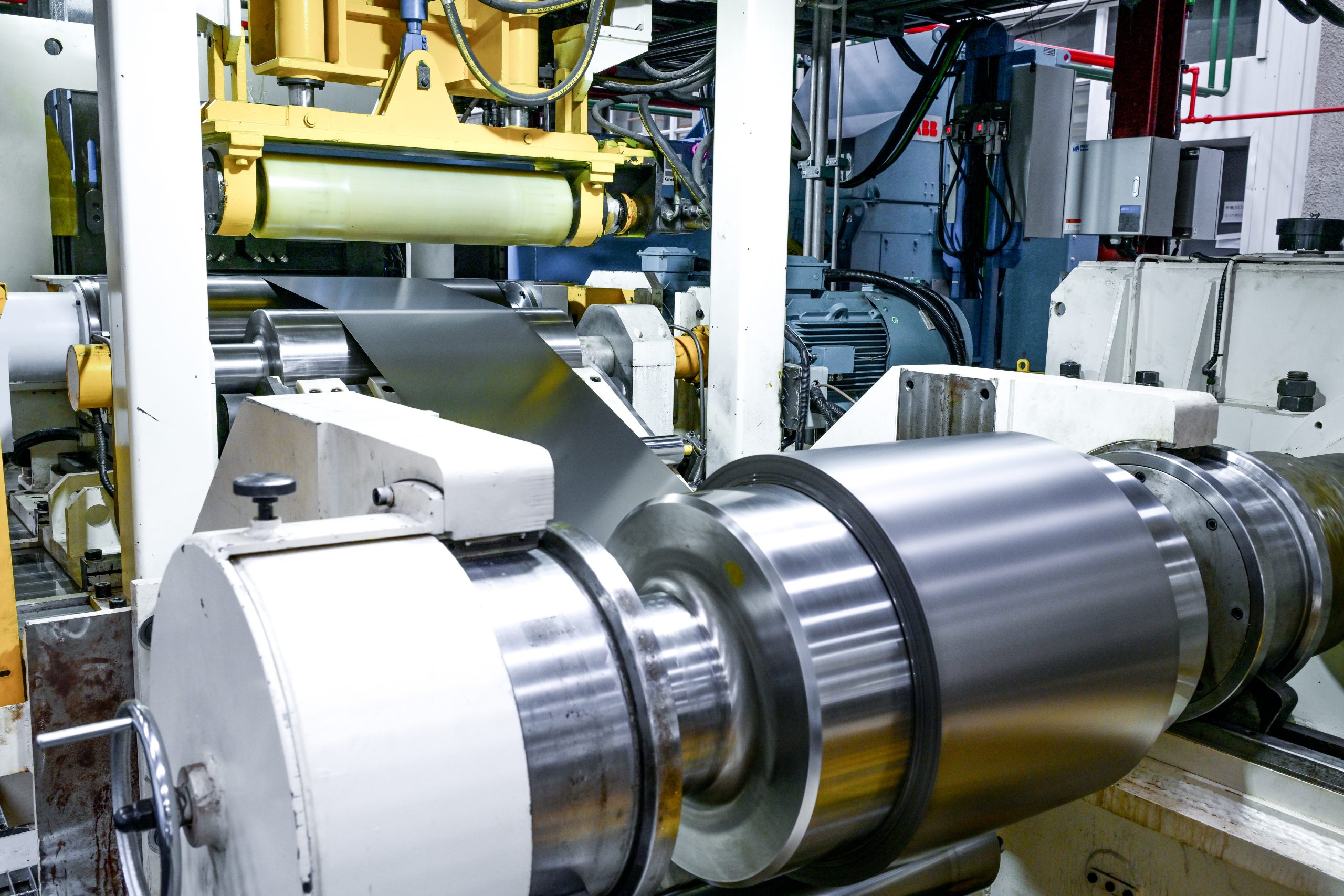
Gr5 titanium foil uses Ti-6Al-4V alloy. It contains titanium as the base material, 5.5~6.75% aluminum and 3.5~4.5% vanadium. It belongs to α+β dual-phase titanium alloy.
Impurity elements follow strict limits: oxygen ≤0.20%, carbon ≤0.08%, nitrogen ≤0.05%, hydrogen ≤0.015%, iron ≤0.30%.
This precise ratio gives Gr5 titanium foil tensile strength over 895 MPa. Annealed state ranges from 895 to 930 MPa. Its yield strength is no less than 825 MPa. Density is about 4.43 g/cm³. It features high strength and light weight for aerospace use.
Aluminum stabilizes α phase and improves heat resistance. Vanadium strengthens β phase and boosts room-temperature strength. Controlled impurities keep good ductility and welding performance. So this material works well in aerospace, medical implants and high-end energy equipment under harsh conditions.
1. Standard Chemical Composition of Gr5 Titanium Foil
1.1 Main Alloy Elements: Combined Effects of Aluminum and Vanadium
Aluminum content stays between 5.5% and 6.75%. It is an α phase stabilizer. Aluminum atoms mix into titanium base and raise high-temperature creep resistance and oxidation resistance.
At 300℃ for long-term use, aluminum forms dense oxide film. The film stops oxygen from entering the base and keeps stable structure.
Vanadium content ranges from 3.5% to 4.5%. It is a β phase stabilizer. It retains β phase and improves room-temperature strength and hardenability.
The two elements work together. The alloy forms α+β dual-phase structure at room temperature. The phase ratio is about 6:4 to 7:3. It owns high strength and oxidation resistance from α phase, plus good toughness and workability from β phase. It balances strength and toughness well.
1.2 Strict Control Standards for Impurity Elements
Oxygen limit of 0.20% is a key control index. Oxygen strengthens α phase and raises strength. Too much oxygen makes material brittle. It shortens fatigue life and reduces impact toughness.
Carbon below 0.08% prevents carbide formation. Excess carbide lowers ductility.
Nitrogen below 0.05% avoids nitride defects on material surface.
Hydrogen limit is set to 0.015%. Titanium alloy is sensitive to hydrogen embrittlement. Extra hydrogen forms hydride at stress points and causes delayed cracks.
Advanced processes like vacuum melting and inert gas shielding support precise control of these impurities.
1.3 Iron Control and Balance of Trace Impurities
Iron content is limited to 0.30%. This balance controls cost and performance.
Iron has low solubility in titanium. Excess iron forms β eutectic structure. It weakens high-temperature stability and corrosion resistance.
ASTM B265 does not set separate limits for manganese, silicon and zirconium. But total trace impurities need strict control. This ensures even α+β phase structure after vacuum annealing.
2. How Chemical Composition Affects Mechanical Properties
2.1 Alloying Mechanism for Strength
Ti-6Al-4V makes annealed Gr5 titanium foil have tensile strength above 895 MPa. Pure Gr2 titanium only reaches 345 MPa.
Annealed Gr5 has yield strength from 825 MPa to 895 MPa. Elongation is 10~15%. Density is 4.43 g/cm³. It has much higher specific strength than steel and aluminum alloy.
Small aluminum atoms distort titanium lattice and strengthen the material. Vanadium strengthens β phase and blocks dislocation movement.
In α+β structure, layered α phase bears main load. β phase absorbs deformation energy and adds toughness.
2.2 Chemical Basis for Ductility and Forming Performance
Gr5 elongation is over 10%, lower than pure Gr1 titanium (over 24%). But its α+β structure brings excellent overall mechanical properties.
Aluminum-stabilized α phase slows crack growth under cyclic load. Vanadium-rich β phase allows plastic deformation.
Hardness ranges from HB 270 to 330. The material meets load requirements and keeps good workability.
Low hydrogen content below 0.015% stops brittleness at room temperature.
For foil forming, vacuum annealing restores ductility. Precision levelers improve flatness to meet usage standards.
2.3 High-Temperature Strength Retention and Creep Resistance
Gr5 titanium foil works stably at 300℃ for long periods. It resists short-time heat up to 400℃. Aluminum strengthens α phase to achieve this performance.
At high temperature, layered α phase stops dislocation climb and grain boundary slide. It maintains creep resistance.
Vanadium prevents β phase from over-growing and keeps stable structure.
Pure titanium loses strength quickly above 250℃. Ti-6Al-4V still keeps good strength at 300℃.
This foil serves as electrode material in chemical electrolytic cells. It bears combined electrochemical corrosion and thermal stress. Controlled oxygen keeps dense oxide film and extends service life.
Effects of Composition Adjustment on Mechanical Properties
| Composition Adjustment | Strength Change | Ductility Change | Corrosion Resistance Change | Application Scenarios |
|---|---|---|---|---|
| Aluminum within standard range | Higher strength | Slightly lower ductility | Denser high-temperature oxide film | Heat insulation foil for aero-engine |
| Vanadium within standard range | Higher yield strength | Slightly lower cold workability | Slightly weaker chloride resistance | High-strength structural load parts |
| Oxygen ≤0.15% | Slightly lower strength | Higher elongation | Better pitting resistance | Complex deep drawing parts |
| Hydrogen ≤0.008% | Better fatigue performance | Greatly improved toughness | Crack resistance in welding heat-affected zone | Medical implants, pressure vessels |
| Iron ≤0.20% | Slightly lower strength | Better high-temperature ductility | Optimized biocompatibility | Medical devices, food processing equipment |
3. Chemical Composition Standards and Global Certification Systems
3.1 Analysis of ASTM B265 Composition Range
ASTM B265 is the core standard for Gr5 titanium foil. It defines Ti-6Al-4V as Grade 5.
Clear element limits: Al 5.5~6.75%, V 3.5~4.5%, Fe ≤0.30%, O ≤0.20%, C ≤0.08%, N ≤0.05%, H ≤0.015%. Titanium makes up the rest.
This standard also lists different mechanical properties under various annealing states.
3.2 Matching of AMS and UNS Codes
AMS 4911 is the aerospace material specification for Ti-6Al-4V foil. It adds rules for surface quality, grain size and non-destructive testing beyond ASTM standards.
UNS R56400 is the unified number code for global supply chain identification.
European standards and JIS H 4600 follow nearly the same composition rules. They have small differences in oxygen tolerance.
Multiple standard systems help clients meet certification requirements for aerospace, high-end manufacturing and precision electronics.
3.3 Special Rules for Medical Grade and Aerospace Grade
Medical implant grade Gr5 titanium foil follows ASTM F136, also known as TC4 ELI in China. It has stricter composition limits: Fe ≤0.25%, O ≤0.13%, N ≤0.03%, C ≤0.08%. These rules reduce biological risks for orthopedic and dental implants.
Aero-engine foil must pass extra fatigue tests per AMS 4911.
For new energy products, low hydrogen content stops pore formation during laser welding. It improves welding joint strength.
Comparison of Gr5 Titanium Foil Chemical Composition Standard
| Element | ASTM B265 Gr5 | AMS 4911 | ASTM F136 (Medical Grade) | JIS H 4600 |
|---|---|---|---|---|
| Ti (Titanium) | Balance | Balance | Balance | Balance |
| Al (Aluminum) | 5.5-6.75% | 5.5-6.75% | 5.5-6.5% | 5.5-6.75% |
| V (Vanadium) | 3.5-4.5% | 3.5-4.5% | 3.5-4.5% | 3.5-4.5% |
| Fe (Iron) | ≤0.30% | ≤0.30% | ≤0.25% | ≤0.30% |
| O (Oxygen) | ≤0.20% | ≤0.20% | ≤0.13% | ≤0.25% |
| C (Carbon) | ≤0.08% | ≤0.08% | ≤0.08% | ≤0.08% |
| N (Nitrogen) | ≤0.05% | ≤0.05% | ≤0.03% | ≤0.05% |
| H (Hydrogen) | ≤0.015% | ≤0.0125% | ≤0.012% | ≤0.013% |
4. Composition Analysis and Quality Control
4.1 Modern Composition Testing Technologies
ICP-OES is the standard method to test main alloy elements. It measures spectral intensity of aluminum, vanadium and iron. Test accuracy reaches ±0.01%.
Inert gas fusion infrared absorption method tests oxygen and nitrogen. Samples melt at high temperature in graphite crucible and release gas. Infrared detector carries out quantitative analysis. Detection limit is 0.001%.
Thermal conductivity method or mass spectrometry tests hydrogen content.
4.2 Composition Stability Control in Production
Composition may change due to oxidation and hydrogen absorption from titanium ingot to finished foil.
Heating furnaces use inert gas protection during hot rolling. This prevents surface oxygen absorption and hardening.
Multiple precision cold rolling passes include strict cleaning. It removes rolling oil and stops carbon and hydrogen from entering material base.
Continuous vacuum annealing avoids incomplete dehydrogenation and over-sized grains.
4.3 Client Verification and Third-Party Certification
High-end clients ask for test reports from independent third-party labs.
TÜV, SGS use XRF for quick screening, and wet chemical analysis for final verification.
Aerospace orders require full batch tracking from titanium sponge raw material to finished foil.
For heat dissipation foil used in new energy batteries, factories add special hydrogen test and welding performance evaluation.
Quality Control System for Gr5 Titanium Foil Composition
| Control Stage | Test Equipment | Control Accuracy | Reference Standard |
|---|---|---|---|
| Raw material incoming | ICP-OES Spectrometer | ±0.01% | ASTM E1409 |
| Melting process | On-line oxygen probe for vacuum furnace | ±0.005% | AMS 2371 |
| Rolling semi-finished product | Portable XRF Analyzer | ±0.02% (rapid screening) | ISO 22036 |
| Annealed finished product | Inert gas fusion infrared absorption | ±0.001% (ONH) | ASTM E1447 |
| Final inspection | Wet chemical analysis | ±0.005% | GB/T 4698 |
5. Composition Matching for Different Application Scenarios
5.1 Composition Optimization for Aerospace
Honeycomb core materials for aircraft skin need stable strength in wide temperature range. Upper limit of aluminum content keeps low-temperature toughness. Lower limit of vanadium avoids excessive hardness and impact brittleness.
Heat insulation foil for engines bears instant high temperature up to 400℃. Strict oxygen control prevents oxide film peeling.
Improved alloys like TC4-DT see wider use in main load-bearing aerospace parts.

5.2 Chemical Requirements for Medical Implants and Biocompatibility
Implants such as artificial joints and bone screws are very sensitive to impurities.
Medical grade Gr5 titanium foil follows ASTM F136. Oxygen below 0.13% stabilizes surface passivation film. Carbon below 0.08% stops carbide particles from irritating human tissue.
Manufacturers conduct biological evaluation per ISO 10993. Material surface properties affect cell activity and bonding between implant and bone.

5.3 Special Composition Requirements for Electronics and New Energy
Electromagnetic shielding foil needs low magnetic permeability. α and β phases of Gr5 titanium foil are both paramagnetic. Stable vanadium content controls magnetic performance.
Battery pack heat dissipation foil needs high thermal conductivity and high strength. Gr5 thermal conductivity is 6.7~7.2 W/m·K, lower than pure titanium. Designers need to take this feature into account.
Bipolar plates for hydrogen fuel cells require good hydrogen embrittlement resistance. Low hydrogen content and vanadium-strengthened β phase trap hydrogen and prevent crack growth.

Conclusion
Ti-6Al-4V composition of Gr5 titanium foil uses 5.5~6.75% aluminum and 3.5~4.5% vanadium. It builds α+β dual-phase strengthening system. The material achieves tensile strength over 895 MPa and light weight.
Strict limits on oxygen (≤0.20%) and hydrogen (≤0.015%) ensure reliable performance and long service life in aerospace, medical implants and new energy equipment.
Advanced rolling and vacuum annealing technologies control composition fluctuation. Factories realize stable mass production of ultra-thin and wide foil. Products meet strict global requirements on composition consistency and traceability.
FAQ
1. How does fluctuation of aluminum and vanadium content affect performance?
Content change within standard range will affect mechanical properties. Factories use spectrometers for real-time monitoring. They keep element fluctuation in small range to guarantee consistent performance of each batch.
2. How to verify actual impurity content of Gr5 titanium foil?
Ask suppliers to provide test reports from inert gas fusion infrared method and complete batch tracking records. You can send samples to SGS, TÜV for recheck with wet chemical analysis. Products come with material certificates and support witness sampling.
3. Key differences between medical grade and aerospace grade Gr5 titanium foil?
Medical grade (ASTM F136) has stricter oxygen limit at 0.13%, while aerospace grade is 0.20%. Medical grade limits iron below 0.25% to reduce biological risks, and hydrogen below 0.012% to avoid delayed cracks. Main alloy element ranges stay nearly the same. Medical grade also needs biological tests per ISO 10993. Aerospace grade focuses more on high-temperature strength and creep resistance.
Professional Gr5 Titanium Foil Manufacturer – Titanium Valley
Titanium Valley is a professional manufacturer and supplier of Gr5 titanium foil. We own world-class 750mm 20-high cold rolling line and continuous vacuum annealing system. Annual output reaches 3000 tons.
We supply high-precision titanium alloy foil in size 0.03-0.8mm × 350-670mm. All products meet ASTM B265, AMS 4911 and other international standards. We provide material certificates and third-party test reports. We accept customized orders for aerospace, medical and new energy industries.
For composition reports and technical support, please contact: sales@titaniumvalleys.com
References
- Zhang Xiyan, Zhao Yongqing, Bai Chenguang. Titanium Alloys and Applications. Beijing: Chemical Industry Press, 2005.
- Zhao Yongqing, Hong Quan, Ge Peng. Microstructure and Properties of Titanium and Titanium Alloys. Changsha: Central South University Press, 2012.
- Wang Guisheng. Corrosion Properties of Titanium and Titanium Alloys. Titanium Industry Progress, 1999(5): 1-6.
- Xin Shewei, Zhao Yongqing, Zeng Weidong. Research Progress on Damage Tolerance of Titanium Alloys. Materials Engineering, 2010(9): 85-91.