
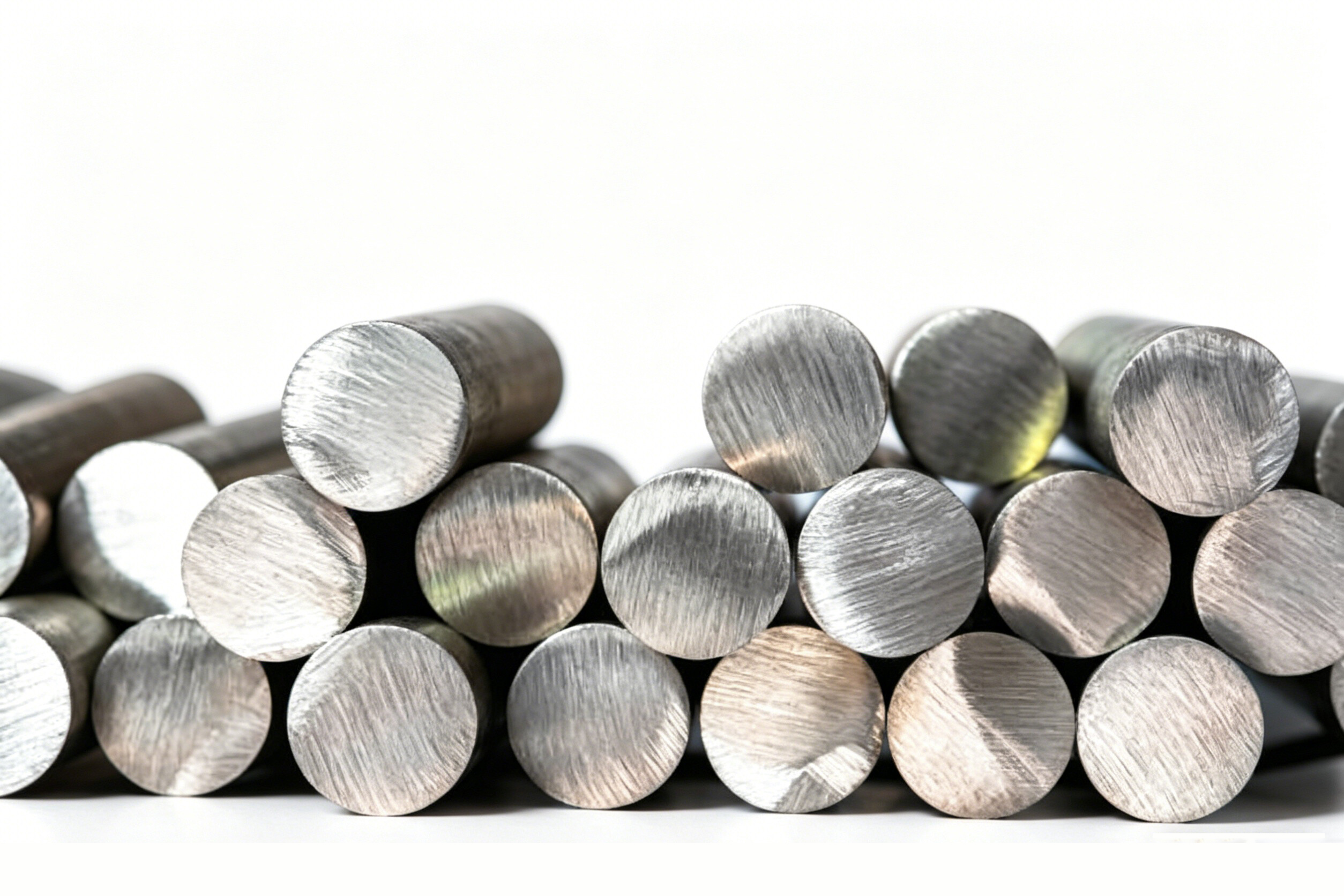
Choosing the right titanium material matters in industrial use. Gr1 titanium rods (commercially pure titanium) and Gr5 titanium rods (titanium alloy) differ Greatly in performance, structure and use. They each have unique strengths. Gr1 titanium rods have purity above 99.5%. They show excellent ductility and corrosion resistance. They fit deep processing, welding and extreme corrosion protection. Gr5 titanium rods (Ti-6Al-4V) add aluminum and vanadium. Their strength reaches 860–930 MPa. They become the top choice for aerospace and high-load structures. The two have clear differences in chemical composition, mechanical properties, processing and applications. Understanding these differences helps engineers and buyers make cost-effective and reliable material choices. It avoids equipment failure or waste from wrong selection.
1. Core Differences in Chemical Composition and Purity
1.1 High Purity of Gr1 Titanium rods
Gr1 titanium rods are alpha-type commercially pure titanium. Titanium content ≥99.5%. It is the purest titanium Grade for industry. Impurity levels are very low: iron ≤0.20%, oxygen ≤0.18%, carbon ≤0.08%, nitrogen ≤0.03%, hydrogen ≤0.015%. This high purity ensures chemical stability and biocompatibility. It forms a dense oxide film naturally on the surface. It stays stable long-term in seawater, chloride ions, dilute acids and alkalis.
1.2 Alloy Design of Gr5 Titanium rods
Gr5 titanium rods use the Ti-6Al-4V alloy system. They contain 6% aluminum and 4% vanadium. They are alpha+beta dual-phase titanium alloys. Aluminum boosts high-temperature strength and oxidation resistance. Vanadium stabilizes the beta phase and improves toughness. This alloy design keeps titanium’s light weight. It delivers mechanical properties close to high-strength steel. But it loses some corrosion resistance and workability.
1.3 How Purity Affects Applications
Material purity directly decides use cases. Gr1’s high purity makes it ideal for medical implants, food/pharmaceutical equipment and electrolytic electrodes. These fields accept zero contamination. Gr5’s alloy elements reduce biocompatibility. But its Great strength-to-weight ratio makes it irreplaceable for aircraft parts, racing components and deep-sea submersibles. Balance purity and performance when selecting materials.
Chemical Composition Differences Between Gr1 and Gr5 Titanium Rods
| Grade | Titanium Content | Main Alloy Elements | Total Impurities | Applicable Standard |
| Gr1 Titanium rod | ≥99.5% | None | ≤0.5% | ASTM B348 |
| Gr5 Titanium rod | Balance Ti + controlled impurities | 6% Al, 4% V | Alloy design | ASTM B348, AMS 4928 |
2. Big Gaps in Mechanical Properties and Strength
2.1 Gr1: Good Ductility, Limited Strength
Gr1 titanium rods have tensile strength of 240–345 MPa. Yield strength ranges from 170–275 MPa. Elongation ≥24%. This “low strength, high toughness” feature makes it the most ductile pure titanium Grade. It bends, deep draws, spins and welds easily. It works for chemical reactor liners, pipe flanges and medical fixture manufacturing needing heavy deformation. Gr1 cuts processing difficulty and scrap rates. It does not fit high-stress load cases. Gr1 has a single alpha phase. It cannot gain strength from heat treatment.
2.2 Gr5: Ultra-High Strength
Gr5 titanium rods have tensile strength of 860–930 MPa. Yield strength ≥795 MPa. Strength is about three times that of Gr1. Alloy strengthening and heat treatment create this high strength. It handles high-speed rotation, heavy impact and extreme stress. Gr5 has an alpha+beta dual phase. It gains strength via heat treatment (solution + aging). It adjusts strength levels. Gr5 uses smaller cross-sections for the same load in aero-engine blades, landing gear parts and sports gear. It lightens structures.
2.3 Fatigue Performance and Durability
Fatigue strength decides service life under cyclic loads. At room temperature and symmetric cyclic loads, Gr1 has a fatigue limit of 120–150 MPa. It fits low-frequency, small-amplitude vibration like chemical pump shafts and marine monitoring brackets. Gr5 has a fatigue limit above 500 MPa. It handles high-frequency vibration and impact. It is the standard material for helicopter rotors, high-speed rail fasteners and racing suspension systems.
Differences in Mechanical Properties Between Gr1 and Gr5 Titanium Rods
| Property | Gr1 Titanium rod | Gr5 Titanium rod | Gap |
| Tensile Strength | 240-345 MPa | 860-930 MPa | Grade 5 is approximately three times stronger than Grade 1 |
| Yield Strength | 170-275 MPa | ≥795 MPa | Grade 5 is approximately three times stronger than Grade 1 |
| Elongation | ≥24% | 10%-15% | Gr1 more ductile |
| Fatigue Limit | 120-150 MPa | ≥500 MPa | Gr5 more durable |
| Hardness | 120-140 HV | 300-350 HV | Gr5 more wear-resistant |
3. Corrosion Resistance and Environmental Adaptability
3.1 Gr1: Broad-Spectrum Corrosion Resistance
Gr1 titanium rods perform well in nearly all corrosive environments. The natural TiO₂ passive film is 1–10 nanometers thick. It self-repairs and resists seawater, high chloride environments (≥20,000 ppm), nitric acid, chromic acid and hypochlorite. Gr1 titanium rods serve over 30 years in desalination heat exchangers, electroplating tank anodes and coastal chemical pipes. Stainless steel lasts only 5-8 years.
3.2 Gr5: Corrosion Risks in Specific Media
Gr5 titanium rods keep basic titanium corrosion resistance. But alloy elements bring new corrosion risks. Gr5 corrodes 2-5 times faster than Gr1 in strong acids (pH<3) and high-temperature fluorine media. Do not use Gr5 for long-term human tissue contact implants.
3.3 Stress Corrosion and Crevice Corrosion Sensitivity
Gr1 titanium rods resist stress corrosion and crevice corrosion. They keep stable corrosion resistance even in weld heat-affected zones and stress-concentrated machined areas. They work reliably for pressure vessels, bolts and offshore platform chains. Gr5 needs extra surface passivation in high-stress and crevice areas (flange seals, thread joints). It may develop local corrosion holes quickly without treatment.
4. Processing and Cost Trade-Offs
4.1 Gr1: Easy to Machine
Gr1 titanium rods cut well. Use carbide tools on standard lathes and mills. Cutting speed: 20-50 m/min. Feed rate: 0.1-0.3 mm/r. High elongation (≥24%) lets cold bend radius reach twice material thickness. Cold stamping single-pass deformation: 30%. Multi-pass cumulative deformation: over 50% without intermediate annealing. Gr1 fits TIG, MIG and electron beam welding. Weld strength reaches over 90% of base metal. Heat-affected zone is narrow. No extra stress relief heat treatment needed. Process is simple.
4.2 Gr5: Hard to Machine, with Solutions
Gr5 titanium rods are hard to machine. Cut at low speed (10-25 m/min), high feed and full cooling. Tool wear is 3-5 times faster than Gr1. Low thermal conductivity (~7.2 W/(m·K)) concentrates heat at tool tips. Use coated carbide or ceramic tools. Hot working window is narrow (900-950℃). Overheating causes alpha brittleness. Weld with inert gas shielding. Post-weld: hold at 650℃ for 2 hours, cool in furnace for stress relief. Otherwise welds crack easily.
4.3 Raw Material and Processing Cost Comparison
Gr1 titanium rods cost $30-45/kg raw material. Processing makes up 25-35% of final price. Gr5 titanium rods cost $45-70/kg raw material. Processing makes up 40–50% of final price. Tool wear, heat treatment and inspection costs rise sharply. Gr5 scrap rates are higher than Gr1. Rework costs are much higher. For mass-produced precision parts, Gr1 total cost can be 30-40% lower than Gr5.
Processing Parameter Differences Between Gr1 and Gr5 Titanium Rods
| Parameter | Gr1 Titanium rod | Gr5 Titanium rod | Key Difference |
| Cutting Speed | 20-50 m/min | 10-25 m/min | Gr5 harder to cut |
| Tool Life | 100% baseline | 30-50% | Gr5 wears tools faster |
| Cold Bend Radius | 2×material thickness | 4-6×material thickness | Gr1 better ductile forming |
| Welding Complexity | Low (standard TIG) | High (strict shielding + heat treatment) | Gr5 higher welding cost |
| Raw Material Price | $30-45/kg | $45-70/kg | Gr5 ~50% more expensive |
5. Application Selection and Decision Guide
5.1 Best Uses for Gr1
Chemical corrosion-resistant equipment is Gr1’s core use. Gr1 stir shafts, heating tubes and supports work maintenance-free over 20 years in sulfuric acid, dilute hydrochloric acid and sodium hydroxide tanks. Gr1 avoids stainless steel pitting in desalination high-pressure pump shafts, heat exchanger tubesheets and flanges. Medical: Gr1 for short-term implants, bone screws and dental abutments (standard/short-term). Gr2/Gr4 work better for high-end permanent implants. Gr1 also fits surgical instrument Grips. It meets biocompatibility standards.

5.2 Key Uses for Gr5
Aerospace is Gr5’s traditional strength. Gr5 titanium rods build aircraft frames, landing gear rods, engine compressor disks and fasteners. High strength-to-weight ratio cuts aircraft weight Greatly. Racing: Gr5 suspension links, steering knuckles and exhaust systems deliver extreme light weight. Deep-sea probes: Gr5 pressure hulls, manipulator joints and propeller shafts handle ultra-high water pressure. Note: Gr5 works up to 300℃. It weakens above 300℃. Do not use in strong acid/alkali chemical environments or equipment needing frequent welding.

5.3 Mixed Material Strategy and Selection Matrix
Combine both materials for complex equipment. Marine lifting equipment: Gr5 for main load-bearing structures; Gr1 for seawater-exposed fasteners, guide wheels and sliders. Chemical reactors: Gr1 for corrosion-resistant shells; Gr5 for high-torque stirrer shafts. Avoid direct large-area contact between dissimilar titanium Grades. This prevents galvanic corrosion in seawater/electrolytes. Use insulating gaskets or coatings if contact is needed.
Selection Guide:
Choose Gr1:Severe corrosion (pH<3 or>11, high chloride); Complex forming (bend, stamp, deep draw); Medical/food contact; Limited budget, no high strength need; Frequent welding and repair.
Choose Gr5:High load (>400 MPa); High-frequency vibration/impact; Extreme light weight; Medium-high temperature (≤300℃ continuous); No strong corrosive media.
Conclusion
Gr1 and Gr5 titanium rods represent pure titanium and titanium alloy extremes. Gr1 uses 99.5% purity, Great ductility and full corrosion resistance for chemical, medical and marine engineering. Gr5 gains ~3× strength via alloying for aerospace and high-end structural parts. Select materials by mechanical needs, corrosion environment, processing and total life-cycle cost. Do not chase high strength blindly.
FAQ
1. Can Gr1 replace Gr5 for aerospace structural parts?
Not for main load-bearing parts. Gr1 tensile strength is only 240–345 MPa. It cannot meet >800 MPa needs for airframes and landing gear. Use Gr1 only for non-load-bearing corrosion-resistant fasteners, pipes and cable clamps. Check strength first.
2. Can Gr5 be used for medical implants?
Choose Grades carefully. Industrial Gr5 (Ti-6Al-4V) may release aluminum/vanadium. Not for permanent implants. FDA and MDR prefer pure titanium (Gr1-Gr4) or medical Gr23 (Ti-6Al-4V ELI) for permanent implants. Gr5 works for surgical handles and external fixators. Use Gr23 ELI for implants. Meet ISO 5832-3.
3. How to tell Gr1 vs Gr5 titanium rods?
Check material test certificate (MTC) for chemical composition. This is the only reliable way. Gr1: Ti ≥99.5%, no alloy elements. Gr5: 6% Al, 4% V. On-site: portable spectrometer for semi-quantitative check. Hardness test for reference (Gr1: 120-140 HV; Gr5: 300-350 HV). Hardness changes with processing. Not sole proof. Ask for third-party reports meeting ASTM B348.
Find a Reliable Titanium rod Supplier?
Baoji Titanium Valley Titanium Nickel Zirconium Material Processing Co., Ltd. is a professional manufacturer. Annual output: 20,000 tons precision titanium rods. Equipped with Italian Danieli rolling lines and full quality control. We supply Gr1 and Gr5 titanium rods meeting ASTM B348. Custom diameters, lengths and surface finishes available. Provide MTC and third-party reports. Contact for technical solutions and samples: sales@titaniumvalleys.com
References
1. Zhao Y, Qu H. Titanium Alloy Materials Handbook[M]. Beijing: Chemical Industry Press, 2019.
2. Li J, Wang J. Corrosion Behavior Comparison of Commercially Pure Titanium and Ti-6Al-4V Alloy in Marine Environments[J]. Chinese Journal of Corrosion and Protection, 2021, 41(3): 267-275.
3. Baoji Nonferrous Metal Research Institute. Titanium and Titanium Alloy Processing Technology[M]. Xi’an: Northwestern Polytechnical University Press, 2018.
4. ASTM International. ASTM B348-21: Standard Specification for Titanium and Titanium Alloy rods and Billets[S]. West Conshohocken: ASTM International, 2021.