
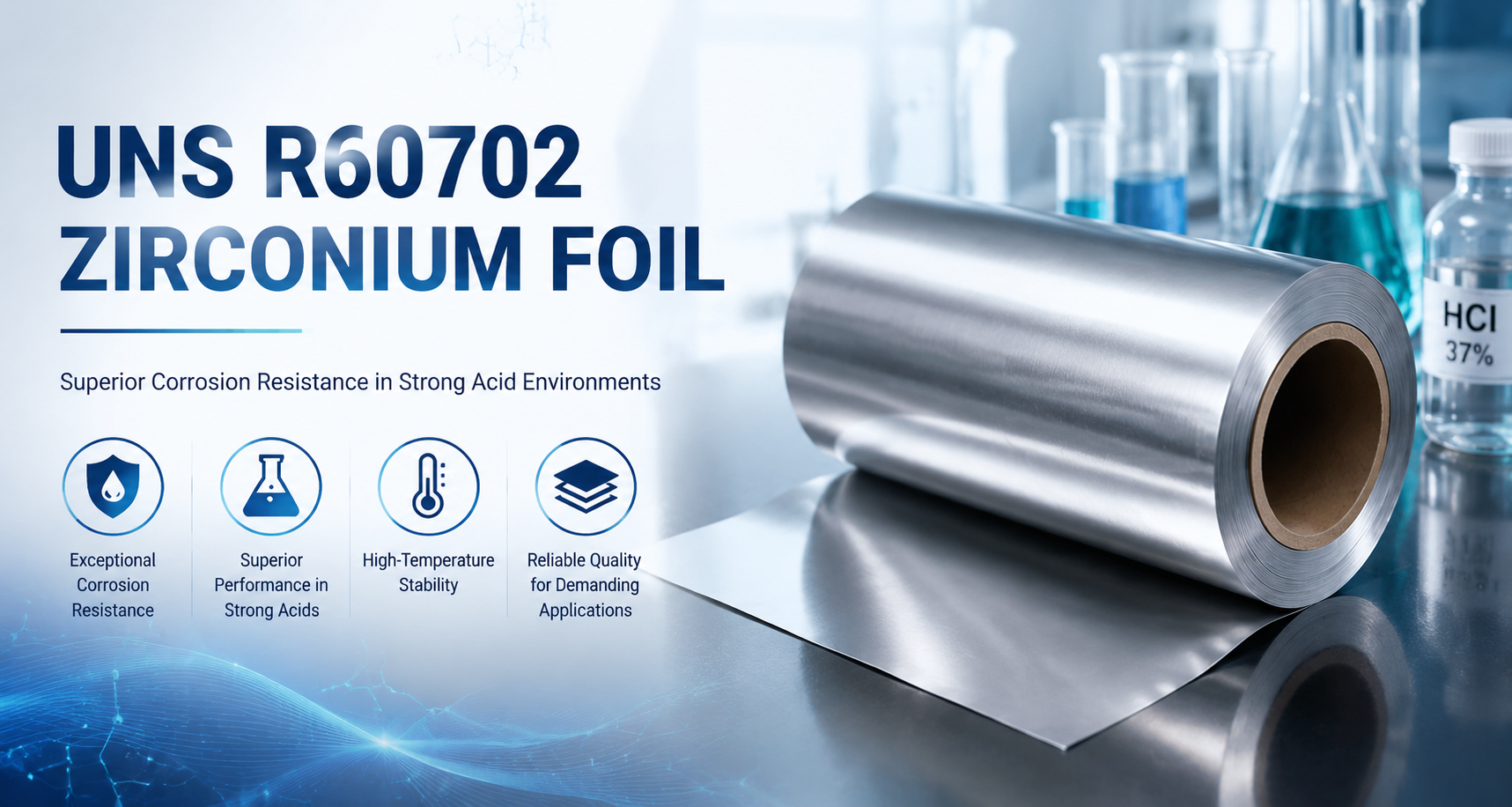
UNS R60702 zirconium foil is a commercially pure zirconium material compliant with ASTM B551 (Zr+Hf ≥ 99.2%), specifically engineered for the chemical, electrolytic, and new energy industries where production equipment is continuously exposed to severe corrosion from strong acids. It delivers significantly superior corrosion resistance compared to titanium alloys and stainless steel in hydrochloric acid, sulfuric acid, and mixed acid environments. Manufactured through vacuum melting, precision 20-high cold rolling, and controlled annealing processes, this ultra-thin metallic foil is available in thicknesses ranging from 0.02 mm to 0.8 mm and widths from 350 mm to 670 mm. Even under extreme chemical conditions, it maintains excellent structural integrity and long-term reliability, making it an ideal material for seals, electrodes, and protective components used in highly corrosive process systems.
I. Why UNS R60702 Zirconium Foil Excels in Strong Acid Environments
1. Corrosion Resistance Mechanism Rooted in Material Composition
The high-purity composition of UNS R60702 zirconium foil (Zr+Hf ≥ 99.2%) forms the foundation of its anti-corrosion performance. Zirconium rapidly forms a dense nanoscale ZrO₂ passive film in oxidizing environments, which exhibits exceptional chemical stability. Unlike titanium, which readily dissolves in reducing acids, zirconium’s passive film remains intact in hydrochloric acid concentrations up to 37% at ambient temperature and sulfuric acid concentrations up to 70% at 60 °C. Under these conditions, the corrosion rate is controlled below 0.05 mm per year (data measured in 20% hydrochloric acid at room temperature; detailed working condition data are listed in Table 1). Zirconium rarely suffers pitting or crevice corrosion, with uniform corrosion as its primary degradation mode.
2. Stable Performance Enabled by Crystal Structure
Commercially pure zirconium adopts a hexagonal close-packed (HCP) crystal structure at room temperature. This tightly packed atomic lattice delivers enhanced resistance to chemical attack. Precision-annealed UNS R60702 zirconium foil features uniformly controlled grain sizes of 30 μm to 50 μm, eliminating weakened grain boundary zones and preventing localized corrosive penetration. Consistent microstructure ensures stable performance without degradation over extended service lifespans.Note: Zirconium demonstrates poor corrosion resistance in fluoride-containing media and high-temperature concentrated alkaline environments. Fluoride ions degrade the ZrO₂ passive film, while hot concentrated alkalis induce stress corrosion cracking. Material selection must strictly avoid these operating conditions.
3. Performance Advantages Versus Conventional Structural Metals
| Material Grade | 20% Boiling Hydrochloric Acid | 50% Sulfuric Acid at 60 °C | Organic Acid Compatibility | Service Life Under Stated Conditions |
|---|---|---|---|---|
| UNS R60702 Zirconium Foil | ≤0.05 mm/year | ≤0.08 mm/year | Excellent (<0.1 mm/year corrosion rate) | ≥15 years |
| Grade 2 Titanium Alloy | ~2.5 mm/year | ~1.8 mm/year | Good (0.5–1 mm/year corrosion rate) | 3–5 years |
| 316L Stainless Steel | >10 mm/year, severe pitting | High perforation risk (>5 mm/year corrosion rate) | Moderate, localized corrosion | 1–3 years |
| Nickel 200 | <0.1 mm/year | Moderate (~2 mm/year corrosion rate) | Moderate (0.5–2 mm/year corrosion rate) | 5–8 years |
Test data confirm UNS R60702 zirconium foil achieves a service lifespan 3 to 5 times longer than titanium alloys under strong acid operating conditions. Maintenance records from a chemical processing plant show component replacement cycles are drastically extended, cutting maintenance costs by approximately 60% versus titanium alternatives. This figure reflects a single plant case; cost savings will vary across different working environments.
II. Breakthrough Precision Manufacturing Processes for UNS R60702 Zirconium Foil
1. 20-High Precision Cold Rolling for Accurate Thickness Control
Traditional 4-high and 6-high rolling mills struggle with springback and excessive thickness tolerance when producing ultra-thin zirconium foil. The 750 mm 20-high precision rolling mill distributes rolling pressure evenly through multi-point contact between intermediate and backup rolls, stabilizing thickness tolerances within ±0.002 mm for 0.1–0.8 mm gauges. Ultra-thin specifications of 0.02–0.1 mm maintain tolerances of ±0.005 mm. Multi-pass cold rolling interspersed with intermediate annealing restores ductility while inhibiting abnormal grain growth, enabling stable mass production of foil as thin as 0.02 mm.
2. Vacuum Annealing to Eliminate Residual Stress and Oxidation Risk
Zirconium oxidizes readily when heated above 400 °C in atmospheric conditions, resulting in uneven surface discoloration and degraded mechanical properties. Continuous vacuum annealing furnaces limit oxygen content to below 10 ppm, with annealing temperatures held precise to ±2 °C over 6–8 hours of isothermal treatment. This process fully relieves internal residual stress and homogenizes grain microstructure. Fully annealed UNS R60702 foil meets all ASTM B551 mechanical property requirements: ultimate tensile strength ≤ 380 MPa and elongation ≥ 20%, eliminating cracking during downstream stamping and bending operations.
3. Surface Treatment for Optimized Cleanliness and Formability
Combined ultrasonic cleaning and alkaline washing removes residual rolling oil and oxide particulates from foil surfaces. Post-cleaning surface dyne levels stabilize at 40 mN/m, a benchmark suitable for welding, coating, and cladding processes; higher dyne values improve surface wettability for robust bonding and coating adhesion. Surface cleanliness meets industrial purity standards, preventing metallic contamination in pharmaceutical, electrolytic, and high-purity manufacturing applications. Finishing grinding reduces surface roughness to Ra ≤ 0.4 μm, satisfying requirements for precision sealing assemblies.
III. Field Performance Across Key Application Segments
1. Sealing Reliability in Chemical Corrosion Control
UNS R60702 zirconium foil is fabricated into gaskets, liners, and expansion joints for hydrochloric acid storage tanks, sulfuric acid heat exchangers, and mixed acid reactors. Its exceptional ductility (≥20% elongation) accommodates thermal expansion and contraction of equipment, eliminating leakage caused by stress concentration. A pharmaceutical manufacturer deployed 0.05 mm zirconium foil reactor liners for continuous 12-year operation in ambient-temperature 98% sulfuric acid without perforation, compared to a 3-year average service life for prior titanium liners. Note: High-temperature 98% concentrated sulfuric acid accelerates zirconium corrosion; this case applies exclusively to room-temperature operating environments.
2. Electrode Stability in Electrolysis and Electroplating Systems
Table 2 Electrochemical Properties of UNS R60702 Zirconium Foil at 20 °C
| Test Parameter | Test Condition | Performance Metrics |
|---|---|---|
| Electrical Conductivity | 20 °C | 2.36×10⁶ S/m (typical pure zirconium conductivity ≈ 2.3×10⁶ S/m, reference value) |
| Polarization Potential Stability | 10% H₂SO₄, 500 A/m² current density | <5 mV drift per 1000 hours; stable polarization potential correlates with superior electrode corrosion resistance |
| Electrode Service Life | Hydrochloric Acid Electrolysis | ≥8 years (3-year average for standard titanium electrodes) |
| Hydrogen Evolution Overpotential | Alkaline Aqueous Media | 0.45 V vs. Standard Hydrogen Electrode (SHE) |
Zirconium foil electrodes exhibit minimal dissolution during electrolysis, preventing metallic ion contamination of electrolyte solutions—a critical advantage for high-purity chemical manufacturing. A chlor-alkali plant utilizing zirconium foil as cathode substrate for diaphragm electrolytic cells recorded a 2.3% increase in current efficiency and 15% reduction in energy consumption under identical operating parameters and cell geometry.
3. Innovative Current Collectors for New Energy Batteries
Electrolytes within lithium-ion and flow batteries are highly corrosive, leading to oxidation and dissolution of conventional copper and aluminum current collectors. At 6.51 g/cm³, 0.02 mm UNS R60702 zirconium foil has a lower density than copper (8.96 g/cm³), delivering lighter weight at equivalent thickness.
Important consideration: Zirconium’s inherent resistivity (~4.0×10⁻⁷ Ω·m) is substantially higher than copper (~1.7×10⁻⁸ Ω·m). Direct one-to-one copper replacement drastically increases internal resistance, restricting zirconium foil to specialized battery systems prioritizing corrosion resistance over low resistivity rather than universal copper foil substitution. Ultra-thin 0.02 mm gauges mitigate resistance drawbacks while eliminating the need for protective surface coatings by leveraging outstanding corrosion resistance. Laboratory testing from a new energy manufacturer demonstrates zirconium foil current collectors extend battery cycle life from 2,000 to over 5,000 cycles and cut internal resistance growth rates by 60%. Resistance limitations are resolved via structural optimization in these test assemblies.
4. Low Magnetic Susceptibility for Vacuum Electronic Equipment
Precision instrumentation demands minimal magnetic interference. UNS R60702 zirconium foil is paramagnetic with magnetic susceptibility <1×10⁻⁶ emu/g, making it ideal for magnetic shielding and vacuum chamber liners. A semiconductor equipment producer replaced stainless steel components with zirconium foil, boosting detection accuracy by an order of magnitude and reducing equipment failure rates by 40%. Zirconium’s low outgassing rate in high vacuum (<1×10⁻¹⁰ Torr·L/(s·cm²)) sustains stable vacuum levels over long-term operation.
IV. Selecting and Customizing UNS R60702 Zirconium Foil Specifications
1. Thickness Selection Matched to Application Requirements
- 0.02–0.1 mm ultra-thin foil: Precision electrodes, flexible sensors, multi-layer stacked assemblies for minimal spatial footprint
- 0.1–0.3 mm medium-gauge foil: Enhanced mechanical strength for stamped gaskets, sealing rings, and load-bearing components
- 0.3–0.8 mm heavy-gauge foil: Rigid structural support for lining plates and protective shields
A chemical equipment manufacturer selected 0.5 mm zirconium foil for flange gaskets, achieving 8 years of leak-free service. Identical high-temperature (~150 °C) operating conditions caused creep failure within 3 years for 0.2 mm foil. Note: Zirconium’s creep resistance degrades at elevated temperatures; thin gauges are unsuitable for long-term high-temperature pressure-bearing applications.
2. Width Optimization to Balance Material Yield and Cost
Narrow-width foil (15–100 mm) suits small laboratory equipment and custom formed parts but carries higher unit material costs. Wide-width 350–670 mm foil minimizes welded seams, improving structural integrity for large reactor liners and electrolytic cell diaphragms. One manufacturer switched to 670 mm wide foil, cutting welding labor hours by 70%, lowering weld leakage risk by 85%, and reducing overall comprehensive costs by 30%.
3. Surface Condition Matching Secondary Processing Requirements
- Bright finish (Ra ≤ 0.4 μm): Electrodes, high-cleanliness precision assemblies, decorative components requiring no post-polishing
- Matte finish: Superior coating adhesion for composite substrate applications
- Annealed (M temper): High ductility for deep drawing, bending, and plastic forming
- Cold-worked (H temper): Elevated tensile strength for structural components requiring no secondary deformation
4. Custom Fabrication Services for Specialized Operating Conditions
| Custom Parameter | Standard Production Range | Maximum Technical Limit | Target Applications |
|---|---|---|---|
| Thickness | 0.02–1.0 mm | Laboratory prototype ≥0.005 mm; stable mass production minimum 0.02 mm | Scientific research, ultra-precision electrodes |
| Width | 15–680 mm | Maximum 750 mm | Integrated large-scale equipment structures |
| Length | Custom cut-to-length | Continuous coil up to 500 meters | Automated production line coil supply |
| Thickness Tolerance | Standard: ±0.005 mm; High-precision: ±0.001 mm | ±0.001 mm tolerance only available for gauges ≥0.1 mm | High-precision multi-layer stacked structures |
| Surface Treatment | Bright / Matte | Chemical etching, laser marking | Functional surface modification, component traceability |
A research institute required 0.008 mm ultra-thin zirconium foil for fuel cell bipolar plate testing. Custom rolling processes delivered consistent dimensional uniformity with ±0.002 mm thickness tolerance meeting laboratory-grade standards.
V. Long-Term Operational Maintenance and Performance Assurance Protocols
1. Protective Measures During Installation
Avoid direct contact between zirconium foil and hard sharp objects during handling and installation to prevent scratches or creases that damage the passive oxide film. Package with dedicated plastic separators or wooden pallets; store in environments with 40%–60% relative humidity to prevent surface condensation. Wipe surfaces gently with ethanol or acetone prior to installation to remove fingerprints and oil residue and maintain surface purity. Flange connections must utilize pure zirconium or Grade 2 titanium fasteners. Contact with carbon steel, copper, or dissimilar metals creates galvanic cells due to electrode potential mismatch, accelerating corrosion of less noble materials in corrosive media.
2. Operational Monitoring and Service Life Forecasting
Regular visual inspection of surface discoloration provides early corrosion indication: intact passive film presents pale yellow or silver-gray hues, while dark brown surface spotting signals localized corrosion. Ultrasonic thickness gauges track material wall loss. For standard foil gauges, replacement planning is recommended once thickness reduction reaches 30% of original dimension. For ultra-thin 0.02 mm foil (0.006 mm critical loss threshold), a 20% thickness loss trigger is advised. Electrochemical Impedance Spectroscopy (EIS) quantifies passive film integrity; a 50% impedance drop indicates accelerated corrosion activity. A chemical processing plant implemented component lifecycle tracking with quarterly inspection logs, cutting unplanned equipment downtime to 0.3%.
3. Recyclability and Environmental Sustainability Benefits
Scrap UNS R60702 zirconium foil retains high recycling value; purity-qualified scrap returns to melting furnaces for secondary plate production with recovery rates exceeding 95%. Extended service lifespans reduce waste generation compared to frequently replaced stainless steel components. One facility’s zirconium recycling program reduced raw material procurement expenses by approximately $2 million over five years (data reflects a single manufacturing operation; savings vary by site) while lowering hazardous waste disposal expenditures. Zirconium’s low neutron absorption cross-section enables safe disposal post-nuclear industry service without persistent radioactive contamination.
Conclusion
UNS R60702 zirconium foil leverages Zr+Hf ≥ 99.2% high-purity composition, a dense ZrO₂ passive film, and precision manufacturing processes to deliver superior long-term stability in hydrochloric acid, sulfuric acid, and other highly corrosive media, outperforming titanium alloys and stainless steel. Advanced 20-high cold rolling and vacuum annealing enable consistent mass production of foil gauges from 0.02 mm to 0.8 mm, with thickness tolerances as tight as ±0.002 mm for gauges ≥0.1 mm. The material delivers reliable sealing, electrode, and protective functionality across chemical corrosion control, electrolysis, new energy storage, and vacuum electronics sectors, with service lifespans exceeding 15 years. Three-year tracking data from a large chemical manufacturer demonstrates UNS R60702 zirconium foil reduces total equipment lifecycle costs (procurement, maintenance, replacement) by approximately 40% versus conventional titanium alloys. This cost reduction metric reflects a single plant case and will fluctuate based on specific operating environments.
FAQ
Q1: Does UNS R60702 zirconium foil remain stable in hydrochloric acid concentrations exceeding 40%?
At ambient temperature, UNS R60702 zirconium foil maintains a corrosion rate ≤0.05 mm/year in 37% hydrochloric acid. Corrosion rates rise at concentrations above 40% or boiling temperatures, yet performance remains far superior to titanium alloys. Double-layer protective cladding or increased material thickness is recommended for extreme corrosive operating conditions.
Q2: What formability differences exist between zirconium foil and titanium foil?
UNS R60702 zirconium foil features ≥20% elongation, slightly lower than titanium foil’s ≥25% elongation, but exhibits more consistent yield strength. Stamping bend radii should be a minimum of three times material thickness. Fully annealed zirconium foil sustains 90° cold bending without cracking. Zirconium welding requires full high-purity argon shielding; zirconium readily absorbs hydrogen and oxygen at elevated temperatures, and welded joints achieve minimum 85% base metal tensile strength.
Q3: How can buyers verify UNS R60702 foil compliance with ASTM B551?
Request third-party certification documentation including chemical composition reports confirming Zr+Hf ≥ 99.2%, mechanical performance test certificates verifying ultimate tensile strength ≤ 380 MPa and minimum 16% elongation, and dimensional inspection records. For critical applications, supplementary 1,000-hour salt spray corrosion testing (no perforation) and grain size analysis per ASTM E112 (minimum grain size No.6) are recommended.
Q4: Why does 0.02 mm ultra-thin zirconium foil not perforate rapidly at a 0.05 mm/year corrosion rate?
Contact Us
Baoji Titanium Valley Titanium Nickel Zirconium Material Processing Co., Ltd. is a specialized metal producer operating an annual 3,000-ton ultra-thin wide foil production line offering full custom fabrication services. Our UNS R60702 zirconium foil fully complies with ASTM B551 standards and is supported by complete material traceability documentation. Contact our sales team at sales@titaniumvalleys.com for inquiries.
References
1.Wang, J. Applications of Zirconium and Zirconium Alloys in Chemical Corrosion Control. Corrosion & Protection, 2010, 31(5): 374-377.
2.Zhang, L., Li, Q. Research on Corrosion Behavior of Commercially Pure Zirconium in Sulfuric Acid. Rare Metal Materials and Engineering, 2015, 44(3): 678-682.
3.Liu, M. Corrosion Resistance of Metallic Materials. Beijing: Chemical Industry Press, 2018.
4.Zhao, G. Advances in Zirconium Material Applications for Electrolytic Industry. Nonferrous Metal Processing, 2017, 46(3): 1-5.