
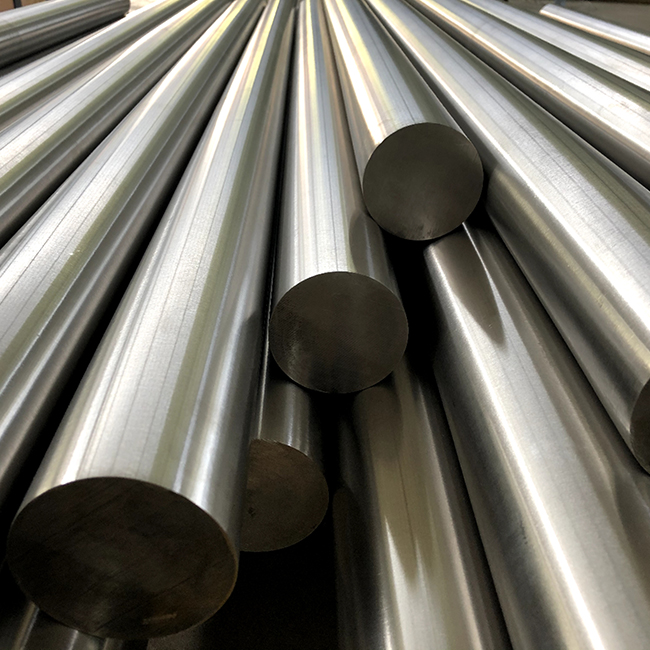
Gr2 titanium rod and Gr4 titanium rod are the two most common commercially pure titanium materials for industrial rod applications. Both belong to commercially pure titanium and carry no alloying elements. Their performance gaps come entirely from different contents of interstitial elements, mainly oxygen and iron. The two grades are all alpha-phase pure titanium, but they show clear gaps in tensile strength, corrosion resistance, machining performance and applicable working conditions. Gr2 titanium rod stands out for great ductility and forming capacity, so it fits projects that need complex forming work. Gr4 titanium rod delivers higher mechanical strength and works for structural parts with strict load requirements. Beyond strength and formability, they also have obvious differences in welding performance, high-temperature stability and low-temperature toughness. Buyers need to run full assessments based on real working conditions before final selection.
I. Comparison of Core Performance Parameters: Chemical Composition and Mechanical Properties
1. Analysis of Chemical Composition Differences
The core gap between Gr2 titanium rod and Gr4 titanium rod lies in controlled interstitial element levels. Under the ASTM B348 standard, Gr2 titanium rod allows oxygen content no higher than 0.25 %, while Gr4 titanium rod accepts oxygen content up to 0.40 %. Oxygen acts as an interstitial hardening element and greatly lifts titanium’s tensile strength and hardness. The two grades also differ in iron limits (Gr2 ≤ 0.30 %, Gr4 ≤ 0.50 %), carbon limits (both ≤ 0.08 %) and nitrogen limits (Gr2 ≤ 0.03 %, Gr4 ≤ 0.05 %). Combined effects of these elements set the full mechanical performance of each grade. One key note: higher oxygen and iron levels boost strength but slightly cut low-temperature toughness and corrosion resistance in some reducing acid solutions. Engineers must balance all factors for high-end working conditions.
Chemical Composition Comparison of Gr2 and Gr4 Titanium Rod (ASTM B348)
| Element | Gr2 Titanium Rod | Gr4 Titanium Rod | Impacts on Material Performance |
|---|---|---|---|
| Oxygen (O) | ≤ 0.25 % | ≤ 0.40 % | Material strength rises along with oxygen content |
| Iron (Fe) | ≤ 0.30 % | ≤ 0.50 % | Raises overall material hardness |
| Nitrogen (N) | ≤ 0.03 % | ≤ 0.05 % | Excess nitrogen reduces material ductility |
| Carbon (C) | ≤ 0.08 % | ≤ 0.08 % | Stops brittle phase formation inside metal |
| Hydrogen (H) | ≤ 0.015 % | ≤ 0.015 % | Controls the risk of hydrogen brittleness |
| Titanium (Ti) | Typical ≥ 99.2 % | Typical ≥ 98.6 % | Base matrix metal of the rod |
Note: The roughly 30 % strength increase is an estimated value against Gr2. Real strength gains change with production batches and heat treatment status.
2. Quantitative Comparison of Mechanical Properties
Differences in mechanical properties directly decide each grade’s suitable use cases. Following ASTM B348 standards, annealed Gr2 titanium rod has minimum tensile strength of 345 MPa, minimum yield strength of 275 MPa and minimum elongation of 20 %. Annealed Gr4 titanium rod reaches minimum tensile strength of 550 MPa, minimum yield strength of 483 MPa and minimum elongation of 15 %. With identical cross-section sizes, Gr4 titanium rod bears much heavier loads. The trade-off for higher strength is lower ductility. Gr4 titanium rod may crack during cold forming processes that demand heavy material deformation. In general, Gr2 titanium rod achieves better forming results in cold stamping, deep drawing and similar processes. Its advantages become more obvious when manufacturers produce complex-shaped parts.
Gr4 titanium rod also delivers better creep resistance. It keeps stable dimensions under long-term loads from 200 ℃ to 350 ℃ and fits high-temperature structural components. Gr2 titanium rod owns superior low-temperature toughness at -196 ℃ and resists brittle fracture far better in cryogenic environments. For hardness, Gr2 titanium rod usually records Vickers hardness from 120 HV to 180 HV, while Gr4 titanium rod hits 180 HV to 220 HV. Gr4 gains clear hardness growth with its strength improvement yet loses part of its ductility at the same time.
3. Corrosion Resistance Performance
Both grades provide outstanding corrosion resistance. They perform nearly equally in oxidizing acid solutions such as nitric acid and neutral salt water. In room-temperature immersion tests with 3.5 % NaCl solution, neither grade develops measurable pitting corrosion. However, Gr2 titanium rod with higher purity and lower interstitial element content shows slightly stronger corrosion resistance than Gr4 titanium rod. This gap appears in reducing acids (hot dilute sulfuric acid, formic acid, oxalic acid), high-concentration chloride solutions under high temperatures and alternating acid-alkali environments. The difference stays small but cannot be ignored for harsh working conditions. Gr4 titanium rod carries mild risks of pitting corrosion after long service in hot seawater or chlorine-rich hot steam. Its corrosion rate runs 5 % to 15 % higher than Gr2 in these environments, while Gr2 maintains steady performance.
Neither grade works well in hydrofluoric acid, hot concentrated sulfuric acid (over 70 % concentration, above 80 ℃) or hot concentrated phosphoric acid. Corrosion speeds jump sharply inside these strong reducing acid media. Gr2 titanium rod also shows slightly better resistance to hydrogen brittleness than Gr4 in high-temperature and high-pressure hydrogen environments.
Gr2 titanium rod has a standard long-term working temperature range from -196 ℃ to 350 ℃. Gr4 titanium rod has higher oxygen content and slightly weaker low-temperature toughness, yet its maximum service temperature reaches roughly 400 ℃. Users should select titanium alloys such as Gr5 for operating temperatures above these limits.
II. Analysis of Machining Performance and Cost Efficiency
1. Compatibility with Cold and Hot Machining
Great ductility makes Gr2 titanium rod the top choice for cold forming work. Manufacturers carry out deep drawing, bending, spinning and other complex forming steps without frequent intermediate annealing cycles. In typical production lines, single-pass deformation rates can hit 20 % to 30 % without cracks. Exact values depend on part shapes and mold designs. Gr4 titanium rod requires stricter process controls for cold forming. Factories usually run stress relief annealing after each deformation pass over 15 % to 20 %. Gr4 also creates larger elastic springback after cold machining, which makes tight dimensional tolerance control harder. Its high yield strength leads to bigger elastic recovery after cutting or bending. For hot working processes, higher oxygen content creates grain refinement effects in Gr4 titanium rod. It resists softening better under high heat and holds more stable dimensions, so it suits precision shaft production perfectly. Recommended hot working temperatures sit at 700 ℃ to 850 ℃ for Gr2 and 750 ℃ to 900 ℃ for Gr4. All hot forming steps need full argon shielding to stop surface oxidation.
2. Evaluation of Welding Performance Differences
Workers apply common welding techniques including TIG, MIG and resistance welding to both grades, yet welded joints deliver different mechanical results. Welded joints of Gr2 titanium rod retain 85 % to 92 % of base metal tensile strength and over 85 % of base metal toughness. Its heat-affected zone rarely turns brittle after welding. Welded joints of Gr4 titanium rod hold 90 % to 95 % of base metal tensile strength, but toughness drops much more sharply after welding. Its ductility may fall to just 60 % to 70 % of the original base metal, and fatigue performance degrades more heavily than Gr2. Gr4 titanium rod demands stricter oxygen control during welding. Operators need to keep oxygen levels below 50 ppm inside shielding gas. High oxygen levels trigger oxidation brittleness inside the heat-affected zone and cut joint reliability.
Both titanium grades require complete degreasing and dehydrogenation before welding. Welding wires match the base material or use pure titanium wire. The full welding area must receive continuous high-purity argon shielding with purity above 99.99 %. All finished welds need post-weld stress relief annealing. Operators control cooling speeds carefully for Gr4 welds to avoid brittleness from martensite phase transformation. The industry standard sets shielding gas oxygen content below 50 ppm (refer to AWS G2.4 / G2.5 welding guidelines for titanium alloys). Practical production suggests keeping oxygen levels under 20 ppm for optimal weld quality.
3. Full Life Cycle Cost Model
Gr4 titanium rod usually carries a 15 % to 20 % higher unit purchase price compared to Gr2 titanium rod. For heavy-load applications, Gr4 allows smaller cross-section sizes and cuts part weight by 10 % to 15 %. Lower total material consumption offsets part of its higher raw material price.
Full Cost Comparison Under Typical Working Conditions (Gr2 as Benchmark Standard)
| Cost Factor | Gr2 Titanium Rod | Gr4 Titanium Rod | Detailed Explanation |
|---|---|---|---|
| Raw Material Unit Price | Benchmark Standard | +15 ~ 20 % | Cost of raw titanium stock |
| Total Material Usage (Equal Strength Design) | Benchmark Standard | -10 ~ 15 % | Gr4 supports thinner cross-section structures |
| Machining Cost (Labor Hours + Tool Wear) | Benchmark Standard | +20 ~ 30 % | Gr4 wears cutting tools faster and creates larger cold-forming springback |
| Surface Treatment Expense | Benchmark Standard | +5 ~ 10 % | Higher Gr4 hardness extends blasting and grinding time |
| Expected Service Life (Chemical & Marine Environments) | 12 ~ 15 Years | 15 ~ 20 Years | The service life gap widens under heavy load conditions |
When calculating full life cycle costs covering raw materials, machining and maintenance, Gr4 titanium rod delivers better long-term economic returns under harsh working conditions. Gr2 titanium rod offers lower upfront investment and overall costs for low-stress mass-production projects.
III. Matching Analysis for Industrial Application Scenarios
1. Chemical and Marine Engineering Fields
Material selection for chemical anti-corrosion projects balances corrosion resistance, tensile strength and total cost. Gr2 titanium rod dominates production of atmospheric storage tanks, heat exchanger tubes and low-pressure pipelines thanks to its balanced cost and reliable corrosion resistance. Gr4 titanium rod’s high strength brings clear advantages for deep-sea mining equipment, subsea pipelines and high-pressure reaction vessels. Engineers choose Gr4 to manufacture high-strength fasteners and heavy-load structural components. One important reminder: neither grade resists hydrofluoric acid. Gr2 shows stronger corrosion resistance than Gr4 in reducing acids such as hot dilute sulfuric acid, formic acid and oxalic acid. Buyers prioritize Gr2 or advanced anti-corrosion titanium alloys for these media. Users exercise extra caution when deploying any pure titanium grade in high-temperature acid solutions with fluoride ions.
2. Medical and Aerospace Applications
Aerospace projects impose strict limits on material strength-to-weight ratios. Manufacturers pick Gr4 titanium rod for surgical instrument handles. It cuts instrument weight by 10 % to 15 % while meeting all strength requirements under equal load standards. For implant manufacturing, Gr4 titanium rod becomes the main material for high-load orthopedic parts such as bone fixation screws and acetabular cups. Its high tensile strength bears repeated physical loads from human body movement. Designers still select Gr2 titanium rod for soft tissue implants including cranial locking plates and suture anchors, plus thin-walled implant parts that need low elastic modulus to prevent stress shielding effects.
Medical-grade pure titanium follows the ASTM F67 standard for surgical implants. Gr2 matches UNS R50400 and Gr4 matches UNS R50700. These medical standards list different chemical limits from industrial ASTM B348 specifications. Gr4 titanium rod delivers better creep resistance for precision positioning brackets inside semiconductor equipment and suits long-term accurate positioning tasks. Gr4 supports maximum working temperatures near 400 ℃, which outperforms Gr2’s 350 ℃ limit and brings advantages for high-temperature equipment. Gr2 maintains superior toughness at cryogenic temperatures of -196 ℃ and fits all low-temperature operating environments.


3. New Energy and Electronic Manufacturing Industries
Gr2 titanium rod’s excellent forming capacity sees wide use in lithium-ion battery production equipment. Factories build complex parts such as electrode rollers and mixing paddles with Gr2. Operators watch electrolyte formulas closely during production. Fluoride-containing electrolytes create severe titanium corrosion through hydrofluoric acid reactions. Engineers select Gr4 titanium rod for heavy-load main spindles and high-speed rotating shafts to gain stronger fatigue resistance. This performance gap carries critical importance for precision 3C electronics production. Gr4’s high strength shrinks part cross-sections and enables smaller equipment designs.
The table below summarizes recommended grades for all major industries. Scenarios marked “Not Allowed” carry extreme corrosion or safety risks and should never use the listed material grades.

Quick Selection Guide for Gr2 and Gr4 Titanium Rod Across Industrial Fields
| Application Field | Recommended Grade | Core Selection Reason | Restricted / Not Allowed Working Conditions |
|---|---|---|---|
| Atmospheric Chemical Storage Tanks & Pipelines | Gr2 | Great formability, no preheating required for welding, low overall cost | None |
| High-Pressure Reaction Vessels & Pressure Containers | Gr4 | High tensile strength supports thinner wall designs and heavy load bearing | Operating temperatures over 400 ℃ |
| Low-Pressure Pipes for Seawater Desalination | Gr2 | Sufficient chloride corrosion resistance, optimal cost performance | None |
| Heavy-Load Shafts & Fasteners for Offshore Platforms | Gr4 | Strong anti-fatigue and stress corrosion resistance | Fluoride-containing media (Not Allowed) |
| Weight-Bearing Orthopedic Implants (Bone Plates, Screws) | Gr4 | High strength guarantees long service stability, must meet ASTM F67 standards | Standard industrial-grade titanium (Not Allowed for Implants) |
| Soft Tissue Implants & Thin-Walled Implant Parts | Gr2 | Low elastic modulus avoids stress shielding, must meet ASTM F67 standards | Standard industrial-grade titanium (Not Allowed for Implants) |
| Surgical Instruments (Forceps, Scissor Handles) | Gr4 | Cuts instrument weight by 10~15 % for comfortable operation | None |
| Surgical Instruments (Precision Clamping Components) | Gr2 | Easy machining and stable surface quality control | None |
| High-Temperature Acid & Reducing Acid Working Environments | Gr2 | Higher purity delivers slightly better corrosion resistance than Gr4 | Hydrofluoric Acid, Hot Concentrated Sulfuric Acid above 80 ℃ (Not Allowed) |
| High-Temperature Structural Parts (300~400 ℃) | Gr4 | Better creep resistance compared to Gr2 | None |
| Cryogenic Working Environments (-196 ℃) | Gr2 | Superior low-temperature toughness against brittle fracture | None |
IV. Material Selection Process and Practical Suggestions
1. Matching Technical Parameters to Working Requirements
Reliable material selection relies on full quantitative performance evaluation. For room-temperature oxidizing corrosion environments, engineers choose Gr4 titanium rod when continuous design stress exceeds 380 MPa. Gr2 titanium rod works better for cold forming projects that demand heavy deformation, such as elongation rates over 25 % or deep drawing ratios above 2.0. Design teams follow the 3S Selection Rule: Strength demand, Shaping requirements, Service environment. Select Gr4 titanium rod when two or three of these three categories require high-performance materials. Pick Gr2 titanium rod if low cost and easy machining stand as top priorities. Recommended safety factor values sit between 2.5 and 3.5 for static chemical loads, 3.5 to 4.5 for dynamic or impact loads, and 4.0 to 6.0 for high-reliability aerospace and medical devices. Design engineers set exact safety factors based on industry standards and real working conditions.
2. Optimized Mixed-Grade Application Strategy
Designers balance performance and total cost by assigning different titanium grades to separate zones inside complex equipment. For large chemical plants or seawater desalination systems, use Gr4 titanium rod for high-stress components including end plates and tension rods. Deploy Gr2 titanium rod for low-stress auxiliary parts such as sealing pieces and bipolar plates. This zoning strategy cuts overall material costs by 15 % to 25 % compared to full Gr4 construction while satisfying all load requirements. The core step lies in accurate identification of stress concentration zones and secondary structural areas. Watch for galvanic corrosion risks when joining different titanium grades. Gr2 carries slightly lower electric potential than Gr4. Direct contact inside conductive media triggers priority corrosion on Gr2 components. Install insulating gaskets or protective coatings between contact surfaces to block this reaction.
3. Mandatory Quality Control Standards
Buyers check suppliers’ full quality assurance systems before purchase. Request complete Material Test Certificates, ultrasonic inspection reports and mechanical performance test records to confirm compliance with ASTM B348 standards. The table below lists standard and premium quality inspection indicators.
Standard Quality Inspection Indicators
| Inspection Item | ASTM B348 Standard Requirement | Premium Aerospace-Grade Standard |
|---|---|---|
| Dimensional Tolerance | ±0.1 mm or values agreed in sales contracts | ±0.05 mm |
| Surface Roughness | Values per signed agreements, typical Ra ≤ 1.6 μm | Ra ≤ 0.8 μm |
| Ultrasonic Inspection Grade | ASTM E2375 Grade B | ASTM E2375 Grade A |
| Chemical Composition (Oxygen Content) | Gr2 ≤0.25 %, Gr4 ≤0.40 % | Oxygen levels 10 % below standard maximum limits |
| Mechanical Performance (Tensile / Yield / Elongation) | Full compliance with ASTM B348 clauses | Batch process capability index Cpk ≥ 1.33 |
| Hydrogen Content | ≤0.015 % | ≤0.008 % (Medical & Aerospace Use) |
Deviations from chemical composition limits follow special rules outside ASTM B348 judgment standards. Buyers and suppliers negotiate allowable analysis deviations within formal sales contracts. For aerospace and medical implant products, add dedicated hydrogen content testing (hydrogen levels below 0.008 % for hydrogen-brittle sensitive applications) and grain size inspection (ASTM Grade 5 to Grade 8). These extra tests confirm the material meets strict anti-fatigue and anti-hydrogen brittleness demands of harsh working environments.
FAQ
1. How to choose between Gr2 titanium rod and Gr4 titanium rod for seawater desalination equipment?
Select Gr2 titanium rod for non-load parts such as low-pressure pipelines and heat exchanger tubes. It delivers sufficient chloride corrosion resistance at a lower purchase price. Gr2 and Gr4 show nearly identical corrosion rates for hot seawater over 60 ℃, high-flow scouring conditions or fluid with solid particles. Engineers pick Gr4 titanium rod for high-stress parts including high-pressure pump shafts and main structural supports. Its high yield strength allows thinner cross-sections, achieves lightweight designs and lifts overall equipment reliability. One critical note: stop direct contact between these titanium grades and dissimilar metals such as carbon steel or stainless steel, especially under wet conductive environments, to avoid galvanic corrosion damage.
2. What is the tensile strength gap between welded joints of the two titanium rod grades?
Under standard TIG welding processes, welded Gr2 titanium rod joints record tensile strength from 310 MPa to 380 MPa, which equals 85 % to 92 % of base metal strength and maintains good toughness. Welded Gr4 titanium rod joints hit tensile strength from 490 MPa to 550 MPa, covering 90 % to 95 % of base metal strength. However, Gr4 welds suffer much larger toughness loss, with ductility dropping to 60 % to 70 % of the original base metal. Operators recover partial mechanical performance through post-weld stress relief annealing at 550 ℃ to 650 ℃ with a holding time of 1 to 2 hours. Follow these practical operation rules:
- Cover the full welding zone with continuous high-purity argon shielding (≥99.99 %) and extend trailing shielding covers to cooling areas.
- Remove all oil and oxide layers completely before welding starts.
- Control welding heat input and avoid grain coarsening from overheating.
- Preheat Gr4 plates thicker than 5 mm to 100 ~ 150 ℃ to lower internal thermal stress.
3. What simple test methods tell Gr2 titanium rod apart from Gr4 titanium rod?
The two grades share identical outer appearances and cannot be distinguished by visual checks alone. Users run hardness testing or chemical composition analysis for accurate identification. Gr2 titanium rod normally records Vickers hardness between 120 HV and 180 HV, while Gr4 titanium rod ranges from 180 HV to 220 HV. Portable XRF spectrometers deliver quick screening of oxygen and iron content (Gr2 O ≤ 0.25 %, Fe ≤ 0.30 %; Gr4 O ≤ 0.40 %, Fe ≤ 0.50 %). Complete Material Test Certificates from certified suppliers serve as the most reliable identification proof. One reminder: portable XRF equipment lacks high precision for light elements such as oxygen. Accurate oxygen content measurement still relies on optical emission spectroscopy or inert gas fusion chemical analysis. Hardness tests deliver fast qualitative results yet receive interference from heat treatment status (annealed or cold-worked). Do not use hardness readings as the single judgment standard for grade identification.
Looking for a Trusted Titanium Rod Manufacturer?
Baoji Titanium Valley Titanium Nickel Zirconium Material Processing Co., Ltd. acts as a professional manufacturer and supplier of titanium rods. The company operates world-class production equipment and full-process quality control systems. It supplies premium Gr2 titanium rod and Gr4 titanium rod products that fully meet international standards including ASTM B348. The factory accepts custom size machining and delivers stable large-batch supply. Our products serve high-end industrial sectors such as aerospace, surgical medical devices and chemical anti-corrosion systems. Contact our team to receive detailed technical datasheets, full material certificates and custom engineering solutions via email: sales@titaniumvalleys.com
References
- ASTM International. ASTM B348-19: Standard Specification for Titanium and Titanium Alloy Bars and Billets[S]. West Conshohocken: ASTM International, 2019.
- ASTM International. ASTM F67-24: Standard Specification for Unalloyed Titanium, for Surgical Implant Applications[S]. West Conshohocken: ASTM International, 2024.
- Zhao Y Q, Qu H L. Research on Application and Corrosion Behavior of Titanium Alloys in Marine Engineering[J]. Transactions of Nonferrous Metals Society of China, 2021, 31(6): 1523-1538.