
What Is the Grain Structure of Gr12 Titanium Rod and How Does It Control Corrosion Resistance and Strength?
- Gr12 Titanium Rod
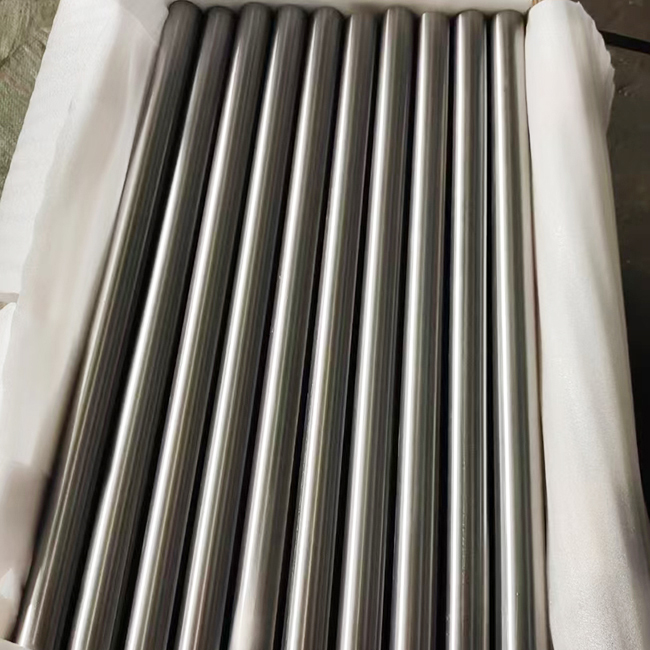
The grain structure of Gr12 titanium rod is mainly dominated by the alpha phase (hexagonal close-packed crystal structure). It shows a near-alpha microstructure. Gr12 is a low-molybdenum and nickel-microalloyed commercially pure titanium.
Compared with standard pure titanium and high-strength titanium alloys, Gr12 contains almost no beta phase and no secondary strengthening phase. Its key advantage is improved corrosion resistance rather than high strength.
In annealed condition, grains are usually equiaxed or slightly elongated. Average grain size is about 20–50 μm, depending on hot working and heat treatment conditions.
Mo (0.3%) and Ni (0.8%) are added as alloying elements. Molybdenum provides solid solution strengthening. Nickel improves resistance to reducing acids and reduces hydrogen embrittlement risk. Their strengthening effect is much lower than heat-treated alloys like TC4.
Gr12 is designed as a corrosion-resistant grade, not a high-strength grade. Grain uniformity and refinement strongly affect mechanical properties, corrosion resistance, and workability. This is the microstructural foundation of its performance in chemical and marine environments.
1. Phase Composition and Crystal Structure of Gr12 Titanium Rod
1.1 Alpha Phase Dominated HCP Crystal Structure
The main phase of Gr12 is alpha phase with a hexagonal close-packed (HCP) structure.
For pure titanium, lattice constants are approximately:
a = 0.295 nm, c = 0.468 nm (room temperature, ASTM data).
After alloying with Mo and Ni, slight lattice distortion occurs.
HCP structure has high thermal stability and strong corrosion resistance, but fewer slip systems, so room temperature plasticity is lower than BCC metals.
In production, forging ratio and annealing control grain refinement and improve overall properties.
1.2 Strengthening Mechanism of Mo and Ni
Mo and Ni atoms dissolve into the alpha matrix in atomic form.
Mo provides main solid solution strengthening and improves resistance to reducing acids.
Ni mainly improves hydrogen embrittlement resistance and corrosion resistance in reducing environments.
Their strengthening contribution is limited compared with high-strength titanium alloys.
Through vacuum arc remelting and multi-pass forging, element distribution becomes uniform, which improves batch stability.
1.3 Beta Phase Precipitation Behavior
Under high-temperature heating above 800°C and slow cooling, a very small amount of beta phase (BCC) may appear at grain boundaries.
This beta phase is Mo-rich, submicron in size, and below 1% volume fraction.
It can pin grain boundaries and slightly refine grains. However, excessive precipitation may cause grain boundary brittleness.
Under standard annealing (580–750°C), beta phase is almost not visible. The structure remains alpha dominated.
| Phase Type | Crystal Structure | Main Elements | Volume Fraction | Main Function |
|---|---|---|---|---|
| Alpha phase | HCP | Ti, Mo (solid solution), Ni (solid solution) | ≥99% | Strength and corrosion resistance |
| Beta phase (trace) | BCC | Mo-rich | ≤1% | Grain boundary pinning |
| Inclusions | Non-metallic compounds | O, N, C | <0.1% | Must be strictly controlled |
2. Grain Size and Morphology Effects on Properties
2.1 Equiaxed and Elongated Grain Formation
Gr12 annealed structure shows equiaxed grains or slightly elongated grains.
Equiaxed grains form after recrystallization above 700°C. They improve isotropy and ductility.
Elongated grains come from incomplete recrystallization or rolling texture. They increase directional strength but reduce transverse ductility.
Multi-pass forging and controlled annealing help maintain uniform grain structure.
2.2 Grain Size Effect on Strength and Ductility
According to the Hall-Petch relationship, yield strength increases as grain size decreases.
When grain size decreases from 50 μm to 20 μm, strength increases.
But excessive refinement reduces high-temperature creep resistance and increases work hardening rate.
Typical chemical equipment uses 30–40 μm grains for balanced performance.
2.3 Grain Uniformity and Corrosion Resistance
Grain uniformity strongly affects pitting corrosion and crevice corrosion resistance.
Non-uniform grains cause uneven passive film thickness, which can lead to local breakdown.
Fine and uniform grains improve passive film continuity and block chloride ion penetration.
| Grain Size (μm) | Yield Strength (MPa) | Elongation (%) | Application |
|---|---|---|---|
| 15–25 | 380–420 | 18–22 | High strength parts |
| 25–40 | 340–380 | 20–25 | Chemical equipment |
| 40–60 | 310–340 | 22–28 | High temperature parts |
3. Heat Treatment Control of Grain Structure
3.1 Annealing Temperature and Grain Growth
At 580–650°C, stress relief occurs with little grain change.
At 700–800°C, recrystallization occurs and grains grow significantly.
Higher temperature and longer holding time accelerate grain growth.
Temperature control must be precise to ensure stable structure.
3.2 Cold Work and Recrystallization
Cold drawing introduces dislocations and elongates grains into fibrous structures.
When deformation exceeds 30%, strength increases and ductility drops.
Recrystallization annealing restores structure at 650–700°C.
New grains form in high-energy deformation zones and grow gradually.
3.3 Cooling Rate Influence
Cooling rate has limited effect on Gr12 because beta phase content is low.
Air cooling preserves good ductility. Furnace cooling reduces residual stress.
For cold working, air cooling is preferred.
| Heat Treatment | Temp (°C) | Time (h) | Cooling | Grain Size (μm) | Application |
|---|---|---|---|---|---|
| Stress relief | 580–650 | 1–2 | Air | unchanged | Welded parts |
| Full annealing | 700–750 | 2–3 | Air/Furnace | 35–45 | Chemical systems |
| Homogenization | 800–850 | 1–1.5 | Air | 40–55 | Large forgings |
4. Grain Structure Characterization and Quality Control
4.1 Metallography and EBSD Analysis
Metallography using Kroll’s reagent reveals grain boundaries and phase distribution.
ASTM E112 standard is used for grain size measurement.
EBSD provides grain orientation and texture analysis.
4.2 Ultrasonic Testing and Grain Rating
Ultrasonic testing reflects grain uniformity indirectly.
Grain size rating usually ranges from grade 5 to 8.
For chemical and marine use, grade ≥6 is recommended.
4.3 Batch Stability and Composition Control
VAR melting reduces segregation.
Mo and Ni segregation ratio is controlled within 1.05.
SPC systems ensure process stability and grain size consistency within ±8%.
5. Engineering Value of Grain Optimization
5.1 Corrosion Resistance in Chemical Industry
Fine grains improve passive film stability and reduce corrosion rate.
A 30 μm grain structure can reduce corrosion depth by about 40% compared with coarse grains in sulfuric acid environments.
5.2 Marine Desalination Systems
Uniform grains improve resistance to crevice corrosion and stress corrosion cracking.
Ni and Mo improve passive film stability and self-healing ability.
5.3 Machining and Welding Performance
Fine and uniform grains reduce cutting force fluctuation and tool wear.
Weld joints maintain over 90% of base metal strength.
Conclusion
Grain structure is the key microstructural factor controlling Gr12 titanium rod performance.
Through controlled composition, heat treatment, and thermomechanical processing, grain size and uniformity can be optimized.
For strong corrosion environments, fine grains (25–35 μm) are preferred. For high temperature service, medium grains (40–50 μm) are more suitable.
Grain control ensures stable performance for chemical, marine, and energy industries.
FAQ
1. How does grain size affect corrosion resistance?
Smaller and more uniform grains improve passive film continuity and increase resistance to pitting and crevice corrosion in seawater and acid environments.
2. How is grain structure controlled by heat treatment?
Stress relief annealing keeps structure unchanged. Full annealing produces uniform equiaxed grains. High temperature homogenization produces slightly coarser grains for large parts.
3. Why is grain uniformity important in welding and machining?
Uniform grains reduce cutting force fluctuation and improve weld quality. Non-uniform grains increase anisotropy and may cause deformation or cracking.
Contact Us
Baoji Titanium Valley Titanium Nickel Zirconium Material Processing Co., Ltd. provides high-quality Gr12 titanium rods with stable grain structure and full quality certification.
We support custom sizes, surface finishing, and delivery conditions for global chemical, marine, and energy industries.
Contact: sales@titaniumvalleys.com
References
- Zhao Yongqing et al. Titanium alloy phase transformation and heat treatment.
- Li Xingwu et al. Microstructure control of titanium alloys.
- Wang Jinyou et al. Titanium alloys and processing technology.
- ASTM B348-19 Titanium and titanium alloy bars standard.