
What Is the Manufacturing Method of TB13 Titanium Alloy Rod?
- TB13 Titanium Alloy Rod
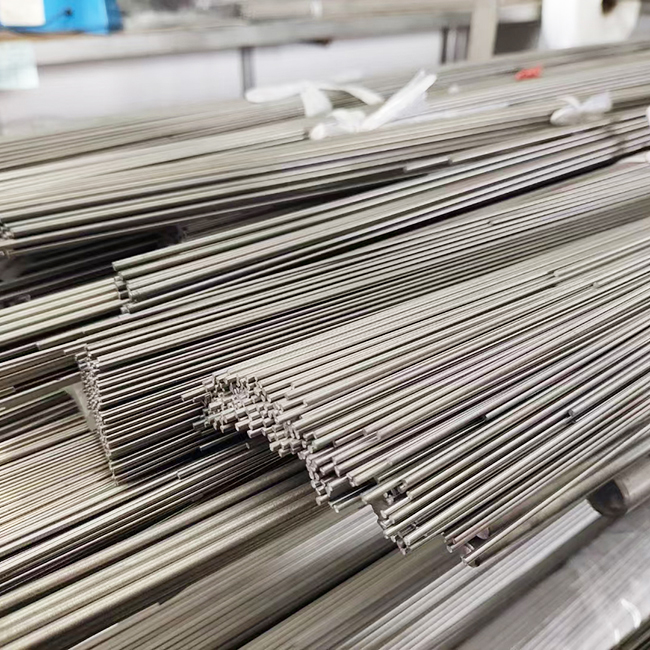
The manufacturing of TB13 titanium alloy rods includes several key processes such as vacuum arc remelting (VAR), forging billet breakdown, hot rolling or cold drawing, beta heat treatment, and final finishing with quality inspection. TB13 is a high-strength, high-elastic near-beta titanium alloy developed in China. Its nominal composition is Ti-3.5Al-21V, with controlled ranges of Al 3.0–4.5% and V 20.0–23.0%.
Through strict process control, TB13 achieves superelasticity, high specific strength, and excellent cold workability. The production process requires precise control of alloy composition, beta-phase forging temperature, heat treatment system, and surface quality. The final product is widely used in high-end eyewear frames, medical devices, and precision elastic components. Modern production lines use automated rolling, online inspection, and full traceability to meet YS/T 1077 standards for aerospace, medical, and electronics applications.
1. Raw Material Preparation and Melting Technology of TB13 Titanium Alloy Rod
1.1 Sponge Titanium Selection and Batching Process
The first step is selecting high-purity sponge titanium. The nominal composition is Ti-3.5Al-21V. The controlled range is Al 3.0–4.5% and V 20.0–23.0%. Titanium is the balance element.
Impurities must be strictly controlled: Fe ≤ 0.20%, C ≤ 0.10%, N ≤ 0.05%, H ≤ 0.015%, O ≤ 0.15%. The batching process uses electronic weighing with ±0.05% accuracy.
Raw materials are cleaned by degreasing, acid washing, and vacuum drying to avoid contamination.
1.2 Vacuum Arc Remelting (VAR) Process
TB13 ingots are produced by vacuum arc remelting under vacuum ≤ 1×10⁻¹ Pa. A DC arc melts the consumable electrode, and molten droplets solidify in a water-cooled copper mold.
VAR provides three key benefits: removal of low-melting impurities, uniform alloy composition, and refined microstructure.
Melting is usually performed twice. The first melt improves homogeneity. The second melt improves purity and reduces segregation.
Melting current depends on ingot size:
- Φ200–400 mm: 4000–8000 A
- Φ500–700 mm: 8000–12000 A
Pouring speed is 3–5 kg/min to avoid shrinkage and porosity.
1.3 Ingot Inspection and Pre-Treatment
After melting, ingots undergo ultrasonic testing, chemical analysis, and macrostructure inspection.
Qualified ingots must show no cracks, inclusions, or severe segregation. Grain structure must be uniform.
Pre-treatment includes:
- Turning to remove oxide layer (5–8 mm)
- End cutting
- High-temperature diffusion annealing at 750–800°C for 4–6 hours
This step removes V element segregation and improves β-phase uniformity.
Chemical Composition of TB13 Titanium Alloy (wt%)
| Element | Al | V | Fe | C | N | H | O | Ti |
|---|---|---|---|---|---|---|---|---|
| Content | 3.0–4.5 | 20.0–23.0 | ≤0.20 | ≤0.10 | ≤0.05 | ≤0.015 | ≤0.20 | Balance |
Note: Oxygen must not exceed 0.15%, or cold workability will decrease.
2. Forging and Microstructure Control Technology
2.1 Beta Phase Forging Window
TB13 is a near-beta alloy. Its beta transformation temperature is about 790–810°C.
Forging is carried out in the beta phase region at 880–980°C. This range provides high plasticity and low deformation resistance.
If temperature exceeds 950°C, beta grains grow too large and reduce toughness. If below 850°C, the alloy enters the two-phase region and cracking risk increases.
Heating time is about 30 minutes per 25 mm thickness. Temperature control accuracy must be within ±10°C.
2.2 Multi-Heat Forging and Deformation Control
Forging usually requires 3–5 heats. Each heat has 30%–50% deformation.
First heat uses upsetting and drawing to break coarse cast grains. Later heats shape the billet closer to final size.
If deformation is below 30%, cast structure remains. If above 50%, shear bands may form.
After each heat, reheating is required to avoid temperature drop below beta region.
2.3 Cooling and Microstructure Control
Cooling method strongly affects final structure.
Water cooling produces metastable beta phase with high cold workability. Air cooling forms fine alpha phase, which reduces plasticity but increases strength.
For high cold forming ability, water or fast air cooling is preferred.
3. Rolling and Cold Working Process
3.1 Hot Rolling Process
Hot rolling is performed at 850–950°C. This is within the beta or upper two-phase region.
Rolling is divided into roughing and finishing:
- Roughing: 80 mm → 30 mm (60–70% reduction)
- Finishing: 30 mm → 12 mm (10–15% per pass)
Multi-stand rolling improves efficiency.
Temperature must be stable between passes.
3.2 Cold Drawing and Dimensional Control
TB13 has excellent cold workability. In quenched state, it can reach 80% deformation without cracking.
Cold drawing reduces diameter step by step and improves surface finish.
Typical reduction per pass is 15%–25%.
Final tolerance reaches h9–h11, and surface roughness Ra ≤ 0.8 μm.
3.3 Intermediate Annealing
Cold work causes hardening and reduces plasticity.
Annealing is required after 50%–60% deformation:
- Temperature: 700–750°C
- Time: 1–2 hours
- Cooling: air cooling
Main purpose is stress relief and structure softening.
Processing Parameters of TB13 Titanium Rod
| Process | Temp (°C) | Reduction per Pass (%) | Total Reduction (%) | Ra (μm) | Tolerance |
|---|---|---|---|---|---|
| Hot Roughing | 900–950 | 25–35 | 60–70 | 3.2–6.3 | h13–h14 |
| Hot Finishing | 850–900 | 10–15 | 70–85 | 1.6–3.2 | h11–h12 |
| Cold Drawing | Room temp | 15–25 | 50–80 | 0.4–0.8 | h9–h11 |
4. Heat Treatment and Property Optimization
4.1 Beta Quenching Process
Beta quenching is the key step for TB13 performance.
Heat at 820–850°C for 30–60 minutes, then water quench or fast air cool.
This produces metastable beta structure with high ductility and superelasticity.
Typical properties:
- Tensile strength: 750–850 MPa
- Elongation: 20%–30%
4.2 Aging Strengthening Process
Aging improves strength after quenching.
Typical aging:
- 450–550°C for 4–8 hours
This forms fine dispersed alpha precipitates.
At 500°C for 6 hours:
- Strength: 1100–1250 MPa
- Elongation: 8%–12%
Higher temperature aging improves balance between strength and toughness.
4.3 Atmosphere Control
Heat treatment must use vacuum or argon protection.
Titanium absorbs oxygen, nitrogen, and hydrogen at high temperature, forming brittle surface layers.
Vacuum levels:
- ≤1×10⁻² Pa for annealing and aging
- ≤1×10⁻¹ Pa for heating before quenching
Argon purity must be ≥99.99%, oxygen ≤50 ppm.
Table 3: Mechanical Properties of TB13 Titanium Rod
| Condition | Tensile Strength (MPa) | Yield Strength (MPa) | Elongation (%) | Elastic Modulus (GPa) | Application |
|---|---|---|---|---|---|
| Solution Treated (ST) | 750–850 | 600–700 | 20–30 | 75–85 | Eyewear, bending parts |
| Solution + Aging (STA) | 1100–1250 | 950–1100 | 8–12 | 85–95 | Springs, high strength parts |
| Over-aged (OA) | 950–1100 | 800–950 | 10–15 | 80–90 | Medical, fatigue parts |
5. Finishing and Quality Inspection System
5.1 Surface Finishing
Finishing includes straightening, cutting, and polishing.
Straightness: ≤1 mm/m
Cutting accuracy: ±0.5°
Surface roughness: Ra 0.4–0.8 μm
High-end products may use electrolytic polishing to reach Ra ≤ 0.2 μm.
5.2 Non-Destructive Testing
Quality inspection includes:
- Ultrasonic testing (internal defects)
- Eddy current testing (surface cracks)
- Penetrant testing (open defects)
Full-length inspection ensures 100% quality control.
Standards follow ASTM E213.
5.3 Mechanical and Chemical Testing
Each batch undergoes:
- Tensile test
- Hardness test
- Chemical composition analysis
Results are included in material test certificates (MTC).
Conclusion
TB13 titanium alloy rod manufacturing combines advanced melting, precision plastic forming, and strict heat treatment control.
VAR ensures purity. Beta forging improves plasticity. Heat treatment balances strength and toughness. Full inspection ensures reliability.
These processes make TB13 suitable for aerospace, medical, and precision industries.
FAQ
1. What is the difference between TB13 and TC4 in manufacturing?
TB13 has wider forging temperature range and better cold workability. TC4 needs narrower process control and more hot working.
2. How to confirm proper beta quenching?
Properly quenched TB13 shows uniform silver surface, single beta phase structure, and high elongation above 20%.
3. What are medical-grade impurity requirements?
O ≤ 0.15%, N ≤ 0.03%, H ≤ 0.012%, Fe ≤ 0.15%, and no Ni or Co allowed.
Contact Us
Baoji Titanium Valley Titanium Nickel Zirconium Material Processing Co., Ltd. provides high-quality TB13 titanium rods with advanced Danieli rolling lines and full quality control.
We supply customized sizes, heat treatment states, and surface finishes for global aerospace, medical, and electronics industries.
Contact: sales@titaniumvalleys.com
References
- Qu Henglei et al. TB13 titanium alloy microstructure and properties study.
- Li Miaquan, Zhao Yongqing. Beta titanium alloy processing theory.
- YS/T 1077-2015 TB13 titanium alloy product standard.
- GB/T 5193-2020 ultrasonic testing method for titanium products.