
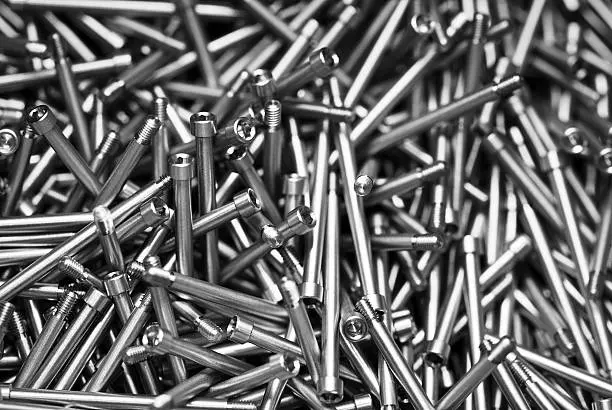
For procurement decision-makers prioritizing long-term reliability and cost efficiency, Grade 2 titanium wire effectively cuts maintenance frequency and component replacement costs. Its excellent fatigue resistance and thermal stability enable critical parts to operate consistently across a wide temperature range from -200 °C to 300 °C. The lower temperature limit is defined per specific equipment requirements, while the standard operating temperature for general industrial springs ranges from -40 °C to 300 °C, delivering long-term economic benefits.
1. Why Select Grade 2 Titanium Wire for Industrial Springs and Fasteners
1.1 Limitations of Traditional Materials Under Harsh Operating Conditions
1.2 Unique Performance Advantages of Grade 2 Titanium Wire
1.3 Performance Verification in Practical Applications
Table 1 Performance Comparison of Common Spring and Fastener Materials (Typical Reference Values; Actual Properties Vary by Material Condition)
| Material Type | Density (g/cm³) | Tensile Strength (MPa) | Seawater Corrosion Resistance (Test Conditions) | Relative Cost |
|---|---|---|---|---|
| Annealed 304 Stainless Steel | 7.93 | 520 | Moderate (ASTM G48, 30 °C, 6% FeCl₃, pitting present) | 1.0 (Baseline) |
| Annealed 316 Stainless Steel | 8.00 | 520 | Good (ASTM G48, 30 °C, 6% FeCl₃, slight pitting) | 1.8 |
| Annealed Grade 2 Titanium Wire | 4.51 | 450 (Typical value; range: 345~550) | Excellent (ASTM G48, 30 °C, 6% FeCl₃, no pitting) | 3.2 |
| Solution Treated and Aged Beryllium Copper Alloy | 8.25 | 1100 | Fair (Susceptible to seawater pitting) | 12.5 (For specified sizes) |
- Tensile strength: Values for 304/316 stainless steel represent typical properties in the annealed condition; cold-worked grades deliver higher strength. The typical tensile strength of annealed Grade 2 titanium wire is 450 MPa, with a full range of 345~550 MPa. Actual strength shall be confirmed based on delivery condition.
- Seawater corrosion resistance: Rated per ASTM G48 Method A (6% FeCl₃ solution, 30 °C, 72-hour pitting test). Performance may vary significantly under seawater conditions with different concentration, temperature and flow velocity.
- Relative cost: Based on wire with a diameter of 2.0 mm. Wire sizes of 5 mm and above may be priced lower than the baseline, while ultra-fine wire below 0.5 mm commands a higher price. Bulk order quantity, origin and market fluctuations greatly affect total cost. Quotations shall be applied for specific pricing.
2. Key Technical Parameters of Grade 2 Titanium Wire for Spring Manufacturing
2.1 Correlation Between Wire Diameter Selection and Spring Performance
2.2 Effects of Heat Treatment on Mechanical Properties
2.3 Impacts of Surface Finishes on Fatigue Life
3. Machining and Performance Optimization of Grade 2 Titanium Wire for Fasteners
3.1 Material Flow Control During Cold Heading
3.2 Tooling and Parameter Matching for Thread Machining
3.3 Application Strategies for Surface Strengthening Technologies
Table 2 Comparison of Common Machining Processes for Grade 2 Titanium Wire Fasteners (Typical Reference; Actual Performance Varies by Equipment Specifications)
| Machining Process | Applicable Wire Size (mm) | Surface Hardness (HV) | Dimensional Tolerance (mm) | Relative Cost (Small Batch / Mass Production) | Applicable Environments & Notes |
|---|---|---|---|---|---|
| Cold Heading + Thread Cutting | 3.0 ~ 6.0 | 180~220 (Work-hardened, non-annealed) | Diameter tolerance: ±0.05 (Measured at thread pitch diameter and shank outer diameter) | 1.0 (Baseline; Cost rises slightly for 6.0 mm wire) | General industrial and moderately corrosive environments. Threads have high surface roughness; not recommended for high fatigue and stress corrosion service. |
| Warm Heading + Thread Rolling | 4.0 ~ 8.0 | 220~260 (Retempered after warm heading; hardness between annealed and cold-drawn grades) | Diameter tolerance: ±0.03 (Rolled threads feature smooth surface and high dimensional stability) | 1.4 (Reduces to 1.2~1.3 for mass production) | Marine atmosphere and moderate salt spray environments. Rolled threads deliver high fatigue strength for dynamic and vibration loads. |
| Precision Cold Heading + Shot Peening | 2.0 ~ 5.0 | 240~280 (Increased surface hardness in compressive stress zone after shot peening) | Diameter tolerance: ±0.02 (For precision assembly such as medical devices and instrumentation) | 1.8 (High for small batches; stable at 1.5 for mass production) | Applications requiring high fatigue resistance and reliability, including aerospace structures and deep-sea equipment. Shot peening improves stress corrosion resistance. |
| CNC Turning + Nitriding | 6.0 ~ 10.0 | 350~450 (Surface microhardness; substrate remains 180~220 HV in annealed condition) | Diameter tolerance: ±0.01 (High precision for center holes and outer diameters; suited for rotating fits) | 2.5 (High unit cost; low cost-effectiveness for mass production) | Wear-prone and fretting corrosion environments. Nitriding damages the passive film; not for highly corrosive media. |
- Hardness values: All hardness readings refer to Vickers hardness (HV). The listed values represent surface or bulk hardness after specific treatments and do not conflict with base material heat treatment conditions. For nitrided parts, surface hardness reaches 350~450 HV while the substrate retains annealed hardness of 180~220 HV.
- Dimensional tolerance measurement: All diameter tolerances are measured on straight shank sections or thread pitch diameter, avoiding thread crests and roots. Precision cold heading with shot peening and CNC turning with nitriding are specified for high-precision fit applications.
- Relative cost: Baseline set as small-batch production (below 5,000 pieces) of 3.0 mm wire processed via cold heading and thread cutting. Mass production (over 50,000 pieces) reduces overall cost by 10% to 25%. Pricing for special sizes (2.0 mm or 10.0 mm wire) shall be negotiated with suppliers.
- Service environment selection: Processes are selected based on load type (static load, dynamic load, impact load) and corrosion severity (neutral environment, acidic environment, chloride-containing environment). For combined severe corrosion and fatigue conditions, warm heading with thread rolling or precision cold heading with shot peening is recommended.
4. Material Selection Guide: Matching Grade 2 Titanium Wire Specifications to Operating Conditions
4.1 Matching Wire Temper to Load Types
4.2 Material Selection Strategy by Corrosion Severity
4.3 Performance Constraints Under Different Temperature Ranges
4.4 Qualitative Evaluation of Cost Efficiency
5. Quality Control and Acceptance Criteria for Fastener Reliability
5.1 Key Inspection Items for Incoming Raw Materials
5.2 In-Process Inspection Specifications
5.3 Comprehensive Performance Verification for Finished Products
Table 3 Standard Inspection Items for Grade 2 Titanium Wire Springs and Fasteners (Reference)
| Inspection Item | Test Method (Standard) | Technical Requirements | Sampling Rules (By Lot and Product Grade) | Notes |
|---|---|---|---|---|
| Chemical Composition | Optical Emission Spectrometry ASTM E415 / GB/T 11170 | Comply with Grade 2 requirements of ASTM B863 (Actual values for main elements recorded) | One test per melting lot | — |
| Tensile Properties | Room Temperature Tensile Test ASTM E8 / GB/T 228.1 | Tensile strength (Rm) ≥ 400 MPa Or per contract requirements (Annealed: ≥ 345 MPa) | General grade: 2 specimens per lot (≤1,000 kg) Critical grade (Aerospace/Medical): 3 specimens per lot (≤500 kg); sampling from each coil | Specimens taken from bulk wire, excluding coil ends |
| Surface Defects | Eddy Current Testing (ET) ASTM E243 | No detrimental defects (cracks, folds, inclusions) Detection threshold: Depth ≥ 0.05 mm (Threshold of 0.1 mm negotiable) | 100% online continuous inspection | Applied for wire ≥ 0.5 mm diameter; Through-type eddy current testing for ultra-fine wire |
| Dimensional Accuracy | Laser Micrometer ISO 3771 | Diameter tolerance: ±0.02 mm (Adjustable per mutual agreement) | Full inspection; sampling at coil start, middle and end sections | Measure at least 1 m away from coil ends; average three readings |
| Salt Spray Resistance | Neutral Salt Spray Test (NSS) ASTM B117 | No red rust or pitting after 480 hours exposure | General grade: 2 pieces per lot Critical grade: 5 pieces per lot; 1 piece sampled from each coil | Test specimens include bent wire or simulated fasteners with surface finish identical to service condition |
| Fatigue Performance | Rotating Beam Fatigue Test ASTM E466 | No fracture after 10⁷ cycles Stress amplitude: 350 MPa (Or per design) | Mandatory for new product qualification and process changes Mass production: 1 specimen per lot (Critical grade only) | Standard test bars for wire ≥ 2 mm diameter; comparative testing for ultra-fine wire |
- Lot definition: A single lot refers to material from the same melting batch, wire diameter and heat treatment batch. Additional specimens are added proportionally for lots exceeding 1,000 kg (1 specimen per additional 500 kg).
- Product grade classification: Critical grade covers aerospace, medical implant, nuclear industry and deep-sea equipment applications; general grade covers conventional chemical processing, automotive and consumer goods.
- All inspection criteria may be adjusted per agreement between purchaser and manufacturer. Values listed are recommended standards.
- Eddy current detection threshold of 0.05 mm applies to wire with good surface condition. Threshold values shall be re-validated for wire below 0.5 mm diameter.
Conclusion
Frequently Asked Questions
Q1: What is the actual cost difference between Grade 2 titanium wire springs and stainless steel springs?
Grade 2 titanium wire has a higher upfront procurement cost than 316 stainless steel. In marine or chloride-containing corrosive environments, however, titanium wire springs deliver several times longer service life and require no anti-corrosion coating maintenance. When accounting for replacement frequency, production downtime and labor costs, titanium wire springs often provide superior total lifecycle economic benefits over the long term. Exact cost differences shall be calculated based on operating conditions and financial models.
Q2: When is it necessary to upgrade from annealed Grade 2 titanium wire to cold-worked grade?
Cold-worked Grade 2 titanium wire is recommended for components subjected to frequent cyclic loading (over 10,000 cycles per day) or operating stress exceeding 70% of the yield strength of annealed material, for improved elastic limit and resistance to stress relaxation. If permanent deformation exceeds design limits after cyclic testing on annealed material, switch to cold-worked grade.
Q3: What precautions apply to Grade 2 titanium wire fasteners for high-temperature service?
The maximum continuous operating temperature for Grade 2 titanium wire is 300 °C. Operation above this temperature causes surface hardening, embrittlement and hydrogen absorption. For service between 300 °C and 450 °C, shorten inspection intervals and monitor material hardness and microstructure. For sustained high-temperature applications, select TC4 titanium alloy fasteners with a maximum continuous operating temperature of approximately 400 °C, and verify thermal expansion compatibility with mating parts.
Looking for a Reliable Manufacturer?
For professional technical solutions and sample testing of Grade 2 titanium wire, please contact Baoji Titanium Valley Titanium Nickel Zirconium Material Processing Co., Ltd.
The company is equipped with Danieli continuous rolling production lines imported from Italy, with an annual production capacity exceeding 20,000 metric tons. A full range of titanium wire from 0.1 mm to 6.5 mm diameter and custom processing services are available. All products comply with ASTM B863 and are supplied with 3.1 material certification.
Email: sales@titaniumvalleys.com
References
- China Nonferrous Metals Industry Association. Titanium and Titanium Alloy Material Handbook [M]. Beijing: Metallurgical Industry Press, 2019.
- Wang Jinming, Li Qiang, Zhang Wei. Research on Application of Grade 2 Titanium Wire in Marine Engineering[J]. Materials Protection, 2020, 53(10): 45-49.
- Li Hua, Zhao Gang. Research on Fatigue Properties of Commercially Pure Titanium Wire Springs[J]. Materials for Mechanical Engineering, 2018, 42(6): 22-26.
- Zhang Qiang. Research on Machining Process and Quality Control of Titanium Alloy Fasteners[D]. Xi’an University of Technology, 2021.
- Sun Haitao, Liu Min. Process Parameter Optimization for Cold Heading of Titanium Wire[J]. Forging & Stamping Technology, 2019, 44(3): 87-92.
- Chen Yong, Wu Xiaofeng. Research Progress on Surface Strengthening Technology of Titanium Alloys[J]. Surface Technology, 2017, 46(8): 157-163.
- ASTM B863-14(2020) Standard Specification for Titanium and Titanium Alloy Wire.
- ASTM B117-19 Standard Practice for Operating Salt Spray (Fog) Apparatus.