
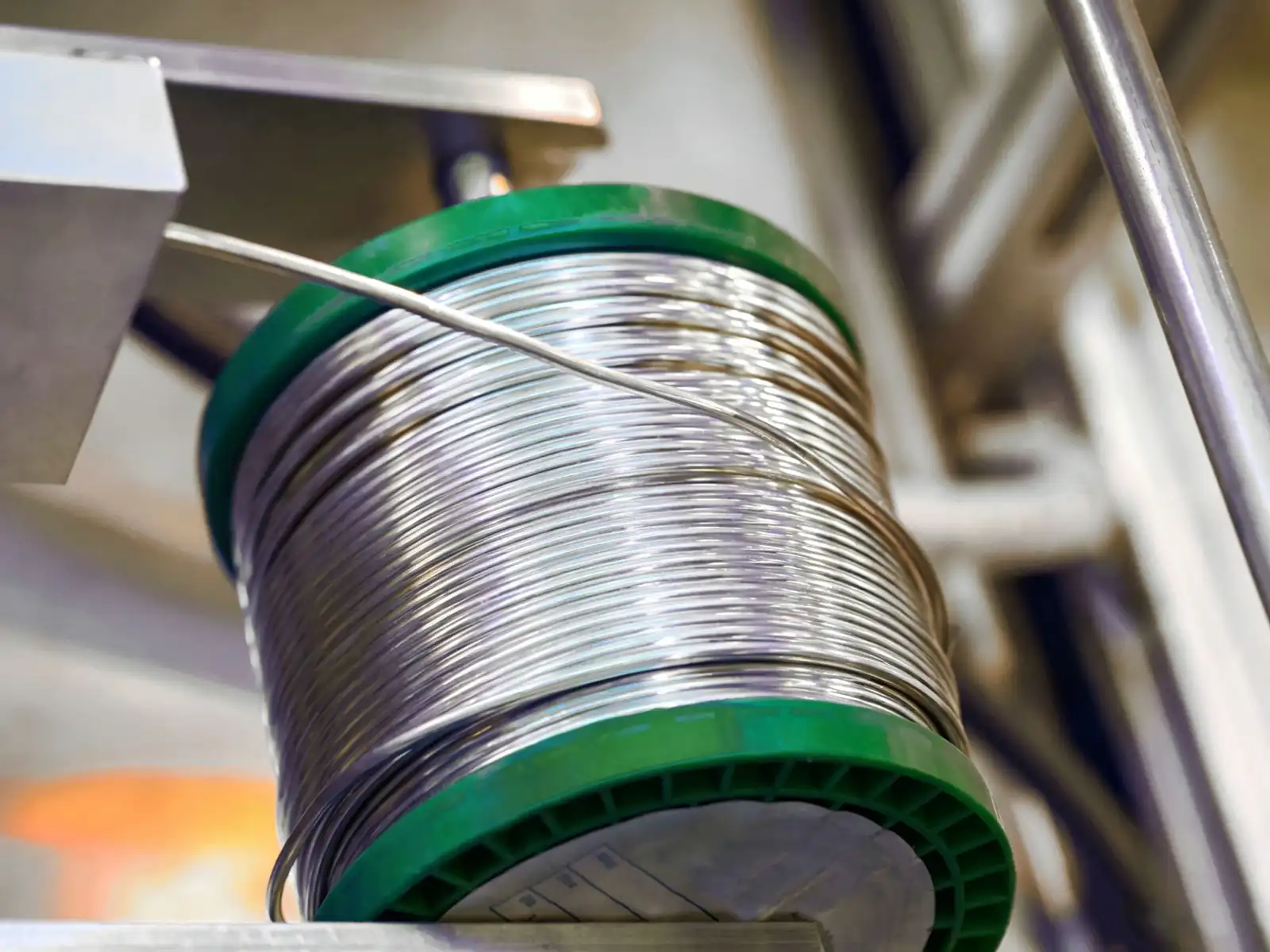
The marine environment poses one of the most severe service conditions for metallic materials. Salt spray, chloride ion attack and continuous humidity fluctuations lead to rapid degradation of conventional metals. Featuring outstanding corrosion resistance, Grade 2 titanium wire has become a preferred material for marine engineering applications. This commercially pure titanium wire forms a dense titanium oxide protective film in seawater, which resists long-term salt spray exposure without pitting corrosion or stress corrosion cracking. Under identical marine conditions, Grade 2 titanium wire exhibits a substantially lower corrosion rate than 316L stainless steel, as validated by the immersion test data below, delivering a service life several times longer. Such superior performance is attributed to the rapid formation of a dense, stable and self-healing TiO₂ passive film on titanium surfaces. This thermodynamically stable film can reliably protect the base metal even under extreme deep-sea conditions including high pressure, low temperature and high chloride ion concentration.
1. Corrosion Mechanisms of Metallic Materials in Marine Environments
1.1 Degradation Pathway of Chloride Ion Attack
1.2 Accelerating Effect of Electrochemical Corrosion
1.3 Synergistic Corrosion Induced by Marine Biofouling
2. Corrosion Resistance Performance Data and Mechanism of Grade 2 Titanium Wire in Marine Environments
2.1 Quantitative Results of Long-Term Immersion Tests
- Medium: Artificial seawater (ASTM D1141) or natural seawater with salinity of 35‰
- Temperature: 25±2℃
- State: Static immersion without agitation; solution renewed every 30 days
- Specimen dimension: 50 mm × 25 mm with thickness ranging from 0.5 mm to 1.0 mm
- Test duration: 720 days (2 years)
- Reference standard: ASTM G31, Laboratory Immersion Corrosion Testing of Metals
Material Type Corrosion Rate (mm/year) Pit Depth (μm) Weight Loss (%)¹ Surface Condition Grade 2 Titanium Wire <0.001 Not Detected 0.02² Bright, no corrosion marks 316L Stainless Steel 0.015~0.025 15~35 0.38 Localized pitting 90/10 Copper-Nickel Alloy 0.008~0.012 8~20 0.25 Slight discoloration Carbon Steel³ 0.12~0.18 300~500 3.2 Severe rusting ¹ Weight loss percentage is calculated based on the initial mass of standard 10 g specimens, with weight loss from acid cleaning for corrosion product removal deducted.
² The 0.02% weight loss of Grade 2 titanium wire includes changes in surface passive film; the actual mass loss of the metallic substrate is negligible.
³ The corrosion rate and pit depth data of carbon steel are typical values obtained under the specified static room-temperature seawater conditions. Actual performance varies substantially in real marine environments due to flow velocity, temperature, biofouling and dissolved oxygen content. Revision shall be conducted according to specific sea areas and operating conditions for engineering design.
Field exposure tests conducted in the South China Sea show that Grade 2 titanium wire with a diameter of 1.0 mm maintained intact surface and stable mechanical properties after two years of continuous immersion in natural seawater. For reference specimens tested simultaneously, 304 stainless steel developed obvious pitting, while aluminum bronze formed loose corrosion product layers with reduced tensile strength. These results verify the excellent long-term durability of Grade 2 titanium wire in real marine service environments.2.2 Structure and Protection Mechanism of the Passive Film
X-ray Photoelectron Spectroscopy (XPS) analysis confirms that the surface oxide film formed on Grade 2 titanium wire in natural seawater is predominantly composed of TiO₂. This thin, dense film adheres firmly to the substrate and provides reliable isolation against corrosive media. Electrochemical Impedance Spectroscopy (EIS) tests demonstrate that the passive film on titanium possesses an impedance value 2 to 3 orders of magnitude higher than that of stainless steel passive films.In cases of mechanical scratching on the film surface, the exposed titanium substrate immediately reacts with dissolved oxygen in water to regenerate the protective film. The film repair rate exceeds the chloride ion penetration rate, forming a dynamically balanced protection system.2.3 Performance Stability Under Extreme Conditions
Deep-sea environments feature extreme conditions including high pressure (>10 MPa), low temperature (2~4 ℃) and high salinity, which impose stringent requirements on material performance. Autoclave tests simulating deep-sea pressure confirm that Grade 2 titanium wire maintains complete surface integrity over extended test periods. Subjected to temperature cycling over a wide range, the tensile strength and elongation of titanium wire show no significant degradation, indicating excellent thermal stability across varying temperatures. After 480 hours of neutral salt spray testing per ASTM B117 (5% NaCl solution, 35 ℃), no visible corrosion was observed on Grade 2 titanium wire surfaces.3. Application Advantages of Commercially Pure Titanium in Marine Engineering
3.1 Critical Components for Seawater Desalination Systems
Table 2 Typical Applications of Grade 2 Titanium Wire in Seawater Desalination Units
Application Location Dimension Requirement Functional Advantages Comparison with Alternative Materials Tube Bundle Lashing for Heat Exchangers φ0.8~1.2 mm Resistant to high-temperature brine corrosion; estimated service life ≥ 20 years (predicted per ASTM G31 corrosion test data; on-site service life to be verified against actual operating conditions) Inconel 625 Nickel-Based Alloy: Good corrosion resistance but approximately 3 times the material cost of titanium wire Wire Mesh Demister for Evaporators φ0.15~0.3 mm Ultra-Fine Wire High specific surface area; resistance to salt scale deposition Stainless Steel Mesh: Insufficient corrosion resistance, requiring replacement approximately every 3 years Connection Wires for Electrolyzer Anodes φ2.0~3.0 mm Electrical conductivity meets current requirements for chlor-alkali electrolysis; outstanding resistance to chlorine gas corrosion via stable surface passive film; commonly used as the substrate for DSA coated anodes Graphite: Low mechanical strength and high brittleness, prone to fracture - Titanium has an electrical resistivity of approximately 0.55 μΩ·m, lower than that of copper. However, given the typical current density below 1000 A/m² for chlor-alkali electrolysis anode connections, titanium fully satisfies conductivity requirements. Its superior resistance to chlorine-induced corrosion makes it irreplaceable by other metallic materials for such applications.
- The service life data are estimated from standard static high-temperature brine corrosion tests per ASTM G31. Actual service life is affected by flow velocity, temperature and impurities. Field exposure testing is recommended for verification.
Woven meshes fabricated from Grade 2 titanium wire are adopted for high-pressure pump sealing assemblies in reverse osmosis seawater desalination plants, with zero failure records after 5 years of continuous operation under designated working conditions. By contrast, conventional copper alloy sealing meshes suffer corrosion penetration after only 18 months under the same service conditions.In Multi-Stage Flash (MSF) desalination units, titanium wire with a diameter of 1.6 mm is used for mechanical fastening between tube sheets and heat exchange tubes. This solution eliminates corrosion risks associated with weld heat-affected zones and improves overall equipment availability.3.2 Corrosion-Resistant Fastening Systems for Offshore Platforms
Corrosion-induced replacement of bolted connections accounts for a substantial portion of annual maintenance costs for offshore oil platforms. Self-locking nuts and pins machined from Grade 2 titanium wire deliver reliable performance in splash zones and tidal zones.At an oil platform in the North Sea, titanium wire pins applied for securing fiberglass reinforced plastic gratings only exhibited slight surface discoloration after years of exposure to marine environments, with shear strength fully retained. In comparison, stainless steel pins developed stress corrosion cracks and eventual fracture over the same service period. Additionally, the non-magnetic property of titanium wire eliminates electromagnetic interference with navigation equipment on platforms, offering unique advantages for installation around precision instruments.3.3 Welding Consumables for Shipbuilding and Repair
Table 3 Performance of ERTi-2 Titanium Welding Wire for Marine Welding Applications
Welding Joint Joint Type & Post-Weld Condition Joint Tensile Strength (MPa) Intermediate Layer Selection & Process Challenges Corrosion Resistance Test Economic Analysis (Including Cost and Man-Hour Evaluation) Titanium Alloy Hull Welds Butt joint, post-weld stress relief annealing 420~460 Welding with matching filler metal; no intermediate layer required 1000 hours salt spray testing per ASTM B117 with no corrosion observed Weld service life equivalent to base metal; minimal long-term maintenance cost Titanium-Steel Dissimilar Metal Transition Joints Lap/butt joint with special transition design 380~410 Intermediate layer: Commercially pure nickel or Monel 400 nickel-copper alloy with thickness of 2~5 mm Process Challenges:
1. Brittle Fe-Ti intermetallic phases form from direct titanium-steel welding
2. Welding requires vacuum or high-purity argon shielding
3. High technical threshold for diffusion welding and explosive welding
No preferential corrosion at transition layer after 1000 hours salt spray testing Reduces costs for flanges and sealing components by approximately 30% compared with bolted titanium-steel connections; eliminates coating processes, cutting overall component cost by 20~30% On-Site Repair Welding for Seawater Piping Butt/fillet joint, on-site TIG welding without post-weld heat treatment 395~430 Welding with matching filler metal; strict oxygen content control required Corrosion rate of weld zone consistent with base metal; general corrosion rate <0.005 mm/year Equipment downtime reduced by approximately 60%; on-site labor cost for single repair reduced by about 50% (based on 3-year statistical data from chemical plant cases) - Tensile strength values are room-temperature test results per ASTM E8, using specimens extracted from weld cross-sections. Strength deviation between butt joints and fillet joints is generally within 5%.
- Post-weld stress relief annealing is only mandatory for thick plates (>10 mm) or highly restrained structures; thin-walled components can be used without heat treatment.
- Economic analysis is summarized from typical chemical and marine repair cases. Actual costs fluctuate with project scale, labor rates and spare part prices. Financial evaluation based on project-specific models is recommended.
In ship repair projects, TIG welding using 1.0 mm diameter Grade 2 titanium wire produces sound weld beads. Welded joints demonstrate excellent corrosion resistance under simulated seawater erosion conditions. Automatic welding systems equipped with 0.8 mm titanium wire feeding units are applied for lap welding of titanium plates on commercial ship ballast tanks, effectively improving welding efficiency.4. Technical Considerations and Cost-Benefit Analysis for Material Selection
4.1 Life Cycle Cost Analysis Model
Economic evaluation of marine engineering materials shall take the full life cycle into account instead of focusing merely on initial procurement cost. Taking a seawater circulating cooling system as an example (excluding financial factors such as interest discount):- Initial installation cost of 316L stainless steel mesh: Baseline value of 1.0
- Initial installation cost of Grade 2 titanium mesh: Approximately 2.8 times the baseline
Over a 15-year service cycle, frequent replacement and associated downtime losses push the total operating cost of stainless steel solutions above that of titanium wire solutions in highly corrosive environments. However, stainless steel remains cost-effective for projects deployed in shallow water with low corrosion severity or short service life. Detailed economic calculation is recommended based on actual operating conditions.4.2 Performance Matching and Specification Optimization
Marine engineering applications require titanium wires of varying specifications to meet diverse service demands:- Heavy-gauge wire (φ4.0~6.0 mm) for submarine cable armoring requires high tensile strength (345~550 MPa for annealed temper) and good flexibility, supplied in annealed (O temper) or cold-worked conditions.
- Ultra-fine wire (φ0.1~0.3 mm) for sensor lead wires is typically supplied in annealed temper to facilitate microelectronic packaging.
Rational material selection shall incorporate stress calculation, fatigue analysis and environmental factor correction to avoid over-design or under-design.4.3 Strategic Value of Stable Supply Chain
Marine engineering projects feature long construction cycles and large capital investment, where stable material supply directly affects project progress. Titanium wire manufacturers with large-scale production capacity ensure on-time delivery for bulk orders and provide certified material test reports. Industrialized production capabilities enable suppliers to deliver one-stop procurement services together with professional technical support for marine engineering clients.5. Future Demand Trends for High-Performance Titanium Wire in Marine Technology
5.1 Lightweight Requirements for Deep-Sea Equipment
Deep-sea submersibles and underwater robots pursue maximum weight reduction. Grade 2 titanium wire has a density of 4.51 g/cm³, equivalent to roughly 58% of that of stainless steel. Under equivalent strength design criteria, titanium components achieve significant weight savings. Next-generation ten-thousand-meter-class deep-sea exploration vehicles impose higher requirements on material specific strength. Although β-titanium alloy wires such as TB13 deliver higher mechanical strength, their higher cost limits large-scale application. Commercially pure titanium remains the dominant material for current deep-sea equipment.5.2 Emerging Applications in Marine Energy Development
Tidal and wave energy power generation facilities operate under long-term seawater immersion and cyclic dynamic loading. Titanium wire strands are adopted for mooring ropes of power generation buoys, presenting superior fatigue resistance and stable strength retention under cyclic loading compared with steel wire ropes. Condensers for ocean thermal energy conversion systems extensively use 0.8~1.2 mm diameter titanium wire for vapor recovery meshes, leveraging titanium’s excellent corrosion resistance and thermal conductivity (21~22 W/(m·K)). Driven by carbon neutrality initiatives, the installed capacity of marine renewable energy will continue to expand, bringing growing demand for titanium materials.5.3 Material Foundation for Intelligent Marine Sensor Networks
The scale of sensor nodes for marine Internet of Things has reached millions globally. Titanium wire serves as corrosion-resistant conductive material for sensor lead wires and antenna frames on each node. Grade 2 titanium wire has an electrical resistivity of approximately 0.57 μΩ·m, higher than copper, yet copper suffers rapid corrosion failure in marine environments while titanium maintains long-term stability. Grid structures welded from titanium wire are used for transducer frames of underwater acoustic arrays, which satisfy acoustic transparency requirements while providing sufficient mechanical rigidity.Conclusion
Benefiting from exceptional marine corrosion resistance, Grade 2 titanium wire has become a key material widely applied in shipbuilding, offshore platforms, seawater desalination and deep-sea equipment. The self-healing passive film formed in chloride-rich environments delivers reliable protection for decades with prominent full life cycle cost advantages.It is necessary to recognize the material limitations of titanium wire: its corrosion resistance degrades in fluoride-containing media, high-temperature concentrated alkali and strongly oxidizing acidic solutions. Fatigue corrosion risks still exist under combined high stress and corrosive service conditions. Proper material selection and engineering design are essential to maximize the performance advantages of titanium wire. With technological advancements in deep-sea exploration and marine energy utilization, market demand for high-performance titanium wire will maintain steady growth.Frequently Asked Questions
Q1: What is the actual service life of Grade 2 titanium wire in seawater?
Field data from multiple marine engineering projects indicate that the designed service life of Grade 2 titanium wire in natural seawater is generally 30 years. Proper design and routine maintenance guarantee long-term reliable operation. Actual service life is influenced by stress level, temperature fluctuation and biofouling intensity. A design life of 30 years is recommended for engineering projects, with adjustments made according to specific operating conditions and acceptable risk levels.
Q2: How is the cost difference reflected between titanium wire and stainless steel wire in marine environments?
In terms of initial procurement cost, Grade 2 titanium wire is 2.5 to 3.5 times more expensive than 316L stainless steel wire. Nevertheless, for components deployed in highly corrosive splash zones and tidal zones, the total long-term cost of stainless steel solutions exceeds that of titanium wire due to repeated replacement and downtime losses. The typical payback period ranges from 5 to 7 years, varying with operating conditions and financial models. Stainless steel offers better cost performance for short-term projects in shallow water with low corrosion risk.
Q3: What are the special marine applications for ultra-fine titanium wire (φ<0.5 mm)?
Ultra-fine titanium wire is primarily used for precision sensor fabrication, underwater acoustic equipment and electronic packaging. For instance, 0.2 mm diameter titanium wire acts as elastic support elements for MEMS sensors on unmanned underwater vehicles; 0.3 mm diameter titanium wire is used for lead wires of CTD sensors on marine environmental monitoring buoys, combining high mechanical strength and long-term corrosion resistance. Refer to relevant test reports for detailed mechanical property parameters.
Call for Action
Baoji Titanium Valley Titanium Nickel Zirconium Material Processing Co., Ltd. is a professional manufacturer and supplier of Grade 2 titanium wire. Equipped with continuous rolling production lines imported from Danieli, Italy, the company achieves an annual production capacity of over 20,000 metric tons and provides customized titanium wires covering a full size range from φ0.1 mm to φ6.5 mm. All products comply with ASTM B863 standards and are supplied with material certification including EN 10204-3.1 third-party inspection reports. For inquiries about marine engineering dedicated titanium wire or technical consulting services, please contact our engineering team via email: sales@titaniumvalleys.comReferences
- Li X G, Wang H D. Corrosion Behavior and Protection Technologies of Titanium and Titanium Alloys in Marine Environments[M]. Beijing: Chemical Industry Press, 2019.
- Liu J H, Zhang B, Du C W. Application Guide of Titanium Alloys for Marine Engineering[M]. Beijing: National Defense Industry Press, 2021.
- Zhao Y Q, Wu Z P, Qu H L. Application and Development of Titanium Alloys in Marine Engineering[J]. Chinese Journal of Materials Progress, 2018, 37(10): 769-777.
- Chen J, Wang H M, Zhang X M. Cost-Benefit Analysis of Titanium Alloys in Marine Environments[J]. Rare Metal Materials and Engineering, 2020, 49(6): 1978-1984.
- Huang X J, Yao X J, Li T F. Corrosion Behavior of Titanium Alloys in Deep-Sea Environments[J]. Materials Protection, 2019, 52(7): 1-6.
- ASTM B117-19 Standard Practice for Operating Salt Spray (Fog) Apparatus.
- ASTM B863-14(2020) Standard Specification for Titanium and Titanium Alloy Wire.