
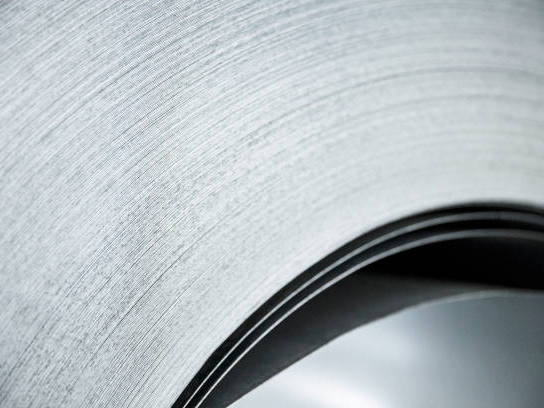
GR1 titanium foil sees wide use in high-end manufacturing sectors such as aerospace, electronic shielding and new energy batteries. It delivers outstanding corrosion resistance, light weight and excellent formability. The standard industrial thickness range of GR1 titanium foil sits between 0.02 mm and 1.0 mm. Manufacturers adopt 750 mm 20-high precision rolling mills to maintain tight thickness accuracy. Standard products come in coil forms with widths from 350 mm to 670 mm, matching most high-end application demands. We also supply custom ultra-thin foil from 0.005 mm to 0.02 mm for ultra-precise microelectronics and optical industries. The industry sets a clear definition: materials under or equal to 0.1 mm count as foil, and materials from 0.1 mm to 2.0 mm belong to strip. This document follows this standard definition throughout.
GR1 titanium foil holds minimum titanium purity of 99.5 %. It brings top-tier corrosion resistance and forming performance. Annealed GR1 foil reaches minimum tensile strength of 240 MPa, fully compliant with ASTM B265. Cold rolled hard-state foil hits tensile strength between 370 MPa and 450 MPa, with minimum elongation of 24 %. Its density only equals 57 % of steel. This material works perfectly for chemical anti-corrosion equipment and lightweight structural design.
I. Standard Thickness Ranges and Classification of GR1 Titanium Foil
1. Regular industrial thickness: 0.02 mm to 1.0 mm
This thickness range covers most industrial application scenarios.
- 0.02 mm ~ 0.1 mm: electromagnetic shielding parts, battery tabs, precision electronic components
- 0.1 mm ~ 0.5 mm: lining plates for chemical equipment, heat exchanger sheets, composite base materials
- 0.5 mm ~ 1.0 mm: structural components, flange sealing gaskets, heavy-duty anti-corrosion parts
Factories apply multi-pass cold rolling paired with continuous argon annealing lines. This process guarantees uniform thickness across full coils and removes local thickness deviations.
2. Custom ultra-thin thickness: 0.005 mm to 0.02 mm
This grade targets ultra-precise fields including microelectronic packaging, optical reflective films and medical implant devices. Mass production of 0.005 mm–0.02 mm ultra-thin foil relies on advanced tension leveling and sanding processes.
For thickness within this full custom ultra-thin band (0.005 mm to 0.02 mm), manufacturers produce it with multi-pass precision rolling. Send width and performance requirements to suppliers to confirm production feasibility.
The material surface needs a dyne level above 44 mN/m, tested with pure water at room temperature per ASTM D2578. This standard delivers reliable coating adhesion, and the foil fits follow-up processes such as sputtering coating and lamination directly.
3. Thickness tolerance control standards
ASTM B265 sets different thickness tolerance limits for various thickness bands. Typical tolerance values read as follows:
0.02 ~ 1.0 mm: ±0.002 mm
High-precision thickness control carries huge value for fuel cell bipolar plates, semiconductor processing foil and precision shielding covers. It cuts machining allowance for follow-up processes and lifts material utilization rate by 15 % to 20 %.
GR1 Titanium Foil Thickness Classification and Core Selection Metrics
| Thickness Range | Application Fields | Core Production Difficulties | Standard Tolerance (ASTM B265) | Surface Roughness Ra (μm) | Flatness (mm/m) |
|---|---|---|---|---|---|
| 0.005 ~ 0.02 mm | Microelectronic packaging, optical films | Wrinkling, tension regulation, slitting burrs | ±0.001 mm (custom order) | ≤ 0.2 | ≤ 2 |
| 0.02 ~ 0.1 mm | Electromagnetic shielding, battery tabs | Work hardening, edge cracking, poor strip shape | ±0.005 ~ 0.008 mm | ≤ 0.3 | ≤ 3 |
| 0.1 ~ 0.5 mm | Chemical lining plates, heat exchange sheets | Residual stress, uneven flatness | ±0.015 mm | ≤ 0.4 | ≤ 2 |
| 0.5 ~ 1.0 mm | Structural parts, sealing gaskets | Thickness unevenness, mechanical strength control | ±0.025 mm | ≤ 0.8 | ≤ 1.5 |
II. Production Process Differences Across Various Thickness Sizes
1. Precision rolling technology for thin foil (0.02 mm ~ 0.1 mm)
Three major production challenges appear during thin GR1 titanium foil rolling: severe work hardening, edge cracking and surface scratches. Factories adopt 20-high rolling mills with small-diameter work rolls (Φ50 mm) and backup roll systems. For GR1 pure titanium, each rolling pass controls reduction rate between 8 % and 12 %. The full rolling sequence covers 15 to 20 passes to reach target thickness.
Every rolling pass ends with ultrasonic cleaning plus alkaline washing. This step clears surface oil and oxide scales to secure stable quality for the next rolling cycle. Continuous annealing runs under full argon protection. Operators lock annealing temperature from 650 ℃ to 700 ℃, with holding time from 1 min to 3 min adjusted by foil thickness. Temperature fluctuation stays within ±2 ℃ to avoid abnormal grain growth and inconsistent mechanical properties.
2. Strip shape control for medium-thick foil (0.3 mm ~ 1.0 mm)
The main production challenges of medium-thick GR1 titanium foil focus on flatness and residual stress elimination. Manufacturers adjust leveling tension between 5 MPa and 15 MPa and apply multi-roll straightening processes. Flatness gets controlled below 3 mm/m with measurement taken 20 mm from each edge (two-point inspection method).
Foil from 0.3 mm to 0.6 mm receives homogenization annealing at 720 ℃ with two hours of argon-protected holding. Foil from 0.6 mm to 1.0 mm needs one extra intermediate annealing cycle. This treatment improves ductility and stabilizes elongation between 25 % and 30 %. Sanding lines further unify surface texture, erase rolling marks and produce matte or mirror surface finishes as requested.
3. Technical breakthroughs for ultra-thin foil (0.005 ~ 0.02 mm)
Ultra-thin GR1 titanium foil production solves three tough issues: easy wrinkling, unstable tension control and slitting burrs. The production line installs an adaptive tension control system. The system tracks rolling force and front/rear tension in real time and adjusts parameters dynamically. Vacuum annealing furnaces maintain vacuum level below 5 × 10⁻³ Pa to stop oxidation and discoloration on ultra-thin foil surfaces.
High-precision slitting machines use hard alloy circular cutting blades paired with dust removal systems. The setup delivers clean cutting edges free of burrs. For small-batch fixed-size orders with width ≤ 200 mm and length ≤ 500 m, finished product yield exceeds 92 %. Wide-coil mass production reaches a yield rate around 85 %.
III. Matching Thickness Sizes with Actual Application Scenarios
1. Thickness requirements for aerospace industries
Aerospace structural parts mostly pick foil from 0.3 mm to 0.8 mm. This range balances light weight and structural strength. Aircraft skin and bulkhead partitions require annealed tensile strength above 240 MPa, elongation above 24 % and stable welding performance.
Engine thermal shielding components adopt foil from 0.5 mm to 1.0 mm. Titanium holds a high melting point near 1660 ℃ and low thermal conductivity, around 22 W/(m·K) at room temperature and 18 W/(m·K) at 300 ℃. These properties deliver both heat resistance and thermal insulation functions.
2. Precision standards for electronics and new energy sectors
Electromagnetic shielding housings commonly use GR1 titanium foil from 0.02 mm to 0.1 mm. Manufacturers form finished parts via precision stamping or laser cutting. For ultra-small precision shielding components, custom 0.005 ~ 0.02 mm ultra-thin foil is available.
Battery tabs select foil between 0.05 mm and 0.15 mm. This product needs ultra-clean surfaces without oil stains or scratches and stable electrical conductivity.
Fuel cell bipolar plates choose foil thickness from 0.08 mm to 0.2 mm. This material balances electrical conductivity, corrosion resistance and stamping formability, with surface roughness Ra ≤ 0.4 μm achieved through precision rolling plus bright annealing.
One key reminder: ultra-thin foil under 0.05 mm wrinkles easily during deep drawing. Solve this problem by boosting blank holder force, adopting multi-pass forming or installing hydraulic cushions on stamping machines.

3. Special thickness specifications for chemical and medical fields
Chemical reactor lining plates mostly use foil from 0.5 mm to 1.0 mm. Workers roll and weld these sheets into integrated liners to cut the number of corrosion-prone welding seams. Seawater desalination heat exchangers select foil between 0.2 mm and 0.5 mm. Titanium’s outstanding chloride resistance delivers a corrosion rate under 0.01 mm per year in seawater environments.
Medical implants such as skull repair plates adopt foil from 0.3 mm to 0.6 mm. This material meets strict standards for biocompatibility, malleability and X-ray permeability. Note that X-ray transmittance drops exponentially as foil thickness rises. Foil thicker than 0.6 mm creates obvious attenuation for low-energy X-rays, so engineers match thickness with imaging requirements during material selection. Medical-grade GR1 titanium foil must comply with ASTM F67 standards for pure titanium implant materials.

Typical Thickness Requirements and Selection Notes of GR1 Titanium Foil Across Industries
| Application Industry | Recommended Thickness (mm) | Core Technical Indicators | Surface Treatment Standards | Caution / Forbidden Usage Reminders |
|---|---|---|---|---|
| Aerospace | 0.3 ~ 0.8 | Annealed tensile strength ≥240 MPa, elongation ≥24 %, good weldability | Acid pickling, passivation | Not fit for long-term service above 350 ℃ |
| Electronic Shielding | 0.02 ~ 0.1; Custom 0.005~0.02 mm for micro-components | Stable strip shape, consistent conductivity, tight thickness tolerance | Ultrasonic cleaning, degreasing | Avoid direct contact with copper to prevent galvanic corrosion |
| New Energy Batteries | 0.05 ~ 0.2 | High surface cleanliness, stable dyne level, strong stamping performance | Alkaline washing + plasma activation | No direct contact with fluoride-containing electrolyte |
| Chemical Equipment | 0.5 ~ 1.0 | Strong corrosion resistance, reliable weldability, reserved corrosion allowance | Acid pickling, bright annealing | Not fit for hydrofluoric acid or hot concentrated sulfuric acid |
| Medical Implants | 0.3 ~ 0.6 | Biocompatibility (ASTM F67), excellent malleability | Electrolytic polishing, passivation | Standard industrial-grade foil cannot serve as implant material |
IV. Impacts of Foil Thickness on Material Mechanical Properties
1. Correlation between mechanical performance and thickness
Cold rolled hard-state GR1 titanium foil gains higher tensile strength as thickness decreases, reaching values between 420 MPa and 450 MPa. Grain refinement and work hardening create this strength improvement, while elongation falls to 20 % ~ 22 %.
Full argon-protected annealing at 650 ℃ ~ 700 ℃ recovers tensile strength to 240 MPa ~ 280 MPa and lifts elongation back to 24 % ~ 28 %. Foil thicker than 0.5 mm accumulates larger internal residual stress. Multiple intermediate annealing cycles plus final stress relief treatment become necessary to secure dimensional stability. All strength data in this document reference fully annealed foil; users need separate specifications for cold rolled hard-state products.
2. Thickness dependence of corrosion resistance
Titanium’s anti-corrosion ability comes from a dense TiO₂ passivation film on its surface, with film thickness between 2 nm and 7 nm. The passivation film itself carries no link to substrate thickness in theory. However, ultra-thin foil from 0.005 mm to 0.02 mm has thin base metal and relatively high surface defect density. This creates a much higher risk of full penetration by local pitting corrosion, which differs from simple corrosion margin shortages.
Chemical equipment projects recommend foil thickness above 0.2 mm to reserve sufficient safety margin. Salt spray tests follow ASTM B117 standards (5 % NaCl solution, 35 ℃). The test records zero penetration holes after 3000 hours of exposure for 0.5 mm GR1 titanium foil, which satisfies long-term anti-corrosion service demands.
3. Matching formability with foil thickness
- Custom ultra-thin GR1 titanium foil (0.005 ~ 0.02 mm): fit micro stamping, precision winding and ultra-thin lamination, high risk of wrinkling during deep drawing
- Thin GR1 titanium foil (0.02 ~ 0.2 mm): fits complex forming processes including stamping, bending and winding. Minimum bending radius along rolling direction hits 1.5 times material thickness; users set 2.0 times thickness for bending across rolling direction.
- Medium-thick GR1 titanium foil (0.3 ~ 0.8 mm): requires proper die fillets and lubricants to avoid surface scratches and edge cracking.
- Extra-thick GR1 titanium foil (> 0.8 mm): carries high deformation resistance under room temperature. Manufacturers suggest hot forming at 300 ℃ ~ 400 ℃ with holding time from 5 min to 10 min to cut forming resistance. Do not extend heating time too long to stop excessive oxidation layer growth on surfaces.
Comparison Between GR1 Titanium Foil Thickness and Core Performance (Fully Annealed, Room Temperature)
| Thickness Range (mm) | Tensile Strength (MPa) | Elongation (%) | Minimum Longitudinal Bending Radius | Reference Service Life in Chemical Environments (pH 4–10, Room Temp) |
|---|---|---|---|---|
| 0.005 ~ 0.02 | 240 ~ 280 | 24 ~ 28 | 0.0075 ~ 0.04 mm | 1 ~ 3 years (high pitting corrosion risk) |
| 0.02 ~ 0.1 | 240 ~ 280 | 24 ~ 28 | 0.03 ~ 0.15 mm | 3 ~ 5 years (watch for pitting corrosion risks) |
| 0.1 ~ 0.3 | 240 ~ 280 | 25 ~ 30 | 0.15 ~ 0.6 mm | 5 ~ 8 years |
| 0.3 ~ 0.6 | 240 ~ 280 | 25 ~ 28 | 0.6 ~ 1.2 mm | 8 ~ 12 years |
| 0.6 ~ 1.0 | 240 ~ 280 | 25 ~ 27 | 1.2 ~ 2.0 mm | 12 ~ 15 years |
V. Custom Thickness Service and Full Quality Assurance System
1. Customization capacity for non-standard thickness sizes
Beyond standard 0.02 mm ~ 1.0 mm sizes, we produce custom GR1 titanium foil covering 0.005 mm to 1.0 mm based on customer drawings and performance demands. One limitation applies to ultra-thin foil between 0.005 mm and 0.02 mm: maximum production width cannot exceed 300 mm.
The full custom order workflow follows these steps: technical discussion → process review → sample trial production → performance verification → mass delivery. Our factory equips coordinate measuring machines, ultrasonic thickness gauges and surface profilometers to carry out 100 % full inspection for all custom orders.
Minimum order weight for trial batches:
- Standard thickness (0.02 ~ 1.0 mm): minimum 50 kg;
- Custom ultra-thin (0.005 ~ 0.02 mm): minimum 200 kg, delivery cycle 4 ~ 8 weeks.
2. Full process quality control nodes
Raw material incoming inspection covers spectroscopic chemical composition analysis, mechanical property testing and ultrasonic flaw detection, with 100 % pass rate required. Online thickness gauges run real-time monitoring during rolling, recording data every 10 meters and automatically removing out-of-spec sections. Metallographic inspection takes place after annealing to guarantee grain size Grade 6–8 per ASTM standards, corresponding to uniform fine equiaxed grains for stable comprehensive mechanical properties. Final products pass three rounds of inspection for dimension, surface and mechanical performance. We supply material test certificates, third-party inspection reports, plus REACH (EC 1907/2006) and RoHS (2011/65/EU) compliance declarations covering limit values of hazardous substances such as lead, mercury, cadmium and hexavalent chromium.
3. Traceability and certification system
Each coil of GR1 titanium foil carries a unique batch number, recording all process parameters and inspection data from raw materials to finished goods with a 15-year data retention period. The production line holds ISO 9001 quality management system certification and ISO 14001 environmental management system certification. Aerospace-grade products comply with AS9100 standards. We can provide ASTM B265, JIS H4600 and EN 10204 3.1 certificates to meet market access requirements for Europe, America, Japan and South Korea.
Conclusion
GR1 titanium foil covers custom ultra-thin 0.005 mm to regular industrial 1.0 mm thickness ranges, meeting demands from aerospace, electronics, chemical, medical and other industries. The core logic for material selection: first clarify service environment (corrosive media, temperature, load) → confirm required mechanical properties (tensile strength, elongation) → match forming processes (stamping, welding) → calculate total cost budget. Avoid using this material in scenarios with fluoride media, long-term exposure above 350 ℃, or ultra-thin structures under strong vibration. Advanced 20-high precision rolling technology and full-process quality control deliver ultra-tight thickness tolerances and consistent batch quality, providing cost-effective titanium foil solutions for high-end manufacturing applications.
FAQ
1. What performance differences exist between 0.02 mm and 0.1 mm GR1 titanium foil for electromagnetic shielding applications?
0.02 mm foil is lighter and thinner, suitable for multi-layer stacked shielding and space-limited assemblies yet with lower mechanical rigidity. 0.1 mm foil offers better structural stiffness and wear resistance, ideal for single-layer large-area shielding housings. Reference shielding effectiveness: both grades reach over 60 dB under 1 GHz near-field electric field conditions (test standard ASTM D4935). The actual value depends on shielding chamber structure and grounding design. Final selection relies on assembly process and cost budget. Custom 0.005–0.02 mm ultra-thin foil serves miniature micro shielding components.
2. Can custom ultra-thin titanium foil (0.005 ~ 0.02 mm) be used as lining for chemical anti-corrosion equipment?
Not recommended. Ultra-thin foil faces three major risks in chemical environments:
① Thin substrate allows local pitting corrosion to penetrate the foil easily;
② Difficult welding, low tensile strength at splice joints;
③ Easy deformation and failure under high temperature or pressure fluctuation.
We recommend foil thickness ≥ 0.3 mm for chemical equipment linings. Custom ultra-thin foil mainly applies to corrosion-free sectors including microelectronic packaging and optical coating films.
3. How to verify the delivered GR1 titanium foil meets high-precision thickness tolerance standards?
Use a digital micrometer with 0.001 mm precision or laser thickness gauge. Take 5 to 7 evenly spaced measuring points along the foil width direction, and one measurement per meter along the length direction. Calculate average thickness and thickness range. Complete all measurements under constant temperature (20 ± 2 ℃) to eliminate thermal expansion errors from temperature shifts. Qualified fixed-size cut sheets should have thickness range ≤ 0.002 mm. Request suppliers to provide inspection reports and Statistical Process Control (SPC) data, confirming process capability index Cpk ≥ 1.33.
Contact Titanium Valley Supplier for Custom Solutions
As a professional GR1 titanium foil manufacturer and supplier, Baoji Titanium Valley Titanium Nickel Zirconium Material Processing Co., Ltd. supplies standard 0.02 ~ 1.0 mm titanium foil and custom ultra-thin foil from 0.005 mm to 0.02 mm. Our factory is equipped with world-class production equipment and supports OEM/ODM cooperation with stable delivery schedules. Send your technical specifications to sales@titaniumvalleys.com to obtain detailed quotations and sample testing services.
References
- Li Minghua, Zhang Jianguo. Research on Cold Rolling Process, Microstructure and Properties of Commercially Pure Titanium Thin Sheets[J]. Rare Metal Materials and Engineering, 2021, 50(3): 456-462.
- Wang Zhigang, Liu Xiaofeng. Key Precision Rolling Technology and Industrial Application of Ultra-Thin Titanium Foil[J]. Transactions of Nonferrous Metals Society of China, 2020, 30(8): 1823-1830.
- Chen Haiyun, Zhao Yongqing. Surface Quality Control Technology for Titanium and Titanium Alloy Strips and Sheets[J]. Titanium Industry Progress, 2019, 36(5): 22-28.
- ASTM International. ASTM B265-20: Standard Specification for Titanium and Titanium Alloy Strip, Sheet, and Plate[S]. West Conshohocken: ASTM International, 2020.