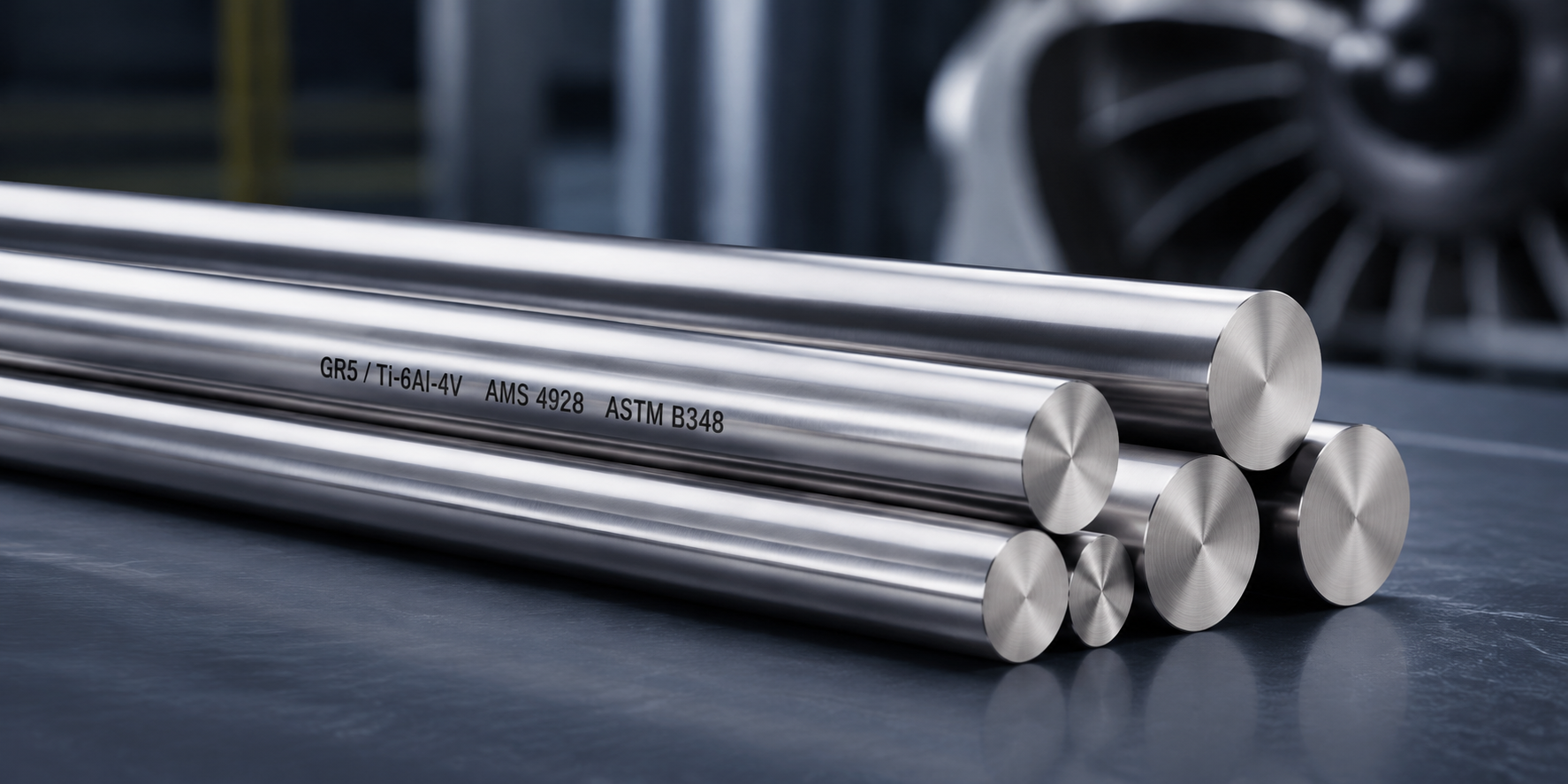
Is Grade 5 Titanium Bar a Key Material for Aviation Applications from Fuselage to Engine?
Gr5 Titanium rod
Grade 5 titanium bar (Ti-6Al-4V) is an irreplaceable critical material in modern aerospace manufacturing due to its outstanding specific strength, fatigue resistance, and high-temperature stability. When an aircraft cruises at 900 kilometers per hour at an altitude of 10,000 meters, its structural components are exposed to extreme operating conditions, including temperatures as low as -55 °C, an atmospheric pressure of approximately 0.26 atm, and cyclic stress endured for tens of thousands of cycles. In such harsh service environments, Grade 5 titanium bar plays a vital role in ensuring structural reliability and performance.For aircraft ranging from the Boeing 787 Dreamliner to the Airbus A350 XWB, titanium alloys account for 9% to 14% of the total structural weight (including sheets, forgings, fasteners, and other forms), among which Grade 5 titanium bar serves as a key component. This article comprehensively analyzes six core application scenarios of Grade 5 titanium bar in the aerospace sector, providing technical references for material selection and process optimization for aerospace manufacturers.
1. Load-Bearing Applications in Airframe Structural Components
1.1 Fuselage Frames and Bulkhead Systems
Fuselage frames act as the skeleton that maintains aircraft profile and transmits loads. Annealed Grade 5 titanium bar (room temperature test, ASTM B348) is fabricated into frame components via precision forging. With a density of only 4.43 g/cm³, the finished parts deliver a yield strength exceeding 825 MPa. In Boeing 777 aircraft, a single titanium alloy bulkhead achieves a weight reduction of 40% while meeting the fatigue life requirement of 60,000 takeoff and landing cycles specified by airworthiness standards, and it is verified to satisfy more stringent service requirements. Its low coefficient of thermal expansion (8.6 × 10⁻⁶ / °C) guarantees excellent dimensional stability under drastic temperature changes.
1.2 Auxiliary Landing Gear Structural Components
Landing gears bear the full weight of the aircraft and impact loads during landing. Grade 5 titanium bar is mainly applied to non-primary load-bearing parts of landing gears, including auxiliary connecting components, torque links and bushings. Components machined from large-size forged Grade 5 titanium bar with a diameter ranging from φ100 mm to φ300 mm reach a hardness of 280~340 HB and a tensile strength above 895 MPa after heat treatment. Compared with conventional 300M steel of equivalent strength grade, these components reduce weight by 35% and feature remarkably enhanced corrosion resistance with superior performance in salt spray environments, which cuts down maintenance frequency and total life-cycle costs.
1.3 Wing-to-Fuselage Joints
This is one of the most complex stress-bearing areas on an aircraft. Large-scale forged wing-to-fuselage joints are primarily made of specialized titanium alloys such as TA15, while Grade 5 titanium bar is widely used for small and medium-sized structural parts. After multi-directional die forging, the α+β duplex microstructure of Grade 5 titanium bar retains good creep resistance at elevated temperatures. Optimized structural design enables uniform stress distribution and reduces fatigue crack growth rate.
Table 1: Performance Comparison of Grade 5 Titanium Bar for Airframe Structural Components (Typical Engineering Values)
Structural Component
Conventional Material
Grade 5 Titanium Bar
Weight Reduction
Service Life Improvement (Applicable Conditions)
Fuselage Bulkhead
7075 Aluminum Alloy
Ti-6Al-4V Forging
Approx. 40%
Fatigue life increased by approximately 3 times (based on typical flight load spectrum, 10⁷ cycles)
Landing Gear Strut
300M High-Strength Steel
Large-Diameter Grade 5 Bar
Approx. 35%
Corrosion life increased by approximately 5 times (ASTM B117 salt spray test, 5000-hour comparison)
Wing-to-Fuselage Joint
TA15 Titanium Alloy
Precision Forged Grade 5 Component
Approx. 15%
Crack growth resistance improved by approximately 60% (per Paris law, ΔK=10MPa√m)
Note: Weight reduction data is based on components designed for identical structural strength; actual values vary with design details.
Service life improvement results are obtained from laboratory accelerated tests and limited field statistics. Actual service performance is affected by load, operating environment, maintenance and other factors, for reference only.
2. High-Temperature Resistant Applications for Aeroengine Hot Section Components
2.1 Compressor Disks and Blades
The operating temperature of aeroengine compressors is generally below 400 °C, the maximum long-term safe service temperature of Grade 5 titanium bar, and the rotational speed exceeds 15,000 r/min. Grade 5 titanium bar is processed into compressor disks through forging in the two-phase region followed by solution and aging heat treatment, with grain size controlled to ASTM Grade 6~8. The finished disks maintain a tensile strength over 895 MPa at high temperatures. Its low density lowers the inertial force of blades and improves the engine thrust-to-weight ratio.
2.2 Fan Casings and Compressor Casings
Fan casings and front compressor casings withstand temperature differences and structural loads. Casing rings machined from Grade 5 titanium bar serve as structural supports. The low thermal conductivity (7.2 W/(m·K)) of titanium alloy reduces outward heat transfer. It should be noted that turbine casings are entirely manufactured from superalloys, and titanium alloys are only adopted for low-temperature sections.
2.3 Fuel Lines and Hydraulic Fittings
High-pressure fuel lines and hydraulic fittings in engine accessory systems operate continuously under vibration, temperature fluctuation and corrosive media. Pipe fittings machined from φ8 mm to φ30 mm cold-drawn Grade 5 titanium bar feature a surface roughness of Ra 0.8 after precision turning and polishing, delivering excellent sealing performance on mating surfaces. It exhibits far better resistance to aviation kerosene and Skydrol hydraulic fluid than stainless steel.
3. High-Reliability Applications for Fastener Systems
3.1 Bolts and Nuts
Hundreds of thousands of fasteners are installed on aircraft structures. High-strength bolts manufactured from Grade 5 titanium bar via cold heading and thread rolling maintain stable preload within the temperature range of -55 °C to 120 °C. Its non-magnetic property prevents electromagnetic interference with airborne electronic equipment. A single titanium bolt achieves a weight reduction of 65% compared with steel bolts. The total weight of the fastener system on Boeing 787 is reduced by more than 1 ton. Aerospace fasteners are manufactured in compliance with NAS, MS, AN and other industry standards.
3.2 Rivets and Pins
Grade 5 titanium rivets are used to fasten aircraft skins and frames. Their superior shear strength and tensile strength ensure reliable connections. Pins take advantage of the high fatigue limit of titanium alloy and resist fatigue crack initiation under alternating loads. More than 30,000 titanium rivets are applied across the Airbus A350 XWB fleet, with no failure recorded after 100,000 flight cycles.
3.3 Clamps and Holders
Clamps for engine pipeline systems are stamped from Grade 5 titanium bar and joined by gas tungsten arc welding for high-quality connections. Its low coefficient of thermal expansion enables clamps to maintain stable clamping force during temperature changes, preventing pipeline loosening and leakage. Titanium alloy clamps are qualified for service at temperatures ranging from -55 °C to 150 °C.
Table 2: Typical Specifications of Grade 5 Titanium Bar Fasteners (Engineering Reference)
Fastener Type
Specification Range
Strength Grade
Operating Temperature
Weight Reduction
High-Strength Bolt
M6~M20
Tensile Strength ≥895MPa (ASTM F468)
-55 ℃~150 ℃
65% vs. Steel
Structural Rivet
φ4~φ8
Shear Strength ≥800MPa
-55 ℃~120 ℃
55% vs. Steel
Pipe Clamp
25.4~76.2mm
Tensile Strength ≥895MPa
-40 ℃~150 ℃
60% vs. Stainless Steel
4. Impact Resistant Applications for Landing Gear Systems
4.1 Auxiliary Landing Gear Components and Bushings
Auxiliary support parts and bushings for landing gear shock absorbers are machined from Grade 5 titanium bar. Components precision-turned from φ150 mm to φ250 mm hot-rolled Grade 5 titanium bar achieve a surface microhardness of 500 HV after nitriding treatment, with significantly improved wear resistance. Grade 5 titanium bar balances high tensile strength and toughness to avoid fracture under extreme loads.
4.2 Torque Links and Rocker Arms
Torque links for landing gear retraction and extension mechanisms require sufficient impact toughness at temperatures as low as -40 °C. The ductile-brittle transition temperature of Grade 5 titanium bar is below -100 °C, ensuring favorable ductility in extremely cold environments. After adopting titanium forgings for Airbus A320 landing gear torque links, each component cuts weight by approximately 1.8 kg, and no fatigue cracks have been detected over a 20-year service period.
4.3 Wheel Shafts and Sleeves
Aircraft wheel shafts endure complex bending, torsion and friction loads during takeoff and landing. Wheel shafts machined from Grade 5 titanium bar are treated by shot peening, forming a residual compressive stress layer with a depth of 0.3 mm that effectively inhibits fatigue crack initiation. The low density reduces the inertia of rotating parts and improves the response speed of braking systems.
5. Corrosion Resistant Applications for Hydraulic and Fuel Systems
5.1 High-Pressure Fuel Pump Housings
The operating pressure of aerospace fuel pumps is generally below 100 bar. A stable TiO₂ passive film forms on the surface of pump housings made from Grade 5 titanium bar under the flushing of aviation kerosene, with a corrosion rate lower than 0.005 mm per year. These components deliver a much longer service life than aluminum alloy pump housings and greatly extend maintenance intervals according to field engineering data.
5.2 Hydraulic Actuator Pistons
Hydraulic actuators for aircraft control systems perform frequent reciprocating motions at temperatures from -55 °C to 70 °C. Piston rods turned from Grade 5 titanium bar have a surface roughness of Ra 0.4. Combined with precision sealing rings, zero leakage is achieved. Its excellent chemical compatibility with Skydrol phosphate ester hydraulic fluid prevents seal failure and system contamination caused by corrosion.
5.3 Fuel Filter Frames
Fuel filter frames for fuel systems require high strength, corrosion resistance and light weight. Mesh frames are fabricated from φ6 mm to φ12 mm small-diameter Grade 5 titanium bar via laser cutting and gas tungsten arc welding. The design increases filtration area and reduces pressure drop. The chemical inertness of titanium alloy prevents catalytic degradation of fuel additives and maintains stable fuel quality.
Table 3: Application Comparison of Grade 5 Titanium Bar in Fuel and Hydraulic Systems (Engineering Reference)
System Component
Operating Conditions
Advantages of Grade 5 Titanium Bar
Service Life Comparison (Applicable Conditions)
High-Pressure Fuel Pump
200~300 bar operating pressure
TiO₂ passive film for anti-erosion performance
Approximately 4 times that of aluminum alloy (bench test for a certain type of high-pressure pump, continuous operation for 1000 hours at fuel temperature of 80 °C)
Hydraulic Piston
Temperature variation from -55 °C to 70 °C
Low corrosion rate and high machining precision
Approximately 3 times that of steel pistons (SAE J1176 dynamic seal reciprocating test, 10⁷ cycles)
Filter Frame
Fuel immersion plus vibration loading
Excellent chemical corrosion resistance
Approximately 5 times that of stainless steel (simulated fuel immersion plus 50Hz vibration, pitting depth comparison after 500 hours)
6. Lightweight Applications for Airborne Equipment Installation
6.1 Electronic Equipment Brackets
Mounting brackets for avionics, radar antennas and other airborne equipment must meet requirements for high strength, light weight and electromagnetic compatibility. Complex-profile brackets milled from Grade 5 titanium bar deliver a specific strength 1.6 times that of aluminum alloy. Its non-magnetic property eliminates interference with navigation equipment, and such brackets are widely used in the cockpit of Boeing 787 aircraft.
6.2 Seat Tracks and Latches
Commercial aircraft seat systems must ensure restraint system integrity under 16g impact loads in compliance with FAR 25.561. Seat tracks and latch mechanisms machined from Grade 5 titanium bar reduce the weight of each assembly while maintaining structural strength. For a 300-seat airliner, the total weight reduction reaches hundreds of kilograms, which helps lower fuel consumption.
6.3 Cargo Door Locking Devices
Locking mechanisms for cargo doors withstand large tensile loads generated by positive and negative pressure differentials during flight. Lock hooks and pins made from precision-forged Grade 5 titanium alloy withstand 200,000 opening and closing cycles in fatigue tests. The material features outstanding resistance to stress corrosion cracking and ensures long-term reliable operation in humid and salt spray environments.
Conclusion
Grade 5 titanium bar is primarily applied to fuselage bulkheads, auxiliary landing gear parts, fan casings, fasteners, fuel and hydraulic components, as well as airborne equipment brackets in the aerospace industry. It achieves an optimal balance among strength, toughness, corrosion resistance and lightweight performance. However, Grade 5 titanium is not suitable for components subjected to extreme high temperature or ultra-high impact loads, such as main landing gear struts and turbine casings. Its maximum long-term operating temperature shall be controlled below 400 °C. Rational material selection and process optimization are essential to fully leverage the performance advantages of Grade 5 titanium bar.
FAQ
Q1: How to define the material selection boundary between Grade 5 titanium bar and 7000-series aluminum alloy for airframe structures?
Grade 5 titanium bar shows prominent comprehensive performance advantages for components operating at temperatures above 120 °C, under high stress, high cyclic fatigue or severe corrosive environments. Aluminum alloys feature lower cost for components working under moderate loads at room temperature. Material selection shall take temperature, fatigue load, corrosion condition and specific strength into comprehensive consideration, rather than relying solely on a single stress threshold.
Q2: What are the special grain size requirements for Grade 5 titanium bar used in aeroengines?
Rotating components such as compressor disks require a grain size of ASTM Grade 6~8, which is obtained via forging in the two-phase region instead of beta forging. Coarse grain structure will lead to severe degradation of fatigue performance, which is a critical inspection item for aerospace certification.
Q3: How to verify the batch stability of Grade 5 titanium alloy fasteners?
In addition to conventional mechanical property tests, salt spray corrosion tests, vibration fatigue tests and hydrogen content detection (≤ 0.010%) shall be conducted. These tests ensure consistent performance of products from different batches under extreme operating conditions and mitigate airworthiness certification risks caused by material property fluctuations.
Contact Us
Baoji Titanium Valley Titanium Nickel Zirconium Material Processing Co., Ltd. is a professional manufacturer and supplier of Grade 5 titanium bar. Equipped with an annual production capacity of 20,000 metric tons and Italian Danieli precision rolling lines, we supply high-quality products complying with ASTM, GB, EN and other international standards for global clients. We provide full-cycle services including customized specifications, surface treatment and technical support. A complete range of in-stock specifications enables rapid response to project demands. Feel free to contact us for detailed technical solutions and quotations: sales@titaniumvalleys.com
References
Wang Jinyou, Ge Zhiming, Zhou Yanbang. Titanium Alloys and Their Processing Technology[M]. Beijing: Aviation Industry Press, 2000.
Liu Bocao, Wu Xueren, Yan Minggao. Aerospace Materials Science[M]. Beijing: Beihang University Press, 2005.
Zhao Yongqing, Hong Quan, Ge Peng. Titanium Alloy Materials and Applications[M]. Changsha: Central South University Press, 2011.
Editorial Board of Aeroengine Design Handbook. Aeroengine Design Handbook: Volume 5, Materials[M]. Beijing: Aviation Industry Press, 2002.
ASTM B348-21 Standard Specification for Titanium and Titanium Alloy Bars and Billets.
AMS 4928 – Titanium Alloy Bar, Wire, and Forgings.