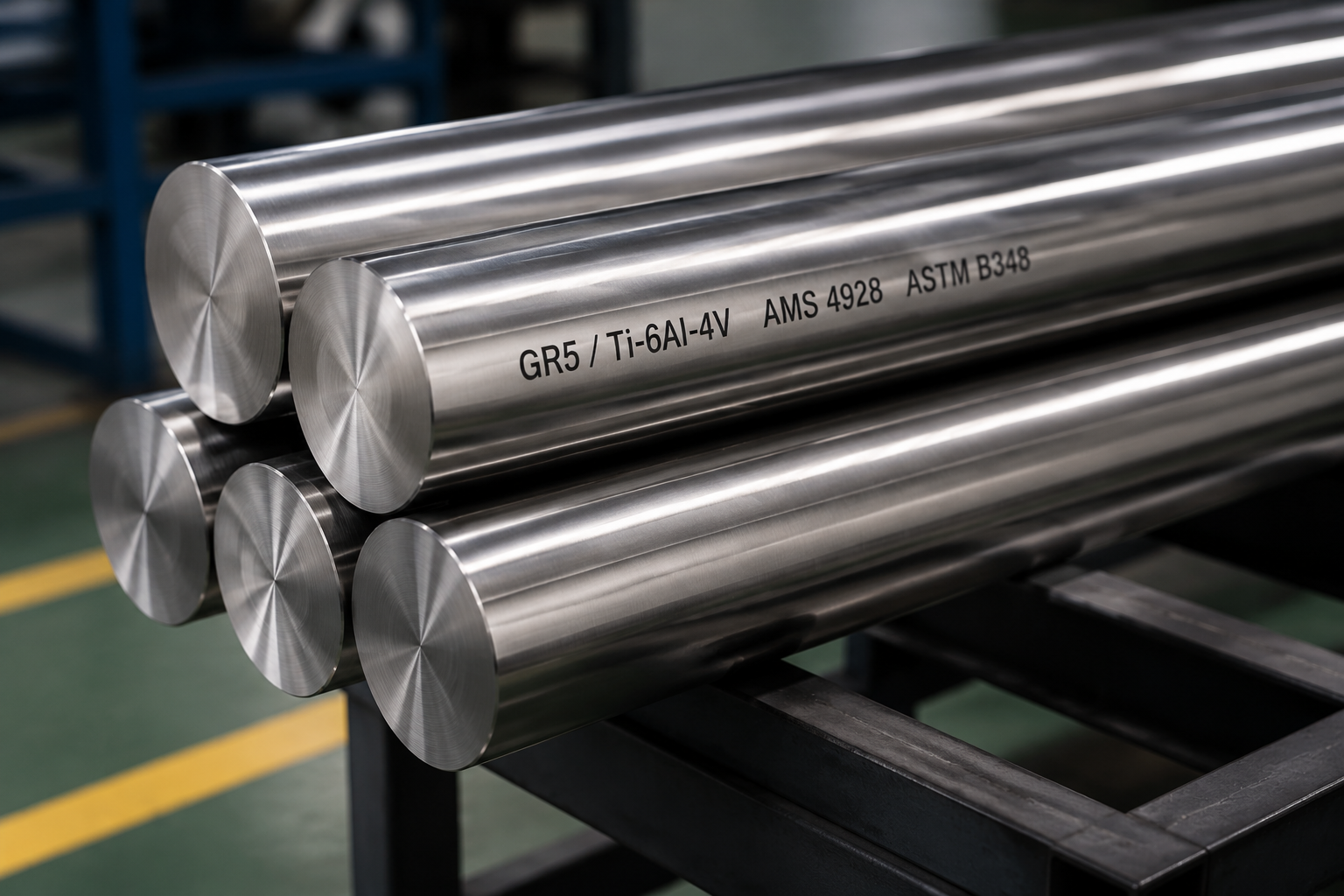
Is Grade 5 Titanium Bar a Key Material for High-Strength Machinery?

Grade 5 titanium bar (Ti-6Al-4V) plays a decisive role in modern high-strength machinery industries, where material selection directly determines the performance limit and service life of equipment. Featuring an exceptional strength-to-weight ratio, superior fatigue performance, and outstanding corrosion resistance, it has become a preferred material for high-end manufacturing sectors including aerospace, precision engineering, and marine applications.This α+β titanium alloy maintains structural stability at temperatures up to 400 °C (the maximum long-term service temperature; short-term service at 450–500 °C is only permitted under specific static working conditions). In the annealed condition, its minimum room-temperature tensile strength reaches 895 MPa, far exceeding that of conventional metallic materials, while its density is only about 60% of that of ordinary carbon steel.When equipment operates under combined extreme conditions such as heavy loads, complex working modes, and harsh environments, Grade 5 titanium bar provides an optimal engineering solution for balancing performance and weight reduction, effectively mitigating the risk of material failure associated with traditional materials under extreme service conditions.
1. Why Grade 5 Titanium Bar Is Preferred for High-Strength Machinery

1.1 Optimal Balance Between Strength and Weight

The design of traditional high-strength machinery has long been restricted by a core dilemma: increased load-bearing capacity inevitably leads to higher structural weight. The specific strength of annealed Grade 5 titanium bar at room temperature is approximately 202 MPa·cm³/g, higher than that of conventional quenched and tempered high-strength steel at about 138 MPa·cm³/g. It can reduce structural weight by 30% to 40% under equivalent load conditions, subject to specific structural designs. This advantage is particularly prominent for rotating parts and reciprocating mechanisms. The substantial reduction of inertial loads directly cuts energy consumption and improves response speed.

1.2 Material Stability Under Complex Operating Conditions

High-strength machinery often operates under superimposed multi-stress environments, including fatigue stress induced by alternating loads, thermal stress caused by temperature fluctuations, and chemical erosion from corrosive media. A nanometer-scale TiO₂ passive film spontaneously forms on the surface of Grade 5 titanium bar, which effectively isolates corrosive media such as chloride ions and seawater under normal conditions and extends service life in uniform corrosion environments. It should be noted that localized corrosion may still occur under conditions of high stress, crevice environments or hydrogen embrittlement susceptibility, so corresponding protective measures shall be adopted during design.

1.3 Life-Cycle Cost Advantages

Despite a higher initial procurement cost, Grade 5 titanium bar delivers economic benefits throughout the equipment service life. It features a high fatigue limit. In standard axial fatigue tests with 10⁷ cycles, its fatigue strength accounts for 50% to 60% of the tensile strength. This characteristic extends the inspection and maintenance intervals of key components. For instance, the maintenance cycle of a petrochemical pump shaft increased from 18 months to 36 months after adopting Grade 5 titanium, based on data collected under designated working conditions. Reduced downtime and maintenance frequency lower production losses. Its excellent corrosion resistance eliminates repeated application of protective coatings, further cutting operational and maintenance costs.

2. Key Applications of Grade 5 Titanium Bar in Precision Mechanical Systems

2.1 Material Upgrade for High-Speed Rotating Shaft Components

High-speed rotating parts such as precision machine tool spindles and turbocharger rotating shafts impose stringent requirements on materials. Spindles manufactured from Grade 5 titanium bar generate lower centrifugal stress and vibration amplitude compared with steel spindles of the same dimensions due to its low density. Its coefficient of linear thermal expansion is 8.6 × 10⁻⁶/°C within the temperature range from room temperature to 300 °C, ensuring superior dimensional stability at high rotating speeds and remarkably improved retention of machining accuracy.

Table 1: Property Comparison Between Grade 5 Titanium Bar and Common Mechanical Materials (Room Temperature, Annealed or Typical Condition)

Performance ParameterGrade 5 Titanium Bar (Annealed)42CrMo Steel (Quenched and Tempered)7075 Aluminum Alloy (T6 Solution and Aging)
Density (g/cm³)4.437.852.81
Tensile Strength (MPa)≥8951080572
Specific Strength (MPa·cm³/g) ¹202138203
Fatigue Limit (MPa) ²510540220
Corrosion Resistance ³ExcellentRequires protectionFair

2.2 Fatigue-Sensitive Structures for Automated Equipment

Components including robot arm joint shafts and precision guide rail sliders are subjected to cyclic loads of millions of cycles. Under specified load conditions, the fatigue crack growth rate of Grade 5 titanium bar is approximately one-third of that of aluminum alloy, which extends the service life of these critical connecting parts. In semiconductor manufacturing equipment, titanium alloy guide rails present lower wear rate than stainless steel counterparts under designated test conditions, helping maintain long-term positioning accuracy.

2.3 Structural Supports for Extreme Temperature Environments

Support frames for cryogenic equipment and high-temperature heat treatment furnaces require materials to retain stable performance over a wide temperature range. The strength of Grade 5 titanium bar increases at the liquid nitrogen temperature of -196 °C with a slight decrease in ductility, and it still maintains high room-temperature strength at 400 °C. Its excellent temperature stability reduces assembly stress caused by thermal expansion and enhances the reliability of precision equipment under cyclic temperature conditions.

3. Material Innovation in Marine Engineering and Marine Supporting Industries

3.1 Dual Challenges of Pressure Resistance and Corrosion Resistance for Deep-Sea Equipment

Structural frames of deep-sea robots and drive shafts of underwater valves endure both high-pressure seawater corrosion and mechanical stress. Hydrostatic pressure does not alter the yield strength of metallic materials, but high-pressure environments may aggravate crevice corrosion or stress corrosion. The passive film on Grade 5 titanium bar remains stable in seawater with high chloride ion concentration. In a marine engineering test, a drive shaft made of titanium alloy for a deep-sea sampler operated continuously for 800 hours without corrosion, while pitting corrosion occurred on a 316L stainless steel shaft after 120 hours of operation. The test was conducted under simulated seawater immersion and cyclic loading conditions.

3.2 Lightweight Retrofit for Marine Power Systems

The adoption of titanium alloy for key transmission components such as marine diesel engine connecting rods and propeller shafts has become an industry trend. A Grade 5 titanium alloy propeller shaft with a diameter of 80 mm and a length of 2 m reduces weight by approximately 42 kg compared with a nickel-chromium-molybdenum steel shaft of the same size. The weight reduction helps improve ship stability and may increase fuel economy by about 3%, which shall be referenced in combination with overall vessel design. Benefiting from excellent resistance to seawater erosion, the maintenance cycle of titanium alloy shaft components is extended from 18 months to 36 months, based on accelerated tests for marine propeller shafts.

Table 2: Service Life Comparison of Grade 5 Titanium Bar in Marine Engineering Applications (Typical Test Values)

Application ComponentFailure Mode of Traditional MaterialsAdvantages of Grade 5 Titanium BarService Life MultiplierTest Standards and Conditions
Deep-sea Valve StemStress corrosion crackingResistance to chloride ion erosion3.5 timesTested per ASTM G36 (Boiling Magnesium Chloride Stress Corrosion Test) under simulated deep-sea conditions, verified via valve replacement tests
Propeller ShaftWear and pitting corrosionHigh hardness plus stable passive film2.8 timesTested per ASTM G32 (Vibratory Cavitation/Erosion Corrosion Test), data from accelerated tests for marine propeller shafts
Mooring ConnectorFatigue fractureHigh fatigue strength4.2 timesTested per ASTM E466 (Rotating Bending Fatigue Test) for mooring chains, stress ratio R=0.1

3.3 Durability Assurance for Seawater Desalination Systems

Core components such as high-pressure pump shafts and multi-stage pump impellers of reverse osmosis seawater desalination units operate in seawater with a salinity of 3.5% for long periods. Pump shafts manufactured from Grade 5 titanium bar show minor increase in surface roughness after 5 years of operation, while 316L stainless steel shafts require replacement within a shorter service period. In addition, the non-magnetic property of titanium alloy helps minimize measurement errors of electromagnetic flowmeters under certain working conditions.

4. Extreme Performance Verification for Aerospace Applications

4.1 Applications for Low-Pressure Compressor Components of Aeroengines

The operating temperature of low-pressure compressor disks and shafts of aeroengines is generally below 400 °C. Grade 5 titanium bar delivers good creep resistance and thermal stability within this temperature range. Compared with nickel-based superalloys, the low density of titanium alloy lowers the centrifugal stress of rotating parts and improves the engine thrust-to-weight ratio. It must be noted that Grade 5 titanium alloy is prohibited for use in high-temperature turbine sections, and is only applied to front compressor sections and fan components.

4.2 Auxiliary Structural Components of Aircraft Landing Gear

Torque links, connecting rods and other auxiliary parts of aircraft landing gear bear severe impact loads during takeoff and landing. Grade 5 titanium bar features high toughness with a typical V-notched impact energy of approximately 60 J at room temperature per ASTM E23 standard, as well as superior fatigue resistance, ensuring long service life. Forged titanium alloy bars are inspected by ultrasonic testing in compliance with ASTM E165 and other aerospace specifications to control internal defects, meeting the reliability requirements for aerospace-grade applications.

4.3 Multifunctional Integrated Structural Frames for Spacecraft

Structures including satellite support frames and rocket interstage sections require materials to combine high strength, low density, radiation resistance and thermal shock resistance. Grade 5 titanium bar exhibits excellent dimensional stability under thermal cycling from -160 °C to +120 °C. Its coefficient of linear thermal expansion from room temperature to 300 °C is approximately 50% of that of aluminum alloy. Its non-magnetic property eliminates interference with precision magnetic measuring equipment, making it an ideal material for spacecraft structures.

5. Precision Applications in Medical Devices and High-End Equipment Manufacturing

5.1 Biocompatibility Requirements for Surgical Instruments

Medical devices such as orthopedic fixation rods and spinal correction bars impose strict biocompatibility requirements on materials. The TiO₂ oxide layer formed on the surface of Grade 5 titanium bar features excellent biological inertness and facilitates favorable osseointegration after implantation. The surface roughness of electrolytically polished titanium alloy can reach Ra 0.2 μm, which reduces bacterial adhesion. Specific performance indicators vary with component locations and surface treatment processes.

5.2 Thermal Stability for Precision Measuring Equipment

Precision positioning components including guide rails of coordinate measuring machines and support legs of optical platforms require extremely low thermal deformation. The coefficient of linear thermal expansion of Grade 5 titanium bar is about half that of aluminum alloy. When the ambient temperature fluctuates by ±2 °C in a constant-temperature workshop, the thermal deformation of a 3-meter-long titanium alloy guide rail is far lower than that of an aluminum alloy counterpart, ensuring long-term stability of measurement accuracy.

5.3 Environmental Adaptability for Outdoor High-End Equipment

Connecting parts of professional mountaineering equipment and structural components of polar research equipment need to maintain stable performance under extreme climatic conditions. Grade 5 titanium bar retains good ductility at -40 °C and is immune to ultraviolet aging. In a durability test conducted by an outdoor equipment manufacturer, titanium alloy connecting shafts worked continuously for 3 years in high salt spray environments without corrosion, while aluminum alloy parts required replacement after 6 months.

Table 3: Summary of Grade 5 Titanium Bar Applications in High-End Equipment

Application FieldKey Performance RequirementsCorresponding Advantages of Grade 5 Titanium Bar (Specific Data)Typical Application CasesOperating Conditions and Reference Standards
Medical ImplantsBiocompatibility + High Strength• Osseointegration: Compliant with ISO 10993

• Non-toxicity: Cytotoxicity Grade 0

• Tensile Strength ≥895 MPa (Annealed)

Spinal Fixation SystemHuman physiological environment (37 °C, pH 7.4, protein-containing medium), ASTM F136 (Surgical Implants)
Precision MeasurementThermal Stability + Rigidity• Coefficient of Linear Thermal Expansion: 8.6×10⁻⁶/°C (20~300 °C)

• Modulus of Elasticity: 110 GPa

• Dimensional Stability: ±0.5 μm/100 mm per 10 °C temperature difference

Guide Rails of Coordinate Measuring MachinesConstant-temperature workshop (20±0.5 °C), no thermal deformation during long-term operation, referenced to VDI/VDE 2617
Polar EquipmentLow-Temperature Toughness + Corrosion Resistance• Impact Energy at -40 °C: ≥47 J (V-notch)

• Salt Spray Resistance: No pitting after 5000 hours per ASTM B117

• Tensile Strength Retention Rate: ≥95% at -40 °C

Connecting Parts of Polar Drilling EquipmentPolar environment (-40 °C, salt spray, ice and snow friction), referenced to ISO 19901 (Offshore Structures)
Semiconductor ManufacturingCleanliness + Dimensional Accuracy• Outgassing Rate: <10⁻⁹ Pa·m³/s (Ultra-high vacuum)

• Surface Roughness: ≤Ra 0.4 μm (Bright polished)

• Dimensional Tolerance: ±0.01 mm

Wafer Transfer Robotic ArmsClass 5 cleanroom, vacuum degree of 10⁻⁷ Pa, non-magnetic, referenced to SEMI standards

6. Techno-Economic Analysis for Material Selection

6.1 Performance Matching Evaluation System

Different working conditions prioritize distinct material properties. For components under high-frequency alternating loads, fatigue limit and crack growth rate shall be the primary evaluation indicators. For corrosive environments, focus shall be placed on passive film stability. Creep resistance is critical for high-temperature applications. Thanks to its comprehensive performance, Grade 5 titanium bar usually achieves high scores in multi-factor weighted evaluation. Meanwhile, galvanic corrosion risks shall be taken into account when multiple materials are used in combination.

6.2 Full-Life Cycle Cost Calculation Model

Material procurement cost only accounts for 15% to 25% of the total expenditure over the equipment life cycle, while maintenance cost and production loss caused by downtime can exceed 40%. A petrochemical plant replaced stainless steel pump shafts with Grade 5 titanium bar. Although the unit material cost increased by approximately 60%, the annual maintenance cost decreased by about 70%, and the total cost of ownership dropped by around 42% within three years. The calculation is based on the following assumptions: equipment interest rate of 5%, inflation rate of 2%, and maintenance frequency reduced to one-third of the original level. Actual figures vary among different enterprises. Such economic advantages are more prominent for critical equipment and continuous production lines.

6.3 Supply Chain Stability Assurance

A mature international standard system has been established for Grade 5 titanium bar, including ASTM B348 (Standard Specification for Titanium and Titanium Alloy Bars and Billets) and AMS 4928 (Titanium Alloy Bar, Wire, and Forgings for Aerospace Service). It is supported by a sound global supply chain. Compared with niche special alloys, Grade 5 titanium bar features stable raw material supply and controllable delivery cycles. Large-scale production keeps its unit cost relatively steady, while its price is subject to periodic fluctuations of sponge titanium raw material costs.

Conclusion

Combining high strength, excellent corrosion resistance and superior fatigue performance, Grade 5 titanium bar has become a vital material for high-strength machinery. It facilitates the development of equipment manufacturing towards lighter weight, higher strength and longer service life, covering applications ranging from deep-sea equipment and aeroengine low-pressure compressor components to precision medical devices and automated production lines. During material selection, it shall be noted that the maximum continuous operating temperature of Grade 5 titanium bar is 400 °C, and it is not applicable for extreme working conditions such as main landing gear struts. Additional protective measures are required for service in crevice environments and high-stress corrosion conditions.

FAQ

Q1: What are the essential differences in mechanical properties between Grade 5 titanium bar and commercially pure titanium?

Grade 5 is an α+β duplex titanium alloy strengthened by the addition of 6% aluminum and 4% vanadium. Its minimum tensile strength in the annealed condition reaches 895 MPa, nearly twice that of annealed Grade 2 commercially pure titanium (approximately 345 MPa). It also maintains good ductility and weldability, making it more suitable for high-load structural components.

Q2: What is the actual service life of Grade 5 titanium bar in salt spray corrosive environments?

In standard ASTM B117 salt spray tests using 5% NaCl solution at 35 °C, no obvious corrosion occurs on the material surface after 3000 hours of testing. However, laboratory salt spray environments differ from actual marine service conditions featuring alternating wet and dry cycles, biological adhesion and applied stress. With proper structural design, Grade 5 titanium bar can operate stably for 10 to 15 years in practical marine engineering applications without additional protective coatings, far longer than the 3 to 5 year service life of 300-series stainless steel. Evaluation based on specific working conditions is recommended.

Q3: How to avoid rapid tool wear during machining?

Titanium alloy has low thermal conductivity, approximately one-quarter of that of steel, which leads to concentrated cutting heat. It is recommended to adopt cemented carbide or ceramic cutting tools. The cutting speed for rough machining is set at 30~50 m/min, and a moderately higher speed can be applied for finish machining. Adopt high-flow water-based cutting fluid for forced cooling. Reducing the feed rate by 20% can extend tool service life by 2 to 3 times. Specific machining parameters shall be adjusted according to machine tool performance and workpiece dimensions.

Contact Us:

Baoji Titanium Valley Titanium Nickel Zirconium Material Processing Co., Ltd. is a professional manufacturer of Grade 5 titanium bar. Equipped with Italian Danieli rolling lines with an annual production capacity of 20,000 metric tons, we supply products covering a full size range from Φ4 mm to Φ300 mm. All products are manufactured in strict compliance with ASTM B348 standards, and Material Test Reports (MTC) as well as Non-Destructive Testing (NDT) reports are available. For technical consultation and customized solutions, please contact sales@titaniumvalleys.com. Our engineering team will provide professional material selection recommendations.

References

  1. Cao Chunxiao, Ye Hengqiang. Application and Development of Titanium Alloys in Aerospace Industry[M]. Beijing: National Defense Industry Press, 2020.
  2. Zhao Yongqing, Ge Peng. Design Principles and Applied Technologies of Modern Titanium Alloy Materials[M]. Beijing: Chemical Industry Press, 2010.
  3. Wang Jinyou, Liu Yuyin. Application of Titanium Alloys in Ship and Marine Engineering[J]. Materials Protection, 2018, 51(5): 106-110.
  4. Zhang Baolin, Li Weidong. Research on Fatigue Properties and Fracture Mechanism of Titanium Alloys[J]. Journal of Aeronautical Materials, 2019, 39(2): 1-8.