
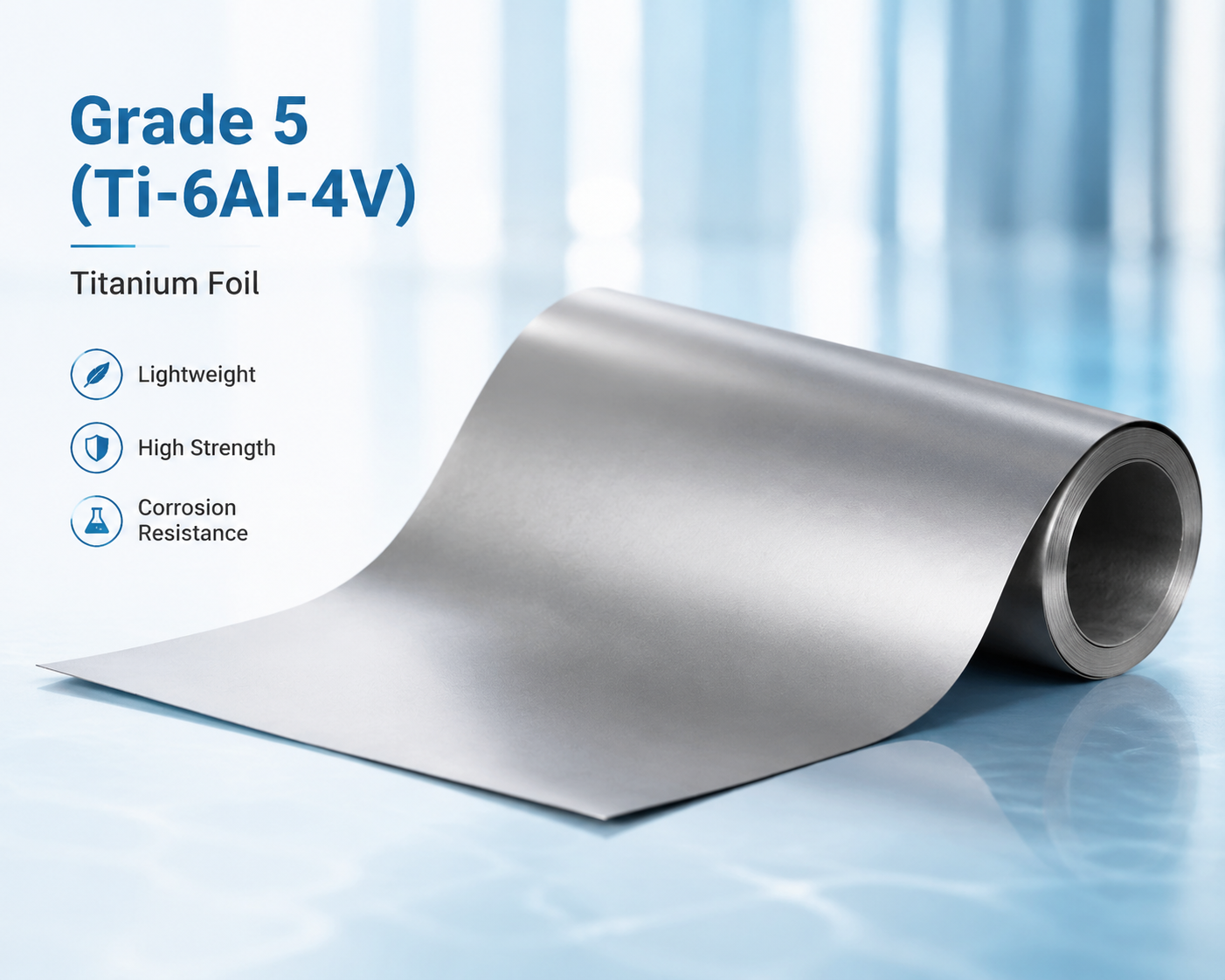
Quality inspection of Grade 5 (Ti-6Al-4V) titanium foil shall be comprehensively performed across five key dimensions: chemical composition, mechanical properties, dimensional accuracy, surface quality and metallographic structure. As an α+β duplex titanium alloy, annealed Grade 5 titanium foil shall meet the minimum requirements: tensile strength ≥ 895 MPa, yield strength ≥ 825 MPa, and elongation ≥ 10%. Thickness tolerances are classified and controlled in accordance with ASTM B265 based on material thickness and width. For instance, the typical thickness tolerance for foils ranging from 0.1 mm to 0.3 mm is ±0.01 mm, subject to specific standard provisions. Products for aerospace and medical applications require complete material test reports, compliance with ASTM B265 or dedicated aerospace titanium foil standards such as the AMS 4900 series, and verification via third-party laboratory testing. Professional inspection items include inductively coupled plasma optical emission spectrometry for chemical composition analysis, tensile testing for mechanical property verification, micro-focus X-ray inspection for internal defects (conventional ultrasonic testing is not applicable to ultra-thin foils), eddy current testing for surface and subsurface crack detection, and metallographic microscope observation for the uniformity of α+β phase distribution. These measures ensure the material complies with stringent requirements for high-end manufacturing.

I. Chemical Composition Analysis: Precision Testing of Alloying Elements in Grade 5 Titanium Foil
1. Verification of Major Alloying Element Content via Spectroscopic Analysis
Inductively Coupled Plasma Optical Emission Spectrometry (ICP-OES) is adopted to test the content of aluminum (5.5~6.75%) and vanadium (3.5~4.5%) in Ti-6Al-4V. Aluminum improves the high-temperature stability and oxidation resistance of the material, while vanadium stabilizes the β phase and enhances material strength. The content of alloying elements shall comply with the composition ranges specified in ASTM B265 instead of absolute deviation limits. For ultra-thin titanium foils, ICP-OES is preferred over direct reading spectroscopy, as direct reading spectroscopy may cause specimen burn-through or insufficient testing accuracy due to the extremely thin material thickness.
2. Control of Interstitial Elements: Strict Limits on Oxygen, Nitrogen, Carbon and Hydrogen Content
Interstitial elements directly affect the ductility and toughness of titanium foil. For industrial-grade Grade 5 titanium foil, the maximum limits are: oxygen ≤ 0.20%, nitrogen ≤ 0.05%, carbon ≤ 0.08%, and hydrogen ≤ 0.015%. Aerospace and medical implant grades impose stricter limits, including hydrogen ≤ 0.010% and oxygen ≤ 0.18%. Inert Gas Fusion (IGF) or infrared absorption methods are used for precise measurement. It should be noted that vacuum annealing can remove partial hydrogen content but cannot substantially reduce oxygen and nitrogen content, which are primarily introduced during melting and rolling processes.
3. Influence and Testing Standards for Iron Impurity Elements
Iron (Fe) is the primary controlled impurity element. ASTM B265 stipulates a unified maximum iron content of ≤ 0.30%. More stringent internal control limits (e.g., ≤ 0.25%) may be agreed upon for special applications such as electromagnetic shielding and medical implantation, though these are not mandatory per official standards. Wet chemical analysis or ICP-OES is applied for accurate quantification. X-ray Fluorescence (XRF) is only suitable for on-site rapid screening, as its results are greatly affected by surface conditions.
Table 1 Chemical Composition Requirements for Grade 5 Titanium Foil (Referencing ASTM B265/AMS 4911)
| Element | Standard Content (wt%) | Test Method | Applicable Standard | Material Grade | Impact of Exceeding Limits by Grade |
|---|---|---|---|---|---|
| Al | 5.5~6.75 | ICP-OES / Direct Reading Spectroscopy | ASTM B265 | Industrial / Aerospace / Medical | Unstable high-temperature performance and reduced stress rupture strength, especially for aero-engine components |
| V | 3.5~4.5 | ICP-OES / Direct Reading Spectroscopy | ASTM B265 | Industrial / Aerospace / Medical | Deviated material strength, which may lead to premature failure of structural parts |
| O | ≤ 0.20 | Inert Gas Fusion Method | ASTM B265 | Industrial | Material embrittlement and decreased elongation when oxygen content exceeds 0.20% |
| AMS 4911 (Aerospace) | Aerospace | Oxygen is strictly limited to ≤ 0.18%; excessive oxygen drastically reduces fatigue life | |||
| ASTM F136 (Medical) | Medical (ELI) | Oxygen ≤ 0.13%; excess oxygen impairs osseointegration and fatigue resistance | |||
| Fe | ≤ 0.30 | XRF / Chemical Analysis | ASTM B265 | Industrial / Aerospace / Medical | Deteriorated corrosion resistance, particularly in reducing acid and chloride environments |
| H | ≤ 0.015 | Inert Gas Fusion Method | ASTM B265 | Industrial | Increased risk of hydrogen embrittlement (stricter control required for high-stress components) |
| AMS 4911 (Aerospace) | Aerospace | Hydrogen ≤ 0.008%; excess hydrogen induces delayed cracking | |||
| ASTM F136 (Medical) | Medical | Hydrogen ≤ 0.005%; prevents hydrogen-induced failure after implantation |
1.Material grades in the table correspond to the listed standards: ASTM B265 for general industrial grade, AMS 4911 for aerospace grade, and ASTM F136 for medical implant Extra Low Interstitial (ELI) grade.
2.Actual acceptance limits may be stricter than standard requirements as specified in contractual agreements.
3.Test methods can be adjusted upon mutual agreement between suppliers and purchasers, provided the testing organizations hold valid qualifications.
II. Mechanical Property Testing: Verification of Strength and Toughness Indicators for Grade 5 Titanium Foil
1. Tensile Testing: Actual Verification of Tensile Strength and Yield Strength
For ultra-thin titanium foils (thickness < 0.2 mm), strip-specific specimens complying with ASTM E8/E8M shall be used to avoid fracture at clamping areas. The tensile rate is adjusted according to specimen dimensions, generally set between 0.5 mm/min and 2 mm/min. The typical tensile strength range of annealed Grade 5 titanium foil is 895~1035 MPa, with a specified minimum tensile strength of 895 MPa. Cold-worked foils deliver higher strength. Sampling rules: specimens shall be taken from different coils and different positions within the same production batch; cross-batch sampling is prohibited.
2. Elongation Testing: Evaluation of Material Ductility and Formability
Elongation (minimum requirement: ≥ 10%) reflects the plastic deformation capacity of the material. Short-gauge-length specimens (e.g., 25 mm gauge length) shall be adopted for ultra-thin foils with thickness ranging from 0.03 mm to 0.10 mm to prevent fracture at clamping sections caused by overlong gauge lengths. The elongation of annealed Grade 5 titanium foil is lower than that of annealed commercially pure titanium (≥ 20%). The elongation of cold-worked pure titanium also decreases, and material status shall be clearly indicated during comparative analysis.
3. Hardness Testing and Fatigue Performance Evaluation
Brinell Hardness (HB) testing is prohibited for titanium foil, as its large indentation and high test load will penetrate the thin material. Vickers Hardness (HV) is the mandatory test method. The typical Vickers hardness of annealed Grade 5 titanium foil ranges from 270 HV to 330 HV. Axial tension fatigue testing or plane bending fatigue testing shall be conducted for fatigue performance assessment; rotating bending fatigue testing is not applicable. Fatigue strength is affected by surface condition, stress ratio and heat treatment. The typical fatigue strength accounts for 50~60% of tensile strength, with test conditions (e.g., stress ratio R=0.1, frequency 20 Hz, room temperature) clearly documented.
III. Dimensional Accuracy and Flatness Quality: Core Control Indicators for Ultra-Thin and Wide Titanium Foil
1. Thickness Tolerance and Uniformity Inspection
In accordance with ASTM B265, thickness tolerances are categorized by material thickness range and width. For example, the tolerance is generally ±0.01 mm for foils with thickness of 0.1~0.3 mm and width ≤ 600 mm. A unified tolerance of ±0.005 mm does not conform to general standards, though it can be applied as a stricter internal control requirement with clear notation. For large-format products, a transverse thickness variation ≤ 0.003 mm is a high-level internal control indicator and not a universal standard requirement.
2. Flatness and Shape Defect Identification
Laser flatness testers or tension-based flatness inspection systems are used to measure flatness via chord height or wave height, with a common requirement of ≤ 2 mm/m. Straightedge measurement is only applied for rough on-site assessment due to limited precision.
3. Width and Slitting Quality Verification
The allowable width deviation is ±0.5 mm. Slit edges shall be straight and burr-free. A surface roughness Ra ≤ 1.6 μm for slit edges is only required for welding and precision assembly applications, rather than a general specification.
Table 2 Key Inspection Items for Dimensional Accuracy
| Dimensional Indicator | Inspection Tool | Accuracy Requirement | Common Defects |
|---|---|---|---|
| Thickness Tolerance | Laser / Contact Thickness Gauge | ± 0.005 mm | Uneven thickness and excessive thickness variation |
| Flatness | Laser Flatness Tester | ≤ 2 mm/m | Wavy edges and central slack |
| Width Deviation | Laser Edge Alignment System | ± 0.5 mm | Slitting burrs and edge deformation |
IV. Surface Quality Inspection: Professional Assessment of Cleanliness and Surface Condition
1. Inspection of Surface Oxidation and Contaminants
Surface oxide layers on Grade 5 titanium foil can be removed via pickling or mechanical polishing. There is no universal cleanliness standard for titanium materials; acceptance criteria are implemented per contractual agreements or internal specifications. Common surface finishes include pickled finish, bright (mirror) finish and matte finish. Grease and dust contaminants shall be removed by ultrasonic cleaning.
2. Non-Destructive Testing Technologies for Surface Defects
Eddy Current Testing (ET) detects surface and subsurface cracks, and high-frequency eddy current testing is effective for foils as thin as 0.03 mm. Fluorescent Penetrant Testing (PT) features high sensitivity and is suitable for components with complex geometries. Micro-focus X-ray testing is used to inspect internal defects such as inclusions and delaminations. Surface defect classification (Grade A/B/C) is defined by internal enterprise regulations and has no unified industry standard.
3. Surface Roughness and Finish Measurement
A surface profilometer is used to measure Ra values. The Ra value for bright finish is typically ≤ 0.8 μm. A Ra variation ≤ 0.2 μm within a single batch is classified as a high-grade internal control requirement.
V. Metallographic Structure and Microstructure Analysis: Ensuring Uniform Distribution of α+β Phases
1. Observation of Phase Morphology via Metallographic Microscope
The typical microstructure of fully annealed Grade 5 titanium foil consists of equiaxed α phase and grain boundary β phase, with the α phase volume fraction ranging from 80% to 90% depending on annealing parameters. Widmanstätten (lamellar) structure is formed due to overheating or improper forging, and massive coexistence of Widmanstätten structure and equiaxed structure is unacceptable. Specimens are etched with Kroll’s reagent for microscopic observation.
2. Grain Size Measurement and Grain Boundary Evaluation
Grain size is measured in accordance with ASTM E112. Grain size grades 6 to 9 correspond to an average grain diameter of 16~45 μm (Grade 6: approximately 45 μm; Grade 9: approximately 16 μm). Fine grains improve material strength and toughness but increase deformation resistance during subsequent cold working, which requires optimized processing parameters. Grain boundaries shall be distinct without continuous β phase networks.
3. Detection of Inclusions and Second-Phase Particles
Scanning Electron Microscopy (SEM) combined with Energy Dispersive Spectroscopy (EDS) is applied for analysis. Internal enterprise control indicators include Ti₃Al particle size ≤ 5 μm and inclusion area fraction ≤ 0.5%, which are not mandatory requirements of ASTM standards. Inclusions may act as crack initiation sources during heavy rolling deformation, while their impact is relatively minor under static loading conditions.
Table 3 Reference Indicators for Metallographic Inspection
| Metallographic Indicator | Standard Requirement | Test Method | Impact of Structural Defects |
|---|---|---|---|
| α Phase Morphology | Uniform distribution of equiaxed or lamellar structure | Optical Microscope (OM) | Non-uniform structure causes material anisotropy in performance |
| Grain Size | Grade 6 ~ 9 (10 ~ 50 μm) | ASTM E112 | Coarse grains reduce material toughness |
| β Phase Distribution | Grain boundary network without continuous chains | SEM / EBSD | Aggregated β phase acts as crack initiation sources |
| Inclusion Content | Area fraction ≤ 0.5 % | SEM + EDS | Reduced fatigue strength |
VI. Standard Compliance and Third-Party Certification: Establishment of a Complete Quality Traceability System
1. Comparative Verification of ASTM B265 and Aerospace Standards
ASTM B265 specifies the chemical composition, mechanical properties and test methods for Grade 5 titanium foil. Aerospace-grade titanium foil shall comply with the AMS 4900 series (AMS 4911 is only applicable to bars and forgings, not foils). Additional applicable standards include EN 2876 and JIS H4600, with all requirements clearly defined in relevant documents.
2. Authoritative Certification of Third-Party Testing Laboratories
Laboratories with ISO/IEC 17025 or NADCAP accreditation shall be selected for testing. ICP-OES is used for major alloying element analysis, and Inductively Coupled Plasma Mass Spectrometry (ICP-MS) for trace impurity detection. Complete test reports shall include melting batch numbers, performance data and metallographic images.
3. Material Certification and Quality Management System Documents
Suppliers shall provide Material Test Certificates (MTC) in compliance with ISO 9001 or AS9100 quality management systems. Medical implant-grade products require additional ISO 10993 biocompatibility testing, which is not required for general industrial-grade materials.
Conclusion
Quality inspection of Grade 5 titanium foil shall be conducted comprehensively across five aspects: chemical composition (compliant with ASTM B265 composition ranges), mechanical properties (minimum tensile strength of 895 MPa and minimum elongation of 10% for annealed products), dimensional accuracy (tolerances classified by thickness and width), surface quality (cleanliness and defect control), and metallographic structure (equiaxed α phase plus grain boundary β phase). Appropriate test methods shall be adopted in accordance with relevant standards: Vickers hardness testing instead of Brinell hardness testing, micro-focus X-ray testing for internal defects, axial or plane bending fatigue testing, and strip-specific tensile specimens. Proper selection of testing methods and standards ensures the material meets the rigorous requirements of high-end applications including aerospace and medical implantation.
FAQ
Q1: What are the differences in inspection requirements between Grade 5 titanium foil and Grade 2 commercially pure titanium foil?
Grade 5 titanium foil requires additional testing for aluminum and vanadium content. Its minimum tensile strength is 895 MPa, while the minimum tensile strength of Grade 2 pure titanium is 345 MPa. Metallographic inspection for Grade 5 focuses on the distribution of duplex α+β phases, whereas Grade 2 pure titanium features a single α phase structure. In terms of interstitial element control, the maximum oxygen limit for Grade 5 is 0.20%, compared with 0.18% for Grade 2. The maximum hydrogen content for aerospace and medical-grade Grade 5 titanium foil is limited to 0.010%.
Q2: How to perform non-destructive testing on 0.03 mm ultra-thin Grade 5 titanium foil?
Micro-focus X-ray transmission testing is used to detect internal defects such as inclusions and delaminations. High-frequency eddy current testing or fluorescent penetrant testing is applied for surface defect inspection. Laser holographic interferometry is mainly used to measure flatness deformation rather than defect detection. It should be noted that micro-focus X-ray testing has limited resolution for micro-delaminations, so combined testing methods are recommended.
Q3: How to judge the qualification of vacuum annealing treatment for Grade 5 titanium foil?
Qualified vacuum annealing products shall present an equiaxed α phase plus grain boundary β phase microstructure without continuous β phase chains, with Vickers hardness ranging from 270 HV to 330 HV. The surface color is silvery white or pale yellow; surface color shall not be used as the sole acceptance criterion since it is affected by multiple factors. Oxygen content analysis can measure total interstitial oxygen but cannot distinguish surface oxide oxygen from matrix dissolved oxygen, so supplementary surface spectroscopy analysis is required.
Contact Us
Baoji Titanium Valley Titanium Nickel Zirconium Material Processing Co., Ltd. operates an automated production line with an annual output of 3,000 tons, providing customized high-precision Grade 5 titanium foil with thickness ranging from 0.02 mm to 1.0 mm and width ranging from 15 mm to 680 mm. As an ISO-certified professional manufacturer, we are equipped with 750 mm twenty-high cold rolling mills and vacuum annealing furnaces to guarantee consistent batch quality and aerospace-grade standards. Contact us to obtain technical data sheets and sample testing services: sales@titaniumvalleys.com
References
1.Chen Zhenhua, Zhao Yongqing. Titanium Alloy Handbook [M]. Beijing: Chemical Industry Press, 2010. (Chapter 6: Mechanical Properties and Testing Methods of Ti-6Al-4V Alloy)
2.Zhang Guofu, Liu Ping. Processing and Quality Control of Titanium and Titanium Alloys [M]. Beijing: Metallurgical Industry Press, 2015. (Section 4: Thickness Tolerance and Industrial Standards for Titanium Foil)
3.Wang Hua, Li Ming. Inspection Standards and Certification System for Aerospace-Grade Grade 5 Titanium Foil [J]. Journal of Materials Engineering, 2018, 46(3): 55-62.
4.Huang Xiaojun, Yang Rui. Research on Annealed Microstructure and Properties of Ti-6Al-4V Alloy [J]. Rare Metal Materials and Engineering, 2013, 42(7): 1420-1425.
5.ASTM B265-20 Standard Specification for Titanium and Titanium Alloy Strip, Sheet, and Plate.
6.AMS 4900L Titanium Alloy, Sheet, Strip, and Plate 6Al-4V.