
What Key Technologies and Processes Improve Weld Quality With High-Purity Grade 5 Titanium Wire?
- Gr5 titanium wire
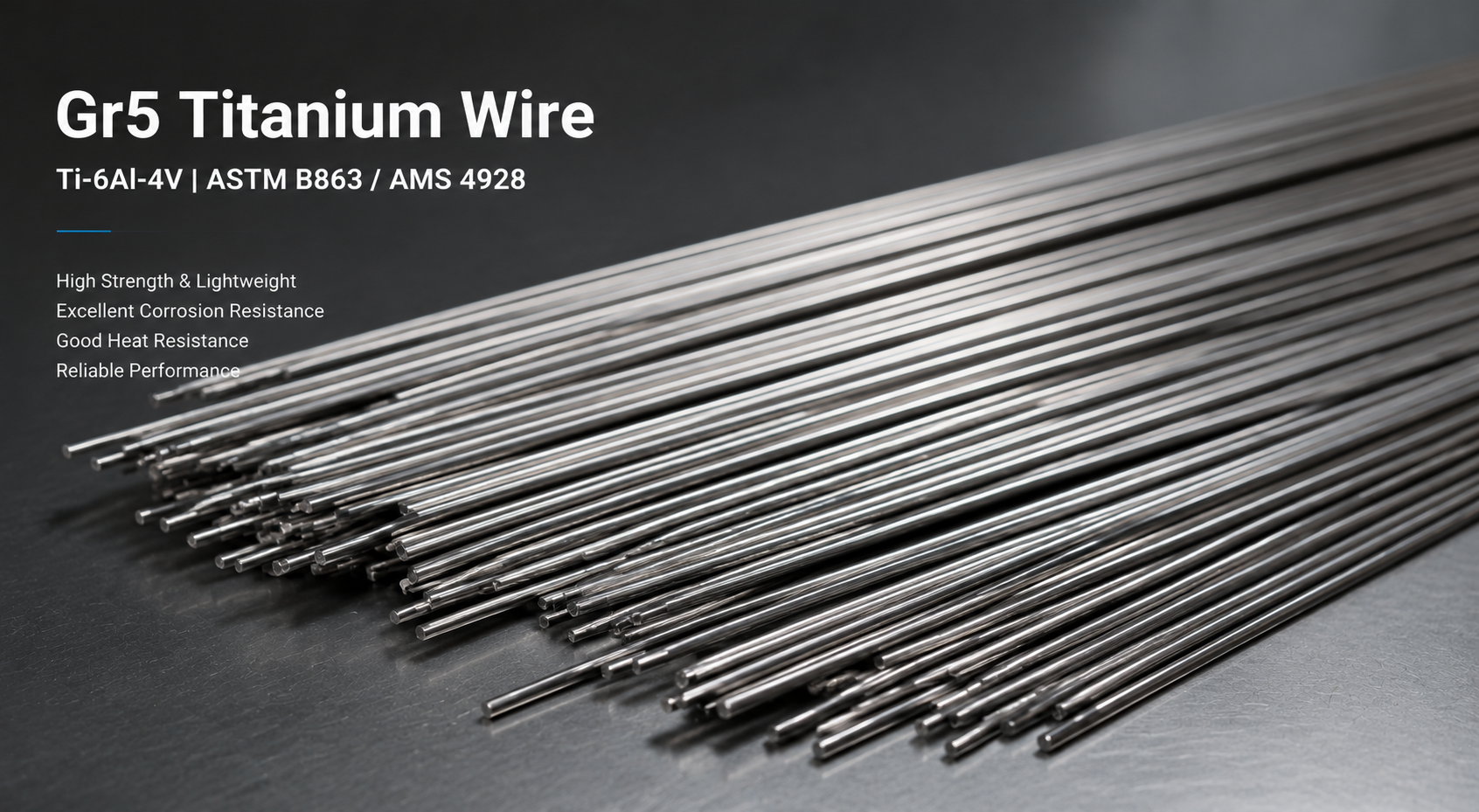
Grade 5 Titanium Wire (Ti-6Al-4V) plays a critical role in high-end manufacturing sectors including aerospace, chemical processing equipment, and ocean engineering, where the reliability of welded joints directly determines structural safety and service life. Conventional welding fillers often produce defects such as porosity and cracking when matched with titanium alloy base metals, mainly due to compositional deviations and insufficient purity levels. Grade 5 Titanium Wire features strict chemical composition control, ultra-low impurity content, and excellent deposition stability during welding. It effectively stabilizes the molten pool, reduces the risk of embrittlement in the heat-affected zone, and enhances both joint strength and corrosion resistance. When used in combination with vacuum or inert gas shielding welding processes, in compliance with ASTM B863 standards, the weld defect rate can be reduced by more than 60% compared with standard filler wires. As a result, the mechanical properties of the welded joints can closely match or even exceed those of the base metal, fully meeting the stringent quality requirements for pressure vessels, aircraft structural components, and deep-sea engineering applications.
1. Why High Purity Is Critical for Titanium Alloy Welding
1.1 Damage Mechanisms of Impurity Elements on Weld Performance
Titanium alloys are highly susceptible to interstitial elements such as oxygen, nitrogen, and hydrogen when in a high-temperature molten state. If oxygen content exceeds 0.20%, brittle oxide inclusions form at grain boundaries, reducing weld ductility by more than 30%. Excess hydrogen triggers delayed cracking; within 48 hours after thick-plate welding, crack propagation rates can reach 0.5 mm/h. Substitutional impurities including iron and silicon shift phase transformation temperatures, causing uneven distribution of the β phase and weakening joint fatigue resistance. High-purity Grade 5 titanium wire limits hydrogen ≤ 0.015%, oxygen ≤ 0.20%, and iron ≤ 0.30%, eliminating embrittlement risks at the source and ensuring uniform, dense weld microstructures.
1.2 Effects of Compositional Matching on Joint Strength
Deviations exceeding ±0.5% in aluminum and vanadium content between filler wire and base metal create compositional gradients within the fusion zone, forming localized softening or hardening regions that act as stress concentration points. High-purity Grade 5 titanium wire strictly adheres to the composition range of 5.5%–6.75% Al and 3.5%–4.5% V. Vacuum melting guarantees consistent batch-to-batch performance, delivering weld tensile strength of 950–1050 MPa with a base metal matching ratio of ≥95%. During welding of aeroengine casings, every 0.1% reduction in compositional deviation extends joint fatigue life by 10%.
1.3 Correlation Between Purity Control and Weld Porosity Rate
Table 1 Influence of Wire Hydrogen Content on Weld Porosity Rate and Density
| Hydrogen Content | Porosity Occurrence Rate | Weld Density |
|---|---|---|
| ≤ 0.015% | < 2% | > 99.5% |
| 0.015%–0.030% | 8%–15% | 97%–98% |
| > 0.030% | > 25% | < 95% |
Data indicates that every 50 ppm reduction in hydrogen cuts weld porosity by 5%–8%. When high-purity filler wire is used alongside argon back shielding, porosity can be held below 1%, pushing X-ray inspection pass rates above 98% to satisfy Class I weld standards for nuclear power and aerospace applications.
2. Unique Metallurgical Advantages of Grade 5 Titanium Wire
2.1 Synergistic Strengthening Effect of α+β Dual-Phase Microstructure
Ti-6Al-4V is a classic α+β two-phase titanium alloy. The hexagonal close-packed (HCP) α phase delivers excellent ductility and fracture toughness, while the body-centered cubic (BCC) β phase provides high strength and hot workability. During welding, cooling rates of 10–100 °C/s prompt fine acicular α precipitates within the β matrix, forming a basket-weave microstructure. This yields weld yield strength of 880 MPa with elongation maintained above 10%. The dual-phase structure balances strength and ductility, avoiding the brittleness of single-phase alloys or insufficient mechanical strength, making it ideal for welded structures subjected to impact loads.
2.2 Inclusion Removal via Vacuum Melting
Conventional arc furnace melting cannot fully eliminate oxide and nitride inclusions. Vacuum induction melting maintains oxygen partial pressure below 10⁻³ Pa, paired with secondary refining in an electron beam cold hearth furnace. This reduces inclusion sizes to <5 μm and cuts inclusion number density by 90%. Ultrasonic testing confirms internal defect equivalent diameters in high-purity Grade 5 wire are less than 0.3 mm, far lower than the 1–2 mm typical of standard filler materials. This eliminates shrinkage cavities and porosity in deposited metal, enabling Class I ultrasonic weld inspection ratings.
2.3 Surface Quality Improvement Through Precision Drawing
Continuous Danieli rolling lines (manufactured in Italy) and multi-pass cold drawing limit titanium wire surface roughness to Ra ≤ 0.4 μm with diameter tolerances of ±0.01 mm. Smooth surfaces minimize welding spatter and prevent oxide scale detachment from contaminating the molten pool. Segmented stress-relief annealing eliminates forming stresses to prevent wire breakage or bending during wire feeding, supporting uninterrupted automated welding. Compared with standard acid-pickled wire, precision polished surfaces stabilize the welding arc by 25% and reduce spatter rates to below 0.5%.
Table 2 Comparison of Titanium Wire Surface Condition, Roughness, and Welding Performance
| Surface Condition | Roughness | Wire Feeding Stability | Spatter Rate |
|---|---|---|---|
| Acid Pickled | 0.8–1.2 μm | Average | 2–3% |
| Polished | 0.3–0.5 μm | Excellent | < 0.5% |
| Machined | 1.5–2.0 μm | Poor | > 5% |
3. Matching Strategies for Welding Process Parameters and Wire Purity
3.1 Coordinated Requirements for Shielding Gas Purity and Wire Cleanliness
Even with high-purity filler wire, inadequate shielding gas quality causes weld oxidation and discoloration. Argon purity must reach ≥99.99% with dew point ≤ -50 °C and oxygen content <5 ppm. Backside argon flow rates are controlled at 8–12 L/min to isolate the molten pool rear surface from atmospheric air. High-purity Grade 5 titanium wire features a thin, dense native oxide film. When paired with gas tungsten arc welding (GTAW/TIG) or plasma arc welding (PAW), single-sided welding with full penetration on 6–8 mm thick plate produces silver-white or pale gold welds free of black oxide layers.
3.2 Heat Input Control and Weld Grain Refinement
Excessive heat input (>2.5 kJ/mm) coarsens β-phase grains, which transform into coarse lamellar α after cooling and degrade impact toughness. Recommended welding parameters: current 80–120 A, voltage 10–12 V, travel speed 150–200 mm/min, interpass temperature ≤150 °C. Segmented welding with water-cooled copper backing plates maintains cooling rates near 50 °C/s, restricting grain sizes to 20–50 μm and delivering joint impact energy ≥35 J for service at cryogenic temperatures as low as -196 °C. The low oxygen content of high-purity wire further promotes acicular α precipitation, refining grains and boosting ductility by 15%–20%.
3.3 Interpass Temperature Management in Multi-Layer Multi-Pass Welding
Thick plate fabrication requires multi-layer multi-pass welding. Interpass temperatures exceeding 200 °C accumulate thermal stress and coarsen heat-affected zone microstructures. Real-time infrared temperature monitoring ensures each weld layer cools to 100–150 °C before depositing subsequent passes. Grade 5 titanium wire has a narrow melting range (1640–1660 °C) and uniform molten pool spread, reducing the total number of weld layers and overall heat input. When welding 30 mm thick pressure vessel heads, high-purity wire eliminates 2–3 weld layers versus standard filler, cutting welding distortion by 40% and peak residual stress by 35%.
4. Weld Quality Verification for Diverse Application Scenarios
4.1 Fatigue-Resistant Welding for Aeroengine Casings
Aeroengine casings endure high-frequency vibration and thermal cycling, requiring welds to withstand 10⁷ fatigue cycles. Ø1.2 mm high-purity Grade 5 wire paired with pulsed GTAW (peak current 150 A, background current 50 A, pulse frequency 2 Hz) delivers precise heat input regulation. Post-weld stress relief heat treatment at 540 °C for 4 hours with air cooling releases residual stress, yielding weld fatigue strength of 650 MPa with a base metal matching ratio ≥0.92. Metallographic examination reveals fine equiaxed α grains without Widmanstätten microstructures, meeting the 30,000-hour service life requirement for aeroengine components.
4.2 Corrosion-Resistant Weld Construction for Chemical Pressure Vessels
Welds in chemical equipment must resist long-term exposure to highly corrosive media including concentrated sulfuric acid and chloride ions. The low iron content (<0.30%) of high-purity Grade 5 wire prevents accelerated galvanic corrosion. After 1000 hours of immersion in pH=2 sulfuric acid solution, weld corrosion rates fall below 0.01 mm/year—only one-tenth the rate of 316L stainless steel. Combined GTAW and ultrasonic impact treatment reduces weld toe stress concentration factors from 3.5 to 1.8 and cuts pitting corrosion susceptibility by 60%, supporting safe operation of reactors and heat exchangers for over 20 years.
4.3 High-Pressure Hermetic Welding for Deep-Sea Equipment
Table 3 Operating Conditions, Mechanical Performance, and Service Requirements for Deep-Sea Equipment Welds
| Application Scenario | Operating Pressure | Minimum Weld Strength | Hermeticity Inspection Standard | Design Service Life (Years) |
|---|---|---|---|---|
| Deep Submersible Hull | 110 MPa | ≥ 950 MPa | Helium Mass Spectrometry < 10⁻¹⁰ Pa·m³/s | > 30 |
| Subsea Pipeline | 40 MPa | ≥ 920 MPa | 5-Hour Hydrostatic Pressure Test, No Leakage | 25 |
| Offshore Production Platform | 60 MPa | ≥ 930 MPa | Class I X-Ray Radiography | 20 |
Deep-sea equipment welds must simultaneously satisfy high strength, high toughness, and complete hermetic sealing. Ø2.0 mm high-purity Grade 5 wire is used for narrow-gap GTAW with a 3–4 mm joint gap and 0.05 MPa backside argon pressure to achieve full penetration welds. Post-weld helium leak testing records leakage rates below 10⁻¹⁰ Pa·m³/s with no deformation under 4,000-meter water depth pressure testing. Restricted hydrogen levels (≤0.015%) eliminate hydrogen-induced delayed cracking, guaranteeing reliability for deep submersible hulls under extreme operating conditions.
5. Quality Inspection System and Weld Defect Prevention
5.1 Comprehensive Application of Non-Destructive Testing
Weld quality inspection encompasses radiographic testing (RT), ultrasonic testing (UT), magnetic particle testing (MT), and penetrant testing (PT). Welds produced with high-purity Grade 5 wire exhibit high density and low ultrasonic attenuation, boosting UT detection sensitivity to 1 mm defects—50% higher than standard filler wire welds. Radiographic film displays uniform grayscale with no internal porosity or slag inclusions, achieving Class I radiographic pass rates above 95%. Eddy current testing identifies surface microcracks as small as 0.1 mm, paired with metallographic analysis to verify microstructural uniformity and establish full-process quality traceability from raw material to finished component.
5.2 Batch Monitoring of Chemical Composition and Mechanical Properties
Each wire batch undergoes spectroscopic analysis to control Al and V fluctuations within ±0.2%, with interstitial elements (oxygen, hydrogen, nitrogen) maintained below standard upper limits. Tensile testing delivers tensile strength of 950–1050 MPa, yield strength ≥880 MPa, elongation ≥10%, and reduction of area ≥25%. Weld joint bend testing achieves 180° bending without outer surface cracking, confirming robust weld ductility. Consistent batch performance eliminates frequent welding parameter adjustments during mass production, lifting first-pass production qualification rates above 92%.
5.3 Post-Weld Heat Treatment for Residual Stress Relief
Welding residual stress typically ranges from 200–400 MPa, which initiates fatigue cracking under alternating loads. Vacuum annealing furnaces (vacuum <10⁻³ Pa) heat components to 540–620 °C with a 2–4 hour hold time, followed by furnace cooling to 300 °C prior to air cooling. Post-treatment residual stress drops below 50 MPa, and weld hardness falls from HV350 to HV320, matching base metal hardness and eliminating stress concentration caused by hardness gradients. X-ray diffraction measurements show α-phase lattice distortion rates below 0.5%, indicating complete release of microstructural stress.
Conclusion
Through strict compositional control, vacuum metallurgy, and precision manufacturing, high-purity Grade 5 titanium wire delivers joint strength, ductility, and corrosion resistance that nearly match base metal performance. When paired with optimized welding processes and a comprehensive quality inspection framework, this material meets the rigorous weld quality demands of high-end industries including aerospace, deep-sea engineering, and chemical pressure vessel manufacturing, delivering reliable performance and long-term structural safety for critical components.
FAQ
Q1: What practical welding performance differences exist between high-purity Grade 5 titanium wire and standard titanium filler wire?
High-purity wire limits oxygen and hydrogen to ≤0.20% and ≤0.015% respectively, reducing weld porosity from 8%–15% to below 2% and extending joint fatigue life by 15%–25%. Performance advantages are most pronounced in thick-plate and multi-layer welding, lifting first-pass qualification rates by over 20%.
Q2: How to evaluate adequate shielding during Grade 5 titanium alloy welding?
Weld surface color provides a direct visual assessment: silver-white or pale gold surfaces indicate sufficient shielding; dark blue discoloration signals minor oxidation (acceptable); black or gray surfaces reflect severe oxidation requiring full rework. Argon purity ≥99.99% combined with backside argon shielding ensures acceptable weld color and X-ray inspection pass rates above 95%.
Q3: Which application fields mandate high-purity Grade 5 titanium wire instead of standard filler materials?
High-purity wire is mandatory for components where weld failure can trigger catastrophic incidents, including critical aeroengine parts, deep submersible pressure hulls, nuclear heat exchangers, and medical implants. This material reduces failure risk by over 80% and complies with international certification standards such as FAA and ASME.
Contact Us
Baoji Titanium Valley Titanium Nickel Zirconium Material Processing Co., Ltd. is a professional manufacturer and supplier of high-purity Grade 5 titanium wire with an annual production capacity of 10,000 metric tons. The facility operates Italian Danieli continuous rolling lines, and all products comply with ASTM B863. For customized welding filler materials or technical engineering support, email sales@titaniumvalleys.com to schedule one-on-one consultation with our technical team.
References
1.Zhang QL, Wang Q, Li GP. Welding Processes and Defect Analysis of Titanium Alloys [M]. Beijing: China Machine Press, 2015.
2.Liu Y, Chen H, Wu S. Research on Joint Properties of High-Purity Ti-6Al-4V Welding Wire [J]. Welding Technology, 2020, 49(6): 34-38.
3.Zhao YQ, Hong Q, Ge P, et al. Titanium Alloy Handbook [M]. Changsha: Central South University Press, 2011.
4.Zhang M, Li Q. Formation Mechanism and Control of Weld Porosity in Titanium Alloy Welds [J]. Transactions of the China Welding Institution, 2016, 37(8): 92-96.