
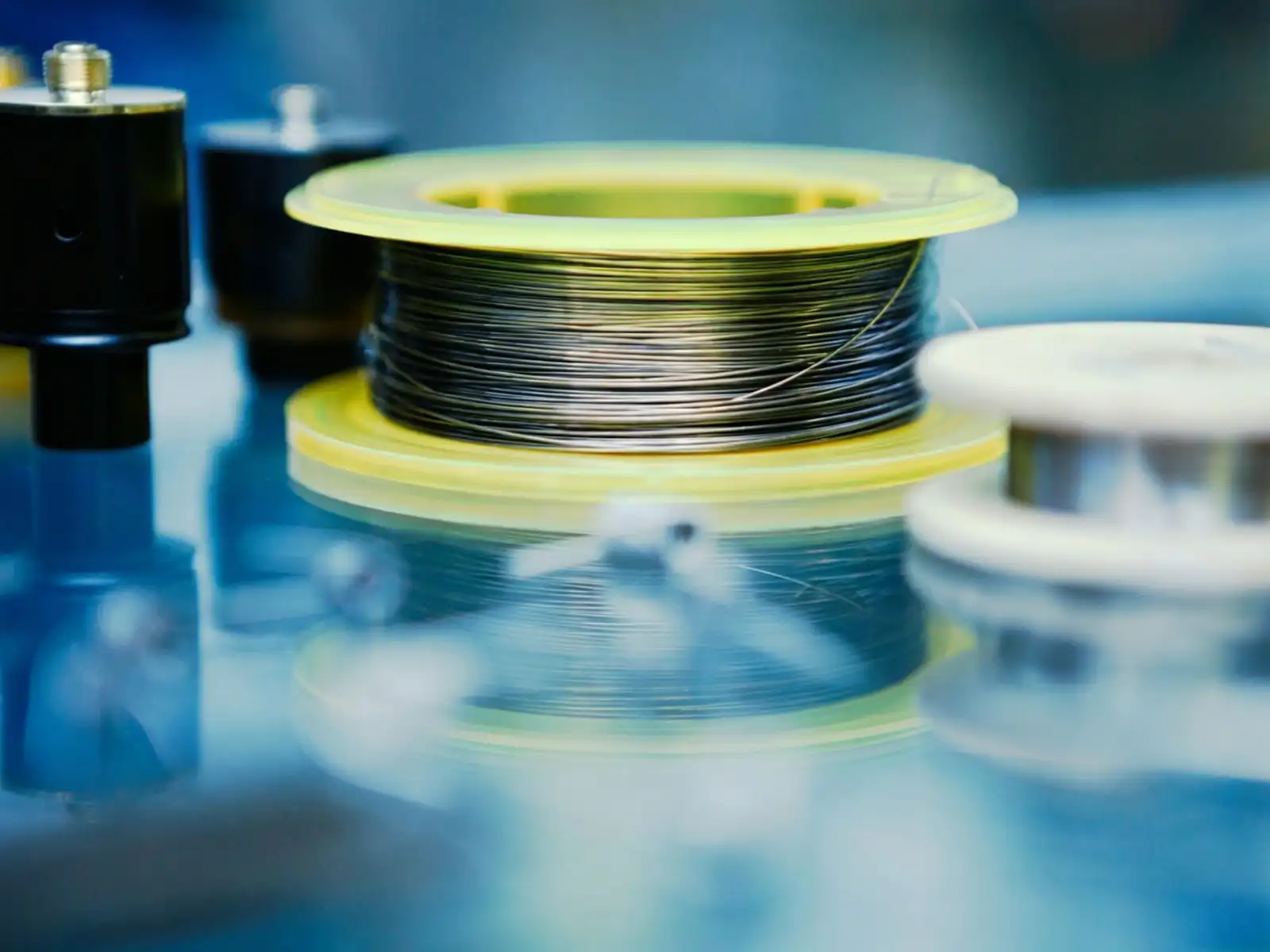
Annealing is a decisive heat treatment process in the precision manufacturing of Gr1 commercially pure titanium wire. By regulating temperature and holding time, this process effectively relieves residual stress accumulated during cold working, promotes recrystallization to form equiaxed grains, and restores the ductility and malleability of the material. For customers in aerospace, medical devices, electronic manufacturing and other sectors that require high purity and tight dimensional tolerances, annealing not only stabilizes the mechanical properties of titanium wire, but also directly affects the yield and consistency of finished products in subsequent deep processing. Titanium wire without proper annealing tends to exhibit increased brittleness, surface cracking and poor dimensional stability, which will ultimately lead to higher equipment failure rates and maintenance costs.
I. How Annealing Alters the Microstructure of Gr1 Titanium Wire
1. Grain Restructuring and Stress Relief Mechanism
2. Purity Retention and Oxidation Control
3. Graded Hardness Control
II. Quantitative Effects of Annealing Parameters on Titanium Wire Properties
Table 1: Effects of Different Annealing Temperatures on Properties of Gr1 Titanium Wire (Holding Time: 30~60 min, Air Cooling, Typical Values)
| Annealing Temperature (°C) | Holding Time (min) | Tensile Strength (MPa) | Elongation (%) | Surface Roughness Ra (μm) |
|---|---|---|---|---|
| 650 | 30 | 520~580 | 12~15 | 0.6~0.8 |
| 750 | 45 | 380~450 | 18~22 | 0.4~0.6 |
| 850 | 60 | 340~380 | 24~28 | 0.3~0.5 |
1. Critical Control of Temperature Window
2. Implicit Influence of Cooling Rate
3. Cumulative Effect of Multi-Pass Annealing
III. Differentiated Annealing Requirements for Titanium Wire in Various Application Fields
1. Stringent Standards for Medical Implant Devices
2. Long-Term Performance Requirements for Chemical Corrosion-Resistant Equipment
Table 2: Recommended Tempers and Key Indicators of Annealed Gr1 Titanium Wire for Different Applications
| Application Field | Recommended Temper (ASTM/National Standard Designation) | Key Performance Indicators | Typical Wire Diameter (mm) |
|---|---|---|---|
| Medical Implants | Annealed (O) | Elongation ≥ 24% | φ0.2~1.0 |
| Welding Filler | Annealed (O) | Excellent ductility, uniform weld formation | φ1.0~3.0 |
| Electronic Springs | Half-hard (H/2) | Superior elasticity and long fatigue life | φ0.06~0.5 |
| Offshore Fasteners | Half-hard (H/2) | Tensile strength ≥ 450 MPa (Annealed wire: ≥ 340 MPa; strength enhanced by cold drawing) | φ2.0~6.0 |
3. Non-Magnetic Requirements for Precision Electronic Components
IV. Balancing Annealing Technology and Production Efficiency
1. Technological Advancement of Continuous Annealing Furnaces
2. Intelligent Upgrade with On-Line Monitoring
3. Energy Saving and Carbon Emission Reduction
V. Annealing Record Management in Quality Traceability System
1. Correlation Between Heat Lot Numbers and Material Certificates
2. Rapid Response Mechanism for Non-Conforming Batches
3. Value of Third-Party Certifications
Conclusion
Frequently Asked Questions
Q1: How to verify sufficient annealing of titanium wire?
Hardness testing and metallographic analysis are adopted for verification. Per ASTM standards, fully annealed wire shall have a hardness of 140~180 HV. Uniform equiaxed grains with an average grain size of 15~30 μm shall be observed under a metallurgical microscope, with no residual elongated fibrous microstructure. The wire shall not crack after 180° bending test. For medical and aerospace grade products, surface oxygen content shall also be tested to meet relevant standards.
Q2: What are the major challenges for annealing ultra-fine titanium wire (φ < 0.3 mm)?
Ultra-fine wire dissipates heat rapidly, resulting in large temperature gradients and risks of local overheating or uneven heating. In industrial production, rapid heating with short holding time and argon shielding are commonly applied. The process window for ultra-fine wire is much narrower than that for conventional-size wire.
Q3: What is the shelf life of annealed titanium wire without performance degradation?
Titanium wire stored under vacuum packaging maintains stable performance for 12 to 24 months. When exposed to ambient air, the material will gradually absorb oxygen. The service life shall be determined according to storage temperature, humidity and packaging grade. For high-demand applications, it is recommended to use the product within 12 months. The relative humidity of the storage environment shall be controlled at ≤ 60% RH.
Custom Annealed Titanium Wire Solutions with Titanium Valley
References
- Zhao Y Q, Zhang P X, et al. Titanium and Titanium Alloys [M]. Beijing: Science Press, 2016.
- Zhang B C. Titanium Alloys: Engineering Materials and Applications [M]. Beijing: Chemical Industry Press, 2016.
- Huang B Y, et al. Titanium Alloys and Their Applications [M]. Beijing: Metallurgical Industry Press, 2015.
- ASTM B863-14(2020) Standard Specification for Titanium and Titanium Alloy Wire.
- GB/T 3623-2022 Titanium and Titanium Alloy Wires.