
Why Is Gr4 Titanium Bar Used for Industrial Corrosion Resistance and Precision Manufacturing?
- Gr4 Titanium Bar
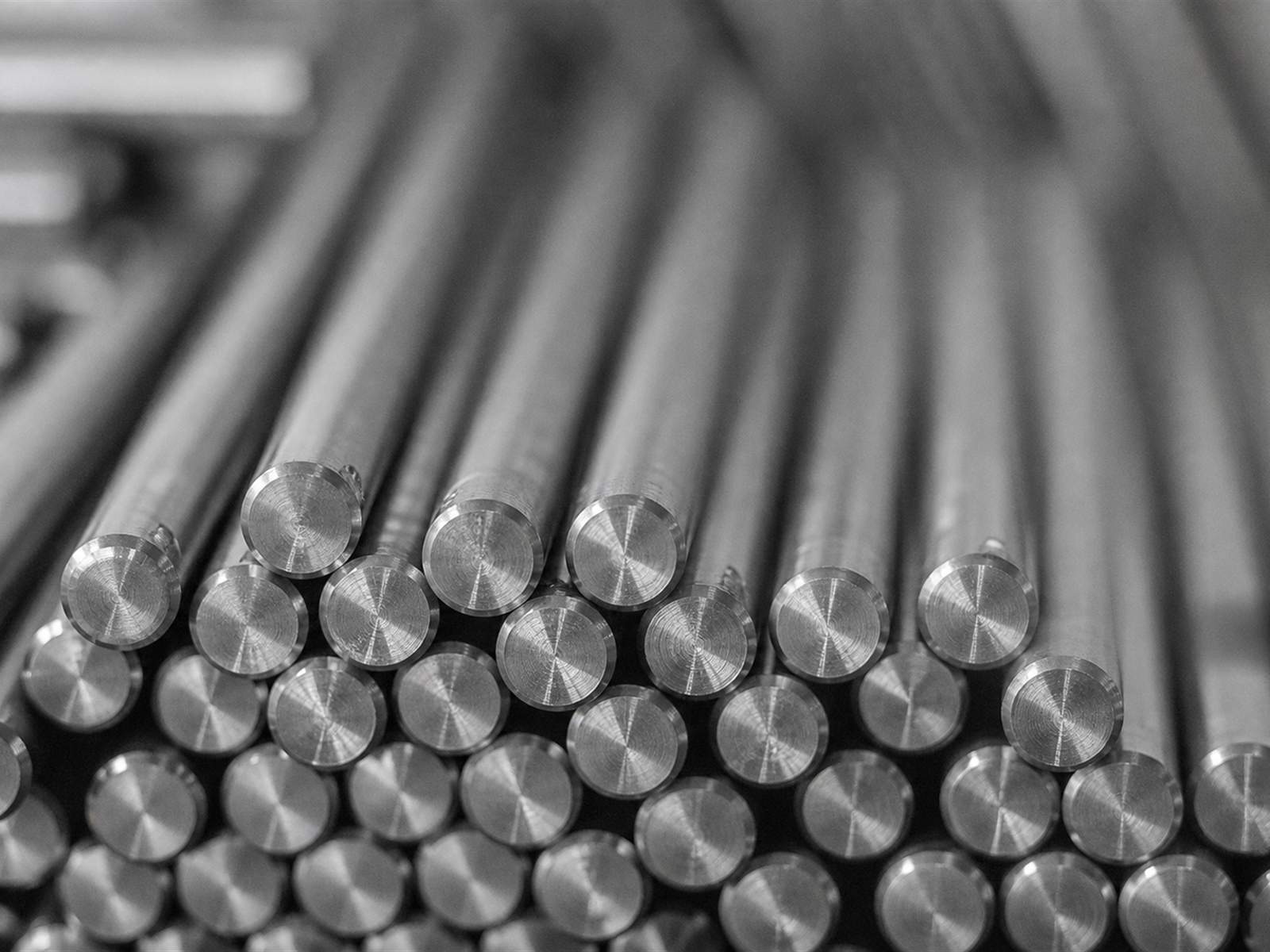
In industrial applications that require corrosion resistance, precision machining, and compatibility with multiple service environments, material selection often involves tradeoffs among strength, inventory complexity, and long-term reliability. Gr4 titanium bar (UNS R50700) is the highest-strength commercially pure titanium grade, with tensile strength typically in the 485 to 550 MPa range, a density of 4.51 g/cm3, excellent biocompatibility, and stable corrosion resistance in oxidizing and chloride-containing environments. Compared with carbon steel and many stainless steels, Gr4 titanium bar can reduce weight, provide nonmagnetic behavior, and support long service life in seawater, nitric acid, alkaline solutions, and mixed-acid media containing oxidizing ions.
What Core Technical Properties Make Gr4 Titanium Bar Useful?
How Does High-Purity Alpha-Phase Titanium Support Stable Properties?
Gr4 titanium bar is produced from high-purity titanium sponge through double or multiple vacuum arc remelting. Its single alpha-phase structure supports toughness, weldability, and stable mechanical performance over a broad temperature range. The material can maintain useful properties from approximately -100 °C to 350 °C when the correct product condition and design limits are specified.
| Chemical Element | Standard Content | Performance Effect |
|---|---|---|
| Titanium (Ti) | >=99.0% | Provides base strength and corrosion resistance |
| Oxygen (O) | <=0.40% | Strengthens the matrix and increases tensile strength |
| Iron (Fe) | <=0.50% | Influences ductility and machinability |
| Carbon (C) | <=0.08% | Helps control grain size and toughness |
How Does Gr4 Balance Strength and Corrosion Resistance?
Compared with lower-strength commercially pure titanium grades such as Gr1 and Gr2, Gr4 provides approximately 60% higher tensile strength while retaining the corrosion behavior associated with titanium. In suitable oxidizing acids, alkaline solutions, and chloride-containing environments, a stable TiO2 passive film forms on the surface and protects the metal.
How Should Machinability Be Described Accurately?
Titanium is generally considered a difficult-to-machine material because of low thermal conductivity, tool adhesion, and work hardening. Gr4 is more economical to process than highly alloyed titanium grades such as Gr5, but it should not be described as having universally excellent machinability. A more accurate description is that Gr4 has balanced processing behavior among commercially pure titanium grades and lower machining resistance than many high-strength titanium alloys.
How Does Gr4 Titanium Bar Fit Industrial Corrosion Applications?
How Can It Simplify Material Selection in Chemical Processing?
Chemical plants may handle nitric acid, organic acids, alkaline solutions, oxidizing salt solutions, and mixed media. Gr4 titanium bar is suitable for nitric acid, many organic acids, alkaline solutions, and mixed-acid environments containing oxidizing ions. It should not be promoted as broadly resistant to hydrochloric acid or sulfuric acid unless the concentration, temperature, and oxidizing inhibitors are clearly specified. For reducing acids, Gr7 titanium-palladium alloy or Gr12 titanium-molybdenum-nickel alloy is often the more appropriate corrosion-resistant titanium grade.
Why Is It Valuable in Marine and Coastal Service?
Seawater contains high chloride levels and can cause pitting or stress corrosion cracking in many stainless steels. Gr4 titanium bar typically corrodes at less than 0.01 mm/year in seawater and can provide long service life in splash-zone and tidal-zone equipment when crevice conditions are controlled.
| Material | Seawater Corrosion Rate | Service Life | Total Cost Index |
|---|---|---|---|
| Carbon steel | 0.3 mm/year | 2 to 3 years | 100 baseline |
| 316L stainless steel | 0.05 mm/year | 5 to 8 years | 85 |
| Gr4 titanium bar | <0.01 mm/year | >30 years | 35 |
How Is It Used in Environmental Water Treatment?
Wastewater treatment and flue-gas desulfurization systems expose components to fluctuating pH, chlorides, and abrasive slurry. Gr4 titanium bar can be used for spray layers, electrolysis anodes, ion-exchange structures, fasteners, and support rods when service chemistry is compatible with titanium passivation.
What Precision Applications Use Gr4 Titanium Bar?
Which Aerospace Components Are Appropriate?
Gr4 titanium bar is suitable for non-primary and secondary aerospace components where corrosion resistance, moderate strength, and weight reduction are required. Typical examples include aerospace tube fittings, heat shields, anti-icing duct components, hydraulic-system fittings, and non-primary fasteners. It should not be described as the material of choice for landing gear support members or engine mounts, which normally require high-strength titanium alloys such as Gr5, Ti-10V-2Fe-3Al, or other aerospace structural alloys.
Which Medical Devices Are Appropriate?
Gr4 titanium bar has excellent biocompatibility and nonmagnetic behavior. In medical device applications, it is commonly used for dental implants, maxillofacial fixation plates, surgical instruments, bone pins, and precision medical instrument components. High-load orthopedic implants such as intramedullary nails and bone plates more commonly use Ti-6Al-4V ELI under ISO 5832-3 or equivalent specifications.
Why Is It Useful in Precision Electronics?
Semiconductor manufacturing and vacuum coating systems require materials with low magnetic response and low ion release. Gr4 titanium has permeability close to 1 and low contamination risk in high-purity water and organic solvents. It can be used in vacuum chamber supports, OLED evaporation equipment, sputtering-related structures, and precision fixtures.
How Should Gr4 Titanium Bar Be Purchased and Inspected?
How Are Specifications Selected?
Common Gr4 titanium bar sizes include round, square, and hexagonal products from approximately 6 mm to 300 mm diameter or equivalent section size. Lengths can be customized up to 6000 mm. Buyers should maintain regular inventory for common diameters and use made-to-order production for special dimensions.
What Certification and Testing Are Required?
A complete material test certificate should include chemical composition, tensile properties, grain size, and heat number. Ultrasonic testing should be specified for critical components. Surface roughness for cold-drawn bar may be <=Ra 1.6, while polished products can reach Ra 0.4.
| Inspection Item | Test Method | Acceptance Requirement |
|---|---|---|
| Tensile strength | Room-temperature tensile test | 485 to 550 MPa |
| Elongation | 50 mm gauge-length tensile test | >=15% |
| Grain size | Metallographic microscope | Grade <=5 |
| Ultrasonic testing | UT inspection | No equivalent defect larger than phi 1.5 mm |
Which Machining Parameters Are Used?
For turning Gr4 titanium bar, carbide coated tools, water-soluble coolant, cutting speed of about 60 to 100 m/min, feed of 0.15 to 0.25 mm/rev, and cutting depth below 3 mm are commonly used starting points. Welding requires high-purity argon shielding, including backside protection when needed.
How Does Supply Chain Strategy Affect Cost?
What Is the Advantage of the Baoji Titanium Cluster?
Baoji is a major titanium processing center with integrated sponge titanium, melting, rolling, and precision processing capacity. Localized sourcing can shorten lead time and reduce cost compared with many imported supply routes.
How Can Regional Stocking Reduce Risk?
For export markets such as the United States, Germany, and Japan, a combined production and overseas stocking model can reduce lead time for regular products while preserving cost advantages for planned orders.
What Technical Services Add Value?
Professional suppliers should support material selection, process parameter optimization, failure analysis, special dimensions, surface modification, and drawing-based machining.
What Is the Conclusion?
Gr4 titanium bar combines the highest strength level among commercially pure titanium grades with corrosion resistance, low density, nonmagnetic behavior, and established medical and industrial use. Its best applications are those that need corrosion resistance and moderate strength, not primary high-load aerospace structures or high-load orthopedic implants.
What Questions Do Buyers Commonly Ask?
How Should Gr4 and Gr2 Titanium Bar Be Selected?
Gr4 provides higher tensile strength and is better for parts that need smaller sections or higher load capacity. Gr2 provides higher ductility and is better for complex cold forming.
Does Gr4 Need Surface Protection in Seawater?
Gr4 usually forms a stable oxide film in seawater and often does not require coating. In sulfide-containing or high-temperature seawater above 80 °C, surface treatment or additional corrosion review is recommended.
How Can Material Authenticity Be Verified?
Buyers should request third-party test reports, verify chemical composition and mechanical properties, check heat-number marking, and perform positive material identification when required.
How Can You Source Gr4 Titanium Bar?
Baoji Titanium Valley Titanium Nickel Zirconium Material Processing Co., Ltd. supplies Gr4 titanium bar from 6 to 300 mm diameter, with custom processing and global delivery. Contact sales@titaniumvalleys.com for technical data and quotation support.
References
1. Zhao Yongqing, Ge Peng. Titanium Alloy Materials Science and Engineering[M]. Beijing: Chemical Industry Press, 2020.
2. Standardization Administration of China. GB/T 3620.1-2016 Designation and Chemical Composition of Titanium and Titanium Alloys[M]. Beijing: Standards Press of China, 2016.
3. Titanium, Zirconium and Hafnium Branch of China Nonferrous Metals Industry Association. China Titanium Industry Development Report (2023)[M]. Beijing: Metallurgical Industry Press, 2023.
4. Wang Jinxu, Yu Zhentao. Titanium Materials Engineering[M]. Beijing: Science Press, 2018.