
What Is TB13 Titanium Alloy Rod? Comprehensive Materials Guide?
- TB13 Titanium Alloy
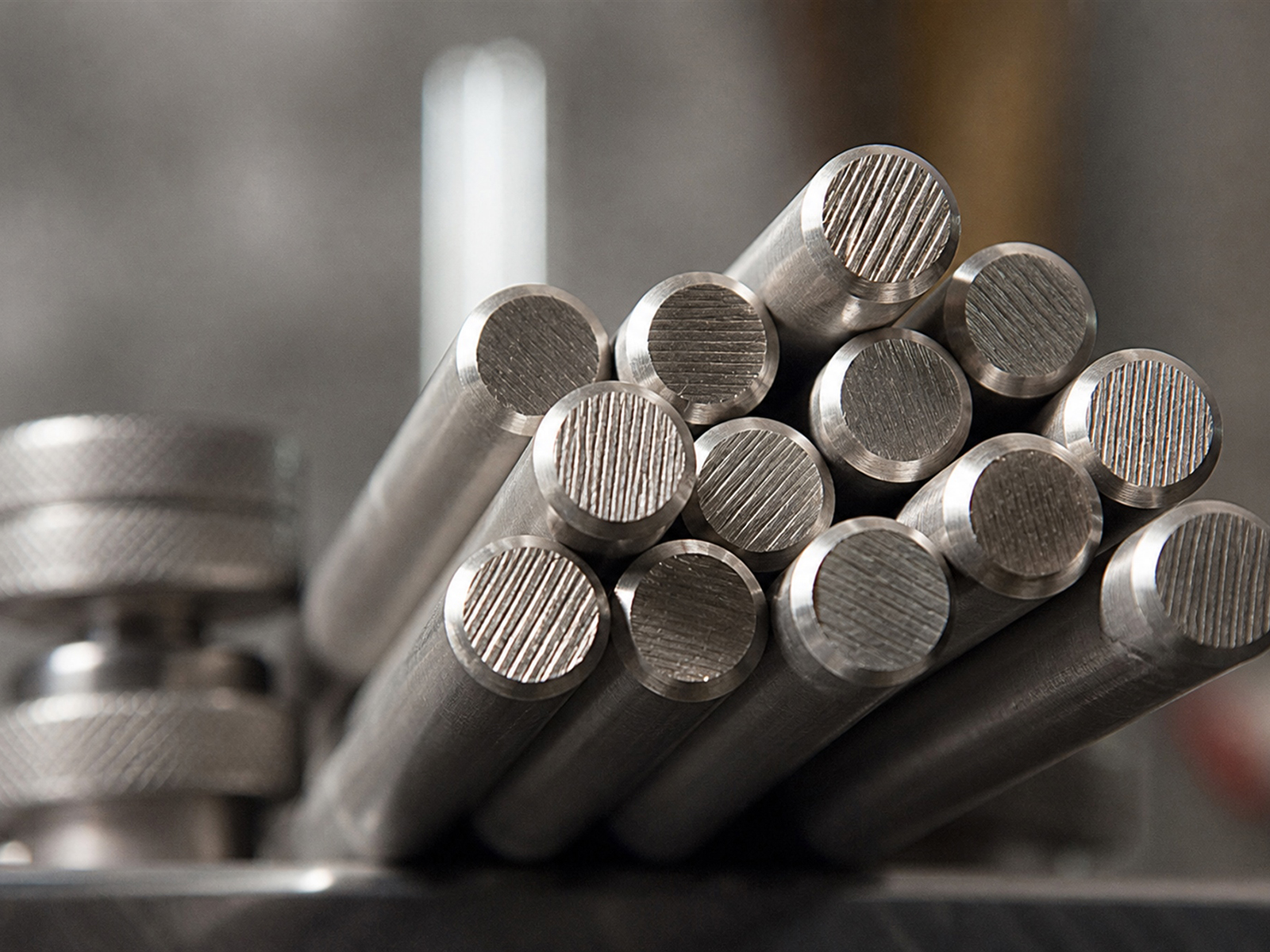
TB13 titanium alloy rod is a metastable beta titanium alloy material independently developed by China. Its unique feature is that it maintains a single beta phase structure at room temperature. The alloy uses titanium as the base, with 3.0%-4.5% aluminum and 20.0%-23.0% vanadium added to form a high-performance material with super elasticity, lightweight and excellent cold working properties. TB13 bars are made through vacuum consumable arc melting, forging, hot rolling or cold drawing, and have round, square or hexagonal cross-sections. The material has a density of about 4.5g/cm³, which is lighter than conventional titanium alloys. The nickel content is strictly controlled to reduce the risk of allergies. It is widely used in high-end eyeglass frames, medical equipment, precision elastic components, aerospace and other fields.
1. Why Is Material Properties and Technical Advantages of TB13 Titanium Alloy Rods Important?
(1) What Should You Know About Superelasticity and Shape Stability?
As a β-type titanium alloy, TB13 has significant superelastic characteristics, which is due to its reversible stress-induced martensite transformation mechanism. After the material is bent under force, even if it undergoes large deformation, it can automatically return to its original shape after the external force is removed. This kind of super elasticity makes it almost no permanent deformation or breakage after repeated bending tens of thousands of times. Eyeglass frame manufacturers particularly value this feature – traditional metal frames are prone to plastic deformation during the adjustment process, while TB13 frames can withstand multiple adjustments without losing elasticity, which can reduce after-sales repair rates.
(2) Why Is Material Advantages of Lightweight Design Important?
Compared with stainless steel with a density of 8.0g/cm³ or chromium-cobalt alloy with a density of 7.8g/cm³, the density of TB13 is reduced by about 40%-45%, which is of great significance in the fields of aerospace and wearable devices. A pair of eyeglass frames made of TB13 can reduce the weight by more than 30%, improving wearing comfort. In the medical field, lightweight orthodontic archwires and surgical instruments not only reduce patient discomfort, but also reduce energy consumption in transportation and operation. In the field of precision machinery, lightweight rods can reduce the inertia load of rotating parts and improve response speed and energy efficiency.
(3) What Should You Know About Cold Forming Capability?
TB13 exhibits more than 80% cold deformation ability in solid solution state, far exceeding the 20%-30% deformation rate of conventional α-type or α+β-type titanium alloys. This high plasticity originates from the body-centered cubic crystal structure of the β phase, whose slip system is more active than the hexagonal close-packed structure. Manufacturers can directly perform cold bending, cold drawing, stamping and other processing on the bars without frequent intermediate annealing, and the production process is simplified by more than 30%. In the eyewear industry, complex temple curvatures and hinge structures can be formed in one step through precision cold bending; in the electronics industry, micro-shrapnel and buckles can be mass-produced through high-speed stamping, and the yield rate can be increased to more than 98%.
2. What Should You Know About Production Process and Quality Control System of TB13 Titanium Alloy Rod?
(1) What Should You Know About Vacuum Melting and Forging Technology?
The production of TB13 rods begins with vacuum consumable arc remelting (VAR) technology. This process is carried out in a 10⁻³Pa level vacuum environment, which effectively removes hydrogen, oxygen, nitrogen and other gas impurities to ensure that the hydrogen content is ≤ 0.015% and the oxygen content is ≤ 0.20%. The high-purity electrode is melted and solidified layer by layer in a water-cooled copper crucible to form an ingot with dense structure and uniform composition. Subsequently, high-temperature forging at 1000-1100℃ is used to break the as-cast structure, eliminate segregation and pores, and refine the grains to 50-150 um, thereby improving the material’s comprehensive mechanical properties and fatigue life.
(2) What Should You Know About Hot Rolling and Cold Drawing Process Routes?
Hot rolling process: The forged billet is rolled in multiple passes at 800-950℃, with a cumulative deformation of 60%-75%, and the bar diameter can be reduced from φ100mm to φ10mm. The rolling process avoids surface cracks and internal voids by precisely controlling the pass deformation rate (15%-25% per pass) and the temperature between passes (± 20℃). Some production lines adopt online diameter measurement and automatic tension control systems to ensure that the diameter tolerance is controlled within ± 0.05mm.
Cold drawing finishing technology: After hot-rolled bars are pickled to remove scale, they are drawn in multiple passes at room temperature, and the cumulative deformation can reach 70%-80%. Cold working causes a sharp increase in dislocation density and the tensile strength increases to 900-1100MPa, but intermediate annealing (650-750℃ × 1-2h) is required to restore plasticity. It should be noted that the cumulative deformation here refers to the sum of multiple passes, not the deformation of a single pass. The surface roughness of the final product can reach Ra0.8um, and the dimensional accuracy reaches H9-H11 level, meeting the needs of precision processing.
(3) What Should You Know About Heat Treatment System and Performance Control?
The performance of TB13 can be adjusted in a wide range through solid solution and aging treatment. Solid solution treatment (750-850℃ × 30-60 minutes plus cold water) keeps the alloy in a single β phase. At this time, the material has the best plasticity and medium strength (tensile strength 700-850MPa), and is suitable for subsequent cold forming. Aging treatment (400-550℃ × 4-8 hours plus air cooling) precipitates fine α-phase strengthening phases, and the strength can be increased to 1100-1300MPa, but the elongation drops to 8%-12%. Eyeglass frames are usually in a solid solution state to retain the best elasticity; aviation fasteners are in a peak aging state to pursue the highest strength.
Heat treatment status | Tensile strength (MPa) | Yield strength (MPa) | Elongation (%) | Typical applications |
Solid solution | 700-850 | 500-650 | 18-25 | Eyeglass frames, elastic components |
Under-timed state | 900-1000 | 750-850 | 12-16 | medical device |
peak aging state | 1100-1300 | 950-1150 | 8-12 | aviation fasteners |
3. Why Is the Application Value of TB13 Titanium Alloy Rods in Core Fields Important?
(1) Why Is Applications in High-end Eyewear Manufacturing Important?
TB13 has become the choice of some top eyewear brands and occupies a large market share in the beta titanium eyewear field. Compared with traditional nickel-copper alloy, the weight of TB13 frames is reduced by 35%. The weight of a pair of full-frame glasses can be reduced to less than 15 grams. It can be worn for a long time without compressing the bridge of the nose and ears. The super elasticity allows the temples to withstand 180° folding without breaking, and daily collisions and extrusions will not cause the frame to deform. Strictly controlling the nickel content to less than 0.01% (conventional alloys contain 8%-12% nickel) can effectively reduce the risk of contact dermatitis and is suitable for sensitive people. It has outstanding anti-sweat, anti-salt spray and anti-ultraviolet corrosion capabilities. It can still maintain a smooth surface after being used in coastal areas for more than 5 years. Traditional metal frames will show rust spots in 2 years under the same environment.
(2) Why Is Applications in the Field of Medical Devices Important?
In orthodontic medicine, TB13 archwire relies on its low elastic modulus (65-75GPa, about 1/3 of stainless steel) to provide continuous and gentle correction force, reducing periodontal tissue damage and patient pain. Superelasticity allows the archwire to maintain a constant restoring force under large deformation, helping to shorten the follow-up period. Surgical instruments such as microscopic forceps and clamping forceps are made of TB13, which reduces the weight by 40% and makes them less prone to fatigue during long-term operations. The non-magnetic nature of the material (magnetic susceptibility <1.005) makes it safe for use in MRI environments, and orthopedic implants do not need to be removed prior to examination. Cytotoxicity tests and sensitization tests show that its biocompatibility meets ISO 10993 standards, and there are no cases of rejection after being implanted in the body for more than 10 years.
(3) Why Is Aerospace and Precision Machinery Applications Important?
Aviation fasteners put forward stringent requirements for materials that are “lightweight, high, and fatigue-resistant.” After age strengthening, the tensile strength of TB13 exceeds 1200MPa, and the specific strength reaches 270kN·m/kg, which is higher than the 180kN·m/kg of 7075 aluminum alloy. Under the stress amplitude of ± 350MPa, the fatigue life exceeds 10⁷ cycles, and it is suitable for fastening the wing skin and connecting the engine nacelle. The elastic shafts, buckles, and micro springs in precision instruments utilize the low damping characteristics of TB13 (damping ratio 0.001-0.003) to achieve fast response and precise reset. In the field of marine engineering, the chloride ion corrosion resistance is three times that of 316 stainless steel, and the service life of deep-sea equipment is extended by 2-3 times.
Application areas | key performance requirements | TB13 Advantages | Comparison of alternative materials |
Glasses manufacturing | Super elastic, lightweight, hypoallergenic | 180° continuous bending, 35% weight reduction, nickel-free | Nickel-copper alloy: prone to allergies and deformation |
medical device | Biocompatible, low modulus, non-magnetic | Elastic modulus 65GPa, MRI compatible | Stainless steel: high modulus, magnetic |
Aerospace | High strength, fatigue resistance and corrosion resistance | Specific strength 270kN·m/kg, fatigue 10⁷ times | Aluminum alloy: low strength and poor corrosion resistance |
(4) What Should You Know About Electronics and Smart Wearable Devices?
The smart watch case and strap are made of TB13, which is five times more resistant to sweat corrosion than ordinary alloys and will not fade for three years in sports wearing scenarios. Ultra-thin processing of 0.1-0.3mm for micro-shrapnel and connectors is possible, and cold-rolled deformation can reach 85% without cracking, meeting the needs for miniaturization and lightweighting of 5G equipment. Non-magnetic features reduce interference with gyroscopes and magnetometers, helping to improve positioning accuracy. After the battery protection sheet is made of TB13, the impact strength is increased by 60%, and the drop test pass rate is increased from 78% to 96%.
4. How Should Technical Parameters and Material Selection Guide for TB13 Titanium Alloy Rods?
(1) What Should You Know About Chemical Composition and Impurity Control Standards?
The precise ratio of the chemical components of TB13 directly determines its performance. The aluminum content (3.0%-4.5%) serves as an α-phase stabilizing element, improving the material strength and heat resistance; the vanadium content (20.0%-23.0%) serves as a β-phase stabilizing element, giving the alloy superelasticity and cold working capabilities. For every 1% increase in vanadium content, the solid solution strength increases by about 50MPa, but if it is too high, it will lead to increased brittleness. Impurity elements are strictly controlled: iron ≤ 0.20% (exceeding the standard will lead to a decrease in plasticity), oxygen ≤ 0.20% (exceeding the standard will cause embrittlement), and hydrogen ≤ 0.015% (exceeding the standard will cause hydrogen embrittlement). Medical-grade products have more stringent requirements, with the oxygen content controlled at ≤ 0.13% to ensure biocompatibility.
(2) What Should You Know About Mechanical Performance Indicators and Testing Methods?
Tensile property test: According to ASTM E8 standard, a circular specimen with a gauge length of 50mm is stretched to fracture at a strain rate of 10⁻³/s at room temperature. Typical data of solid solution TB13: tensile strength 780MPa, yield strength 580MPa, elongation 22%, and area shrinkage 45%. Peak aging data: tensile strength 1250MPa, yield strength 1050MPa, elongation 10%, and area shrinkage 25%.
Fatigue performance evaluation: The rotational bending fatigue test (stress ratio R=-1) shows that the fatigue strength in the solid solution state is 420MPa (10⁷ cycles), and the aging state reaches 580MPa. It should be noted that this data is the result under specific test conditions, and the fatigue life in actual applications is affected by stress ratio, environment and other factors. Fatigue test of medical archwire simulating oral environment (artificial saliva at 37℃) showed that TB13 could be cycled 10⁶ times under 200MPa stress without breaking, while stainless steel archwire failed after 3×10⁵ times under the same conditions.
Characterization of elastic properties: The elastic modulus was measured by ultrasonic method to be 68± 5GPa, which is much lower than the 110GPa of α-type titanium alloy. Loading and unloading cycle tests (strain range 0-6%) show that TB13 can still fully recover under 4% strain, and the superelastic strain reaches 3.5%-4.0%, while the superelastic strain of ordinary titanium alloys is only 0.8%-1.2%.
Performance indicators | Solid solution | aging state | Test standards |
Tensile strength (MPa) | 700-850 | 1100-1300 | ASTM E8 |
Yield strength (MPa) | 500-650 | 950-1150 | ASTM E8 |
Elongation (%) | 18-25 | 8-12 | ASTM E8 |
Modulus of elasticity (GPa) | 65-75 | 75-85 | ASTM E1876 |
Fatigue strength (MPa, 10⁷) | 400-440 | 560-600 | ASTM E466 (stress ratio R=-1) |
(3) What Should You Know About Dimensional Specifications and Surface Quality Requirements?
The rod diameter range covers φ3mm to φ150mm, and the length can reach 6000mm. The diameter tolerance of precision rods is controlled according to H9 level (for example, φ10mm is +0/-0.036mm), the surface roughness Ra≤ 0.8um, and there are no defects such as cracks, folds, pitting, etc. Ultrasonic flaw detection (UT) is performed in accordance with ASTM E213 standards to ensure that there are no internal defects of φ1mm or more. Eddy current testing (ET) is used for surface microcrack screening with a sensitivity of 0.1mm×0.5mm. The eyewear industry usually uses φ3-8mm fine specifications, medical equipment prefers φ2-5mm ultra-fine specifications, and aviation fasteners use φ10-30mm thick specifications.
5. What Is the Conclusion?
TB13 titanium alloy rod has become an important material in high-end manufacturing due to its super elasticity, lightweight, cold workability and biocompatibility. From eyeglass frames to medical devices, from aviation fasteners to precision electronic components, its technical value continues to promote product upgrades and industrial changes. With the optimization of production processes and improvements in cost control, TB13 is transforming from a niche high-end material to a large-scale application material, and will show broader prospects in the fields of hydrogen energy equipment, carbon-neutral equipment and advanced manufacturing in the future.
FAQ
Q1: What are the essential differences between TB13 titanium alloy rods and ordinary titanium alloys?
TB13 is a β-type titanium alloy that maintains a single β-phase structure at room temperature. It has a superelastic strain of 3.5%-4.0% and a cold deformation capacity of more than 80%, while the superelastic strain of α-type or α+β-type titanium alloys is only about 1% and the cold working deformation rate is less than 30%. This gives TB13 unique advantages in applications that require complex molding and high resilience.
Q2: How to choose the heat treatment status of TB13 rod?
If you need the best plasticity and superelasticity (such as spectacle frames, elastic buckles), choose the solid solution state; if you pursue the highest strength (such as aviation fasteners, high-load shafts), choose the peak-aged state; if you need to balance strength and toughness (such as medical devices), choose the under-aged state. It is recommended to consult the material supplier for specific parameters to customize according to the working conditions.
Q3: How does TB13 titanium alloy rod perform in corrosive environment?
TB13 has no pitting corrosion in 3.5% NaCl salt spray environment for 2000 hours, its acid and alkali resistance is better than 316 stainless steel, and its resistance to sweat corrosion is more than 5 times that of nickel-copper alloy. In marine engineering and chemical industry equipment, its passivation film has strong self-healing ability and remains stable in an environment with a chloride ion concentration of 20, 000 ppm. Its service life is three times that of ordinary alloys.
6. What Should You Know About Looking for Professional TB13 Titanium Alloy Rod Manufacturer?
As a professional manufacturer, Baoji Titanium Valley Titanium Nickel and Zirconium Materials Processing Co., Ltd. has vacuum consumable electric arc furnace (VAR) smelting, precision forging and cold drawing production lines. It can stably supply TB13 metastable β-type titanium alloy rods with diameters of 3-150mm, providing various heat treatment states such as solid solution state and aging state. We provide customized products that comply with international standards such as ASTM E8 for global high-end eyewear frames, medical devices, aerospace and precision electronics customers. Contact sales@titaniumvalleys.com immediately to obtain technical solutions and samples.
References
- Qu Hennglei, Zhao Yongqing, Bai Chenguang. Research on the structure and properties of β-type titanium alloy TB13 [J]. Rare Metal Materials and Engineering, 2019, 48(6): 1823-1829.
- Li Miaoquan, Zhang Wangfeng. Research progress and application of medical β-titanium alloys [J]. China Materials Progress, 2020, 39(3): 201-210.
- Zhang Xuemin, Wang Qingsheng. Development status and trends of high-strength and tough titanium alloys for aviation [J]. Journal of Aeronautical Materials, 2021, 41(2): 15-28.
- Zhao Zhilong, Zhou Wei. Titanium alloy cold working technology and its application in precision manufacturing [J]. Journal of Plastic Engineering, 2022, 29(4): 89-97.