
Exploring the Potential of Ni200 Nickel Bars in Magnetostrictive Devices
- Ni200 Nickel Bars
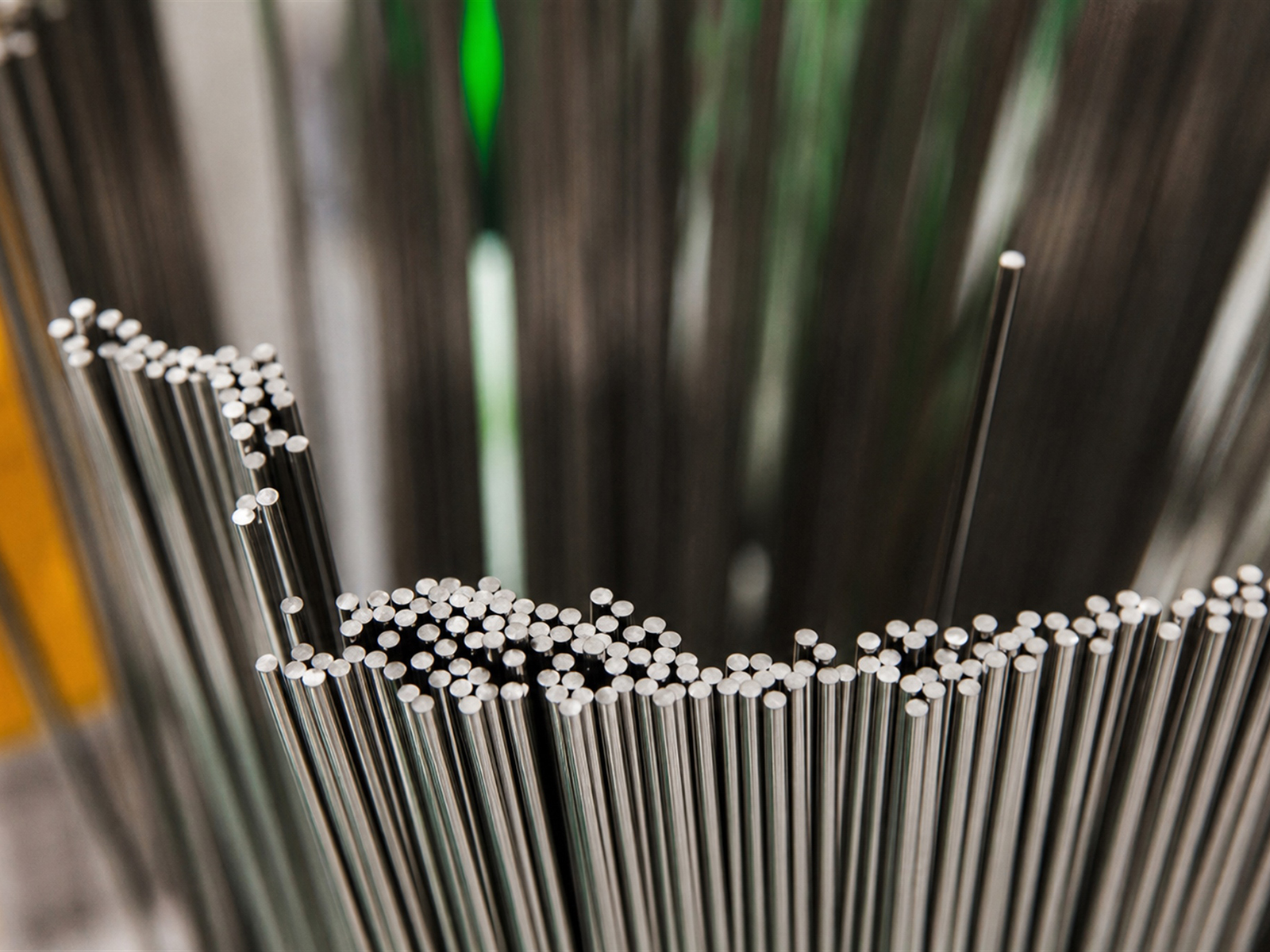
The magnetostrictive effect refers to the phenomenon whereby ferromagnetic materials undergo deformation when subjected to a magnetic field. As an industrially pure nickel grade, Ni200 nickel bars—classified as a soft magnetic material—exhibit distinctive magnetostrictive characteristics, demonstrating significant application value in precision displacement actuators, sonar transducers, ultrasonic generators, and micro-positioning systems. This article provides an in-depth exploration of the material properties, working principles, application advantages, and future development prospects of Ni200 nickel bars in magnetostrictive devices.
1. Magnetostrictive Properties of Ni200 Nickel Bars
(1) Magnetostrictive Coefficient
The saturation magnetostrictive coefficient (λs) of Ni200 nickel bars is approximately -32×10⁻²⁶ at 20°C. Although this value is lower than that of Terfenol-D alloys (λs ≈ +1,800×10⁻²⁶), Ni200 offers lower coercivity and higher magnetic permeability, providing distinct advantages in low-frequency and large-stroke applications.
(2) Magnetic Permeability
The relative magnetic permeability of Ni200 nickel bars can exceed 100,000 in the annealed condition, making it an ideal soft magnetic material. High permeability means that a significant magnetostrictive effect can be achieved under relatively weak external magnetic fields.
(3) Mechanical Quality Factor
The mechanical quality factor (Qm) of Ni200 nickel bars is approximately 50–100, indicating low energy loss during resonant operation. This makes Ni200 well-suited for high-efficiency ultrasonic transducers.
Performance Comparison
| Performance Indicator | Ni200 Nickel Bar | Terfenol-D | Stainless Steel 316L |
| Saturation Magnetostrictive Coefficient | -32×10⁻²⁶ | +1,800×10⁻²⁶ | ≈0 |
| Relative Magnetic Permeability | >100,000 | ~10 | 1.002 |
| Density (g/cm³) | 8.90 | 9.50 | 8.0 |
| Seawater Corrosion Rate | <0.001 mm/year | N/A | 0.1 mm/year |
2. Applications of Ni200 Nickel Bars in Magnetostrictive Devices
(1) Precision Displacement Actuators
Magnetostrictive displacement actuators fabricated from Ni200 nickel bars enable nanometer-precision positioning control. In semiconductor lithography machines, atomic force microscopes (AFM), and precision measurement equipment, Ni200 nickel bar actuators offer the advantages of rapid response and high resolution.
(2) Sonar Transducers
The corrosion resistance of Ni200 nickel bars in seawater makes them an ideal material for hydroacoustic sonar transducers. Compared to Terfenol-D, although Ni200 has a lower magnetostrictive coefficient, its excellent mechanical strength and seawater corrosion resistance compensate for this difference.
(3) Ultrasonic Generators
Ni200 nickel bar ultrasonic generators are widely used in cleaning, welding, and machining applications. The high magnetic permeability and low magnetic hysteresis loss of Ni200 enable it to maintain efficient energy conversion even under high-frequency operating conditions.
(4) Damping and Vibration Isolation Devices
Leveraging the magnetostrictive effect of Ni200 nickel bars, magnetostrictive dampers can be designed for vibration isolation and noise suppression in precision instruments.
Application Overview
| Application Area | Ni200 Component | Key Performance | Operating Frequency |
| Precision Actuators | Displacement Rod | High Permeability | DC–1 kHz |
| Sonar Transducers | Vibrating Diaphragm | Seawater Corrosion Resistance | 10 kHz–100 kHz |
| Ultrasonic Cleaning | Horn (Cauldron) | Mechanical Quality Factor | 20–40 kHz |
3. Advantages of Ni200 Nickel Bars
- Corrosion Resistance: Ni200 performs exceptionally well in seawater and corrosive media, eliminating the need for additional protective coatings.
- Excellent Machinability: Ni200 nickel bars can be machined through turning, milling, and welding processes.
- Non-Toxicity: Ni200 does not contain rare-earth elements, making it environmentally friendly.
- Cost-Effectiveness: Compared to rare-earth magnetostrictive materials such as Terfenol-D, Ni200 offers lower pricing and more stable raw material supply.
Material Comparison Summary
| Comparison Item | Ni200 | Terfenol-D | Galfenol |
| Magnetostrictive Coefficient | -32 | +1,800 | +400 |
| Coercivity (kA/m) | 10–20 | 50–80 | 20–40 |
| Density (g/cm³) | 8.90 | 9.50 | 7.20 |
| Cost Coefficient | 1.0 | 5.0 | 3.0 |
4. Technical Challenges and Improvement Directions
- Lower Magnetostrictive Coefficient: Can be improved through composite materials with other substances or optimization of heat treatment processes.
- Operating Frequency Limitation: The magnetostrictive effect of Ni200 performs optimally at low frequencies (<100 kHz).
- Temperature Stability: The magnetostrictive coefficient of Ni200 varies significantly with temperature; thermal compensation must be considered in device design.
5. Conclusion
Ni200 nickel bars, with their unique magnetostrictive characteristics, excellent corrosion resistance, and favorable machinability, hold significant application value in magnetostrictive devices such as precision actuators, sonar transducers, and ultrasonic generators. With advancements in materials science and manufacturing processes, the application prospects of Ni200 nickel bars in the magnetostrictive field will continue to expand.
FAQ
Q1: How does the magnetostrictive coefficient of Ni200 nickel bars compare to Terfenol-D?
The saturation magnetostrictive coefficient of Ni200 (-32×10⁻²⁶) is significantly lower than that of Terfenol-D (+1,800×10⁻²⁶). However, Ni200 offers higher magnetic permeability and superior corrosion resistance.
Q2: Can Ni200 nickel bars be used long-term in seawater environments?
Yes. The corrosion rate of Ni200 in seawater is less than 0.001 mm/year, making it highly suitable for marine sonar and other seawater-environment applications.
Q3: Why is Ni200 nickel bar more expensive than stainless steel?
Ni200 is a high-purity nickel material with higher raw material costs. Additionally, its smelting and processing techniques are more complex.
Finding a Reliable Ni200 Nickel Bar Supplier
Baoti Titanium Valley Titanium-Nickel-Zirconium Material Processing Co., Ltd. is a professional manufacturer of high-end rare metal processing products. Equipped with an Italian Danieli rolling production line, the company produces over 20,000 metric tons of nickel bars annually, offering full-size customization and EN 10204 Type 3.1 certification services. Contact us immediately for technical support and quotation:
For a broader view of available grades, supply forms, and related specifications, explore our Nickel Rod category.
For product-level details and supply options, you can also review our ASTM B160 Nickel Rod page.
References
ASTM International. ASTM B160-21 Standard Specification for Standard Nickel and Nickel-Cobond Alloy Rod and Bar[S]. West Conshohocken: ASTM International, 2021.