
What Is the Electrical Conductivity of Gr5 Titanium Rod?
- Gr5 Titanium rod
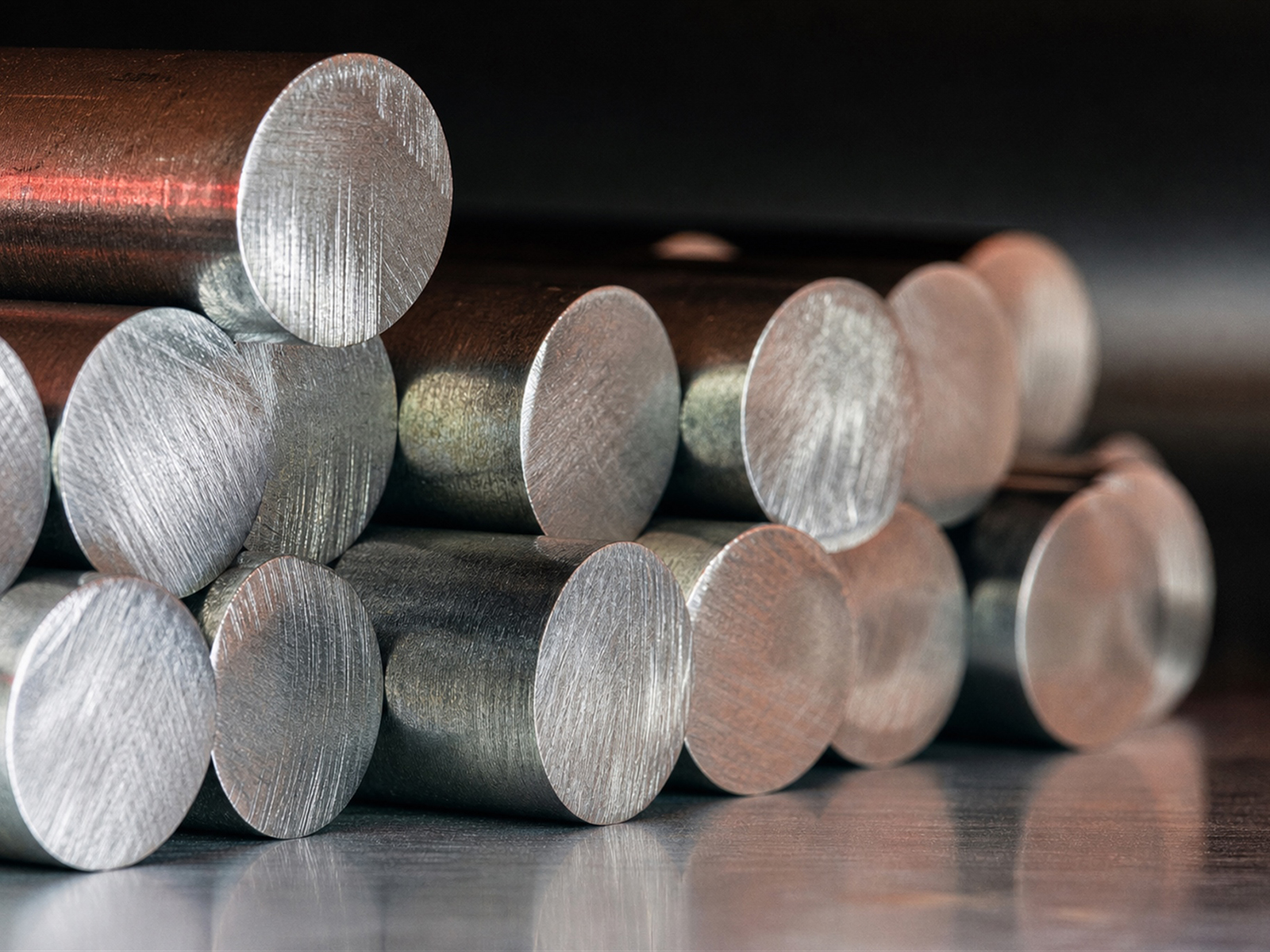
As the most widely used titanium alloy material, Gr5 titanium rod (Ti-6Al-4V) has relatively weak electrical conductivity, with a conductivity of about 5.62×10⁵ S/m, which is only about 0.94% of copper, and a resistivity of about 1.78 uOhm. m. This lower conductivity results from its alloyed structure-the addition of aluminum and vanadium enhances the material’s mechanical strength, but also increases electron scattering, limiting the ability of free electrons to move. Although the electrical conductivity is not as good as that of pure metals, Gr5 titanium rods are still irreplaceable structural materials in aerospace, medical implants, precision machinery and other fields due to their excellent strength-to-weight ratio, corrosion resistance and high temperature stability. Understanding its conductive properties is crucial for rational material selection and process design.
1. What Are the Basic Electrical Properties of Gr5 Titanium Alloy?
(1) What Are the the Influence Mechanism of Alloy Composition on Electrical Conductivity?
In the Ti-6Al-4V alloy, 6% aluminum and 4% vanadium are not a simple physical mixture, but form an α+β dual-phase structure. Aluminum serves as an α-phase stabilizing element and vanadium serves as a β-phase stabilizing element. Their presence significantly changes the electronic structure of the titanium matrix. Alloying elements produce lattice distortion and point defects in the crystal lattice. These microstructural features become scattering centers during electron transmission, shortening the electron mean free path. Compared with the electrical conductivity of pure titanium (Gr1), which is about 2.38×10⁶ S/m, the electrical conductivity of Gr5 has dropped by about 76%. This is the price paid for electrical performance in order to obtain a tensile strength of more than 895 MPa.
(2) What Should You Know About the Influence of Temperature Changes on Resistivity?
The resistivity of metallic materials usually increases with temperature, and Gr5 titanium alloy also follows this rule. Within the operating temperature range from room temperature to 400℃, its resistivity increases approximately linearly, with a temperature coefficient of approximately 0.0035/ C. This means that in high-temperature applications, the conductive properties of the material will be further reduced. During the vacuum melting and heat treatment process, the temperature can reach around the melting point of 1668℃. At this time, the material is in a semi-solid or liquid state, and the electrical behavior undergoes a qualitative change. This temperature sensitivity requires that performance drift caused by thermal effects must be fully considered when designing applications involving current transmission or electromagnetic shielding.
(3) What Are the Comparison of Conductive Properties with Other Engineering Materials?
Comparing Gr5 titanium rods with common engineering materials can provide a clearer understanding of its electrical positioning. The electrical conductivity of copper is as high as 5.96×10⁷ S/m, which is an ideal conductive material; aluminum is about 3.77×10⁷ S/m; stainless steel 304 is about 1.45×10⁶ S/m; and Gr5 titanium alloy is at the level of 5.62×10⁵ S/m, which is lower than stainless steel but far worse than pure metal. This low conductivity makes it unsuitable as the main conductive component. However, in certain composite working conditions, when high strength, corrosion resistance and moderate conductivity are required at the same time, Gr5 becomes the best choice for balancing performance.
| Material type | Conductivity (S/m) | Resistivity (uOhm. m) | Density (g/cm³) | Typical applications |
| pure copper | 5.96×10⁷ | 0.017 | 8.96 | Power transmission, electronic circuits |
| pure aluminum | 3.77×10⁷ | 0.027 | 2.70 | Transmission cables, radiators |
| 304 stainless steel | 1.45×10⁶ | 0.69 | 7.93 | Corrosion-resistant structural parts |
| Gr5 titanium alloy | 5.62×10⁵ | 1.78 | 4.43 | Aerospace structures, medical implants |
| Gr2 pure titanium | 2.38×10⁶ | 0.42 | 4.51 | Chemical equipment, heat exchanger |
2. What Are the the Actual Impact of Working Conditions on Conductive Properties?
(1) What Should You Know About Electrochemical Behavior in Corrosive Media Environments?
In marine engineering and chemical equipment, Gr5 titanium rods are often exposed to strong corrosive media such as chloride ions and sulfuric acid. A dense TiO2 passivation film will quickly form on the surface of the material. This oxide film is only a few nanometers thick but has extremely high insulation properties. The presence of the passivation film significantly increases the surface contact resistance, which may lead to poor contact in electrical connection applications. But this film also prevents further corrosion of the matrix, allowing the material to maintain stable volume resistance for a long time. When designing the electrode bracket of a seawater desalination device or the guide rod of a chemical reactor, it is necessary to balance the contradiction between conductivity and corrosion resistance through surface treatment (such as peeling or polishing).
(2) What Should You Know About Skin Effect Under the Action of High-frequency Electromagnetic Fields?
When high-frequency current passes through the Gr5 titanium rod, a significant skin effect will occur – the current is concentrated in a thin layer on the surface of the conductor, and the effective conductive cross-sectional area is reduced. Titanium alloys have a relative magnetic permeability close to 1 (non-magnetic material), but their lower electrical conductivity results in a larger skin depth. At 1 MHz, the skin depth is approximately 0.33 mm, compared to only 0.066 mm for copper. This means that in radio frequency applications, the high-frequency resistance loss of Gr5 titanium rods is relatively small. This characteristic is exploited in the shielding structures of some precision sensors and aerospace electronic equipment. The non-magnetic nature of the material also avoids hysteresis losses, making it suitable for use as support members for magnetic resonance imaging (MRI) equipment.
(3) What Should You Know About Resistance Change Characteristics Under Mechanical Stress?
When Gr5 titanium rods are subjected to tensile, compressive or torsional loads, the lattice spacing and dislocation density will change, thereby affecting electron mobility. Research shows that when the strain reaches 5%, the resistivity can increase by 2-3%. This strain-resistance effect has potential applications in structural health monitoring – by monitoring resistance changes, the stress state of the component can be inferred. Under fatigue loading conditions, the initiation and expansion of microcracks within the material will cause the local current path to be interrupted and the resistance to show a nonlinear jump. This provides a physical basis for the development of smart structures based on titanium alloys, but also requires strict control of mechanical preload forces in precision electrical connections.
3. What Are the Differences in Electrical Conductivity Under Different Processing Conditions?
(1) What Are the Effect of Heat Treatment Process on Microstructure and Electrical Properties?
The annealed Gr5 titanium rod has undergone stress relief treatment. The α and β phases are evenly distributed and the grain boundaries are clear. In this organizational state, electron scattering mainly comes from the phase interface and alloy elements, and the resistivity is at the standard level (about 1.78 uOhm. m). The hot-rolled material retains a large number of dislocations and residual stresses. These crystal defects add additional scattering centers and increase the resistivity by 5-8%. Aging strengthening treatment will precipitate fine second phase particles. Although the strength and hardness are significantly improved (up to more than 340 HB), these nanoscale precipitates are densely distributed and strongly hinder electron transmission, causing the resistivity to further increase by 10-15%.
(2) What Should You Know About Effect of Electrical Contact on Degree of Surface Finish?
The black leather rod (forged surface) retains the oxide scale and rough texture, and the surface resistance can reach 3-5 times the normal value. It is not suitable for direct use as electrical contacts. The peeling rod removes the oxide layer through careless peeling, exposing the silver-white metal matrix, and the surface resistance is reduced to about 1.2 times the level of the matrix. The bright surface (turned and polished) reaches a surface roughness of Ra 0.8 or above, the microscopic protrusions are flattened, the actual contact area is greatly increased, and the contact resistance is reduced to a minimum. In precision sensor housings or guide shafts of automation equipment that require reliable electrical connections, polished surface treatments must be selected, combined with conductive grease to further reduce interface resistance.
(3) What Should You Know About Electrical Effects of Cold Working Deformation on Crystal Structure?
The cold drawing process causes work hardening of the Gr5 titanium rod, the dislocation density increases dramatically, and the grains are elongated along the deformation direction to form a fibrous structure. This strong lattice distortion increases the probability of electron scattering and increases the resistivity by 12-18% compared to the annealed state. The greater the deformation (such as cold drawing from φ50 to φ8), the more significant the degree of hardening and the more obvious the increase in resistance. Cold working also introduces orientation – the resistivity along the rolling direction is slightly lower than perpendicular, with anisotropy of about 3-5%. In high-precision electrical applications, this directivity can lead to uneven current distribution. Partial work hardening can be eliminated by intermediate annealing, the equiaxed morphology of the grains can be restored, and the electrical properties can return to standard levels, but the loss of strength needs to be weighed.
| Processing status | Surface treatment | Resistivity (uOhm. m) | Surface contact resistance coefficient | Typical application scenarios |
| Annealed state | Black leather surface | 1.78 | 3.0-5.0 times | Structural blanks, forging blanks |
| Annealed state | peeling surface | 1.78 | 1.2 times | General machining, fasteners |
| Annealed state | polished surface | 1.78 | 1.05 times | Precision shafts, electrical contacts |
| cold working state | peeling surface | 1.99-2.10 | 1.3 times | High strength spring, guide rod |
| time-effective strengthening state | Turned surface | 2.05-2.25 | 1.15 times | Aviation fasteners, wear-resistant parts |
4. How Is Conductive Performance Optimization Strategies in Special Application Scenarios?
(1) What Should You Know About Bioelectrical Compatibility Design of Medical Implants?
In orthopedic implants (such as artificial joints and spinal fixators), Gr5 titanium rods need to coexist with human tissue for a long time. Although its conductivity is low, it is an advantage in the in vivo electrophysiological environment – low conductivity reduces electrochemical corrosion and ion migration, avoiding the toxicity of metal ions to surrounding tissues. The TiO2 passivation film on the surface of the implant has a high dielectric constant and can effectively isolate the interference of bioelectric signals. In devices that require electrical isolation, such as neural electrodes or pacemaker housings, the material’s modest insulating properties provide an additional safety barrier. By plasma spraying a hydroxyapatite coating, biocompatibility can be further enhanced while maintaining electrical stability.
(2) What Should You Know About Electrostatic Protection Measures for Aerospace Structural Parts?
Aircraft landing gear, engine connecting rods and other load-bearing components are mostly forged from Gr5 titanium rods. During high-altitude flight, static electricity accumulates due to friction between the aircraft body and the air. If it cannot be discharged in time, it will cause sparks and even damage electronic equipment. The moderate resistivity of titanium alloy makes it neither easy to accumulate charges like an insulator nor form a strong discharge channel like a good conductor. Establish low-impedance grounding paths through copper-based conductive bushings, silver-plated connectors, or conductive adhesives at key locations to guide static charges to the fuselage shell. In the structural design, it is necessary to ensure that the contact resistance between titanium alloy components is less than 0.1Ω, and reliable electrical continuity can be achieved by controlling the bolt pretightening force with a torque wrench and using star-shaped washers to puncture the oxide film.
(3) How Is Electromagnetic Shielding Application Skills in Precision Instruments?
The support frames of optical platforms and precision measuring instruments are often constructed of Gr5 titanium rods to obtain high stiffness and low thermal expansion coefficient. In strong electromagnetic environments, sensitive circuits need to be shielded. The shielding effectiveness of titanium alloys mainly relies on reflection loss rather than absorption loss – incident electromagnetic waves are reflected on the metal surface, and the reflection coefficient is related to the conductivity. Although the shielding effectiveness of Gr5 (approximately 40-60 dB@1GHz) is not as good as that of copper or aluminum, it can be compensated for by structural optimization: using a multi-layer shell design to attenuate electromagnetic waves using multiple reflections; adding conductive rubber seals at key gaps; chemical nickel plating or sputtering copper film on the surface to form a composite conductive layer. These measures enable the titanium alloy frame to maintain its lightweight and high-strength characteristics while also meeting EMC (electromagnetic compatibility) requirements.
5. What Should You Know About Practical Suggestions for Selection and Process Control?
(1) What Should You Know About Material State Selection Principles Based on Electrical Requirements?
When the application scenario has clear requirements for conductivity, it needs to be weighed based on performance priorities. If the resistance requirements are strict (such as contact resistance <10mΩ), annealed peeled or polished rods should be selected to avoid cold working and age-strengthening treatments; if strength is the primary factor (needs to be above 1000 MPa), the increase in resistance caused by cold-working or age-strengthened conditions should be accepted, and the contact performance can be improved through local plating. For components that both bear high loads and participate in electrical connections (such as the operating rod of a high-current switch), a segmented design can be adopted: the stress-bearing section is in a high-strength aging-strengthened state, and the contact section is in an annealed state and surface-plated with silver.
(2) What Are the Electrical Performance Protection Measures During Processing?
The cutting heat and surface residual stress generated during machining can change the electrical state of the material. The depth of the heat-affected layer can be reduced by using low-speed cutting (line speed <60m/min), sufficient cooling, and the use of sharp tools. Coarse grains will form in the heat-affected zone of the welded joint, and the resistivity in this area can increase by 15-20%, which needs to be eliminated through post-weld annealing. Electrical discharge machining will form a remelted layer and micro-cracks on the surface, causing a surge in contact resistance, and the white bright layer must be removed by subsequent grinding. Although chemical polishing can obtain an extremely smooth surface, the pickling liquid residue may introduce impurity ions. It must be thoroughly rinsed with deionized water and vacuum dried before use.
(3) What Are the Electrical Performance Testing Methods in Quality Inspection?
The conventional four-probe method can measure the volume resistivity of the rod. During the test, it is necessary to ensure that the probe is in full contact with the sample and the pressure is controlled at 50-100N. The contact resistance test uses the Kelvin four-wire method to separate the current loop and the voltage measurement loop, eliminating the influence of lead resistance, and the accuracy can reach the micro-ohm level. For high-volume production, eddy current testing can be used to indirectly assess conductivity – the impedance change of an eddy current probe is related to the material conductivity, which is slightly less accurate but fast and non-destructive. For key applications such as aerospace and aerospace, a material resistivity test report (MTC) needs to be provided to ensure that the performance fluctuation of each batch is less than +/-5%, ensuring the reliability of electrical connections from the source.
6. What Is the Conclusion?
Although the electrical conductivity of Gr5 titanium rod is not as good as that of traditional conductive materials, its electrical conductivity of 5.62×10⁵ S/m is at a medium level among titanium alloys. Combined with its excellent mechanical properties and corrosion resistance, it shows unique value in many engineering fields. Understanding the influence mechanism of alloy composition, processing status, and environmental factors on electrical properties, and taking targeted process optimization measures, can give full play to the comprehensive advantages of materials and meet the complex needs of high-end applications such as aerospace, medical, and precision manufacturing.
FAQ
Q1: Will the electrical conductivity of Gr5 titanium rods decay over time?
In a dry environment at normal temperature, the volume resistivity of Gr5 titanium rod remains stable for a long time. However, in a high-temperature corrosive environment, the surface oxide film will gradually thicken, and the contact resistance may slowly increase. Regular surface cleaning and re-establishing metal contact maintains performance.
Q2: How to reduce the contact resistance at the connection between Gr5 titanium rod and copper wire?
Surface silver plating or nickel plating can be used to reduce interface resistance, conductive paste can be used to fill microscopic gaps, and sufficient contact pressure can be ensured through bolts or welding. Avoid making electrical connections directly on oxidized surfaces. If necessary, mechanically polish to expose fresh metal.
Q3: Can Gr5 titanium rods be used in dynamic contact applications that require frequent energization?
It is not recommended to be used in high-frequency mechanical-electrical composite working conditions such as sliding electrical contacts or switch contacts. The high surface hardness makes it easy to wear the paired parts, and the fast repair speed of the oxide film leads to unstable contact. Copper alloy or gold-plated contacts should be used for this type of application, with titanium only serving as a support structure.
How Can You Contact Us?
As a professional Gr5 titanium rod manufacturer, Baoji Titanium Valley Titanium Nickel Zirconium Material Processing Co., Ltd. has a complete production line and strict quality system, and can provide titanium rod products of various specifications and customized processing services that comply with ASTM B348 standards. Welcome to inquire about technical parameters and batch supply plans through sales@titaniumvalleys. com.
For a broader view of available grades, supply forms, and related specifications, explore our Titanium Rod category.
For product-level details and supply options, you can also review our ASTM F136 Gr5 Eli (Gr23) Titanium Rod page.
References
- Zhao Yongqing, Qu Hennglei. “Basics of Physical Metallurgy of Titanium Alloys”. Metallurgical Industry Press, 2019.
- Li Shaofeng, Wang Xinyun. “Titanium Alloy Materials and Application Technology for Aviation”. National Defense Industry Press, 2020.
- Zhang Xiyan, Li Miaoquan. “Titanium and Titanium Alloy Processing Technology”. Chemical Industry Press, 2021.