
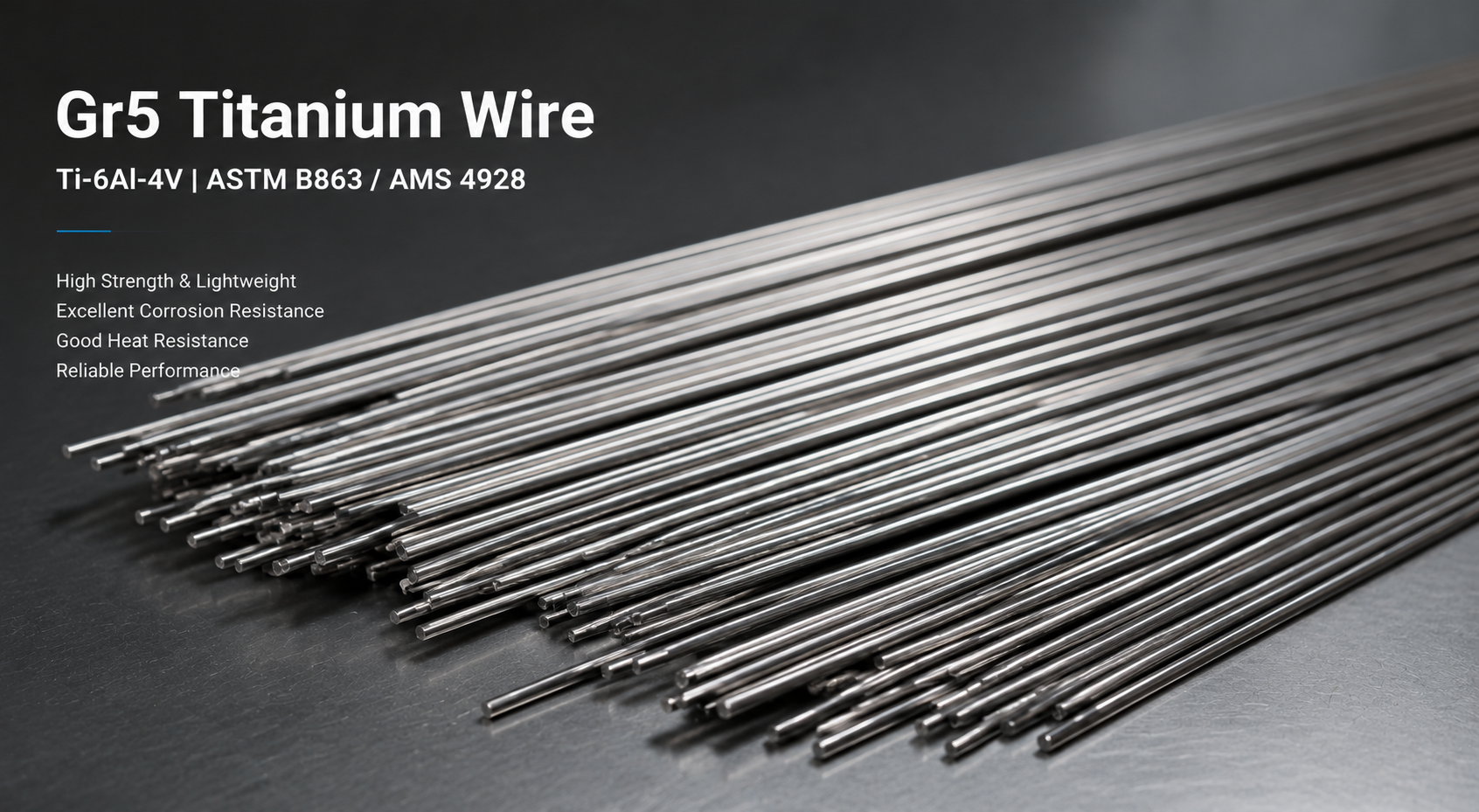
After more than a decade of material development within additive manufacturing, Grade 5 titanium wire has emerged as a primary feedstock material for metal 3D printing. As an α+β dual-phase titanium alloy, it not only satisfies aerospace components’ stringent demand for an ultimate strength-to-weight ratio but also overcomes geometric limitations inherent to conventional manufacturing techniques. For wire-based additive manufacturing processes including Wire Arc Additive Manufacturing (WAAM) and Directed Energy Deposition (DED), Grade 5 titanium wire delivers superior formability. Equipment manufacturers report drastically reduced print failure rates relative to early-generation feedstock materials, alongside improved fatigue life of finished components. From custom structural brackets on Boeing 787 Dreamliners to patient-specific medical implant designs, this alloy wire continues to expand the performance boundaries of high-end additive production. With a density approximately 57% that of steel and a maximum continuous service temperature of 400 °C (short-term peak temperatures of 450–500 °C are permissible yet accompanied by degraded mechanical performance), this unique combination of properties delivers an ideal material solution for weight-critical applications.
1. How Core Properties of Grade 5 Titanium Wire Align With 3D Printing Requirements
1.1 Microstructural Stability Guarantees Printing Consistency
The dual-phase microstructure of Ti-6Al-4V retains outstanding stability under rapid heating and cooling cycles characteristic of additive manufacturing. The α phase delivers baseline tensile strength, while the β phase imparts exceptional ductility. This balanced phase distribution enables the formation of fine-grained microstructures during WAAM when thermal input is properly controlled. Compared to commercially pure titanium wire, Grade 5 exhibits low susceptibility to hot cracking; field engineering data confirms a marked reduction in cracking tendency under optimized process parameters, a critical advantage for fabricating intricate thin-walled geometries.
1.2 Optimized Thermophysical Property Combination
A melting point of roughly 1640 °C paired with a room-temperature thermal conductivity of 7.5–8.0 W/(m·K) creates a uniquely balanced thermophysical profile. Its low thermal conductivity concentrates thermal energy within the melt pool, lowering preheating requirements for build plates. The alloy possesses an elastic modulus of 110 GPa, an intrinsic stiffness metric; however, part distortion during support removal stems primarily from residual stress rather than elastic modulus, which can be mitigated via targeted post-print heat treatment. These thermophysical parameters enable DED systems to operate stably across a broad viable process window.
1.3 Chemical Purity Dictates End Component Performance
Vacuum melting technology restricts oxygen content to below 0.20%. Aerospace-grade Grade 5 wire for additive manufacturing mandates hydrogen content ≤0.010%, while industrial-grade material allows a relaxed threshold of 0.015%. Feedstock purity directly correlates with the fatigue performance of printed parts. Precisely controlled aluminum (5.5–6.75 wt.%) and vanadium (3.5–4.5 wt.%) concentrations ensure repeatable mechanical properties across production batches of printed components. Tightly regulated manufacturing processes yield minimal variance in ultimate tensile strength between separate production lots.
2. Competitive Advantages Relative to Alternative Metal Wires
Table 1: Room-Temperature Typical Property Comparison Between Grade 5 Titanium Wire and Common Additive Manufacturing Metal Wires
| Material Property | Annealed Grade 5 Titanium Wire | Annealed 316L Stainless Steel Wire | As-Printed AlSi10Mg Aluminum Wire | Solution-Aged Inconel 718 Nickel-Base Wire |
|---|---|---|---|---|
| Density (g/cm³) | 4.43 | 7.98 | 2.68 | 8.19 |
| Ultimate Tensile Strength (MPa) | 895–930 | 485–620 | 340–380 | 1100–1240 |
| Specific Strength (MPa·cm³/g) | 202 | 69 | 134 | 141 |
| Corrosion Resistance¹ | Excellent (5,000 h ASTM B117 salt spray exposure with no red rust formation) | 720 h ASTM B117 (5 wt.% NaCl, 35 °C) | 168 h | >3,000 h |
| Maximum Service Temperature (°C)² | 400 continuous / 600 short-term | 450 | 200 | 650 |
| Support Removal Difficulty³ | Moderate (balanced elastic modulus facilitates clean support separation) | Low (high ductility) | Low (low material hardness) | High (high strength and significant springback) |
- All corrosion testing complies with ASTM B117 (5 wt.% NaCl solution, 35 °C). Titanium alloys do not generate iron oxide red rust and retain a metallic surface finish after salt spray exposure, classified as excellent corrosion resistance. Stainless steel and aluminum alloys develop red rust and white oxidation products respectively; listed exposure durations serve only as reference benchmarks.
- Grade 5 titanium wire has a 400 °C continuous operating limit; sustained exposure above this threshold accelerates microstructural degradation. The 600 °C short-term limit applies to exposure durations under one hour and is not intended for standard service design criteria.
- Support removal difficulty constitutes a qualitative assessment derived from mechanical properties (tensile strength, ductility, elastic modulus) and industry operational experience for DED and WAAM processes. Actual removal complexity depends on part geometry and post-processing methods; table ratings are for reference only.
2.1 Dominant Specific Strength-to-Density Performance
For repair applications of low-pressure compressor components within aero engines, Grade 5 titanium printed assemblies deliver substantial weight reduction versus nickel-alloy alternatives while meeting required service lifespans. This weight advantage is amplified within unmanned aerial vehicle manufacturing: frame structures fabricated from Grade 5 titanium offer superior durability at far lower mass than equivalent stainless steel designs. Structural bracket data from a space launch program verifies that Grade 5 printed hardware reduces overall vehicle mass, directly cutting launch operational costs.
2.2 Universal Compatibility With Extreme Operating Environments
Grade 5 exhibits no ductile-to-brittle transition at cryogenic temperatures down to -196 °C (liquid nitrogen), exceptional chloride corrosion resistance under deep-sea hydrostatic pressure (hydrostatic loading does not alter corrosion mechanisms), and chemical stability across a pH range of 2–14. These characteristics establish Grade 5 as a leading candidate material for extreme-environment hardware. Comparative marine engineering testing confirms that Grade 5 printed seawater pump impellers deliver far longer service lifespans than super duplex stainless steel equivalents in chloride-rich seawater environments, substantially lowering long-term maintenance expenditure.
2.3 Biocompatibility Unlocks Expansive Medical Device Market Opportunities
Non-magnetic, non-toxic material characteristics combined with robust osseointegration capability position Grade 5 titanium wire as a staple feedstock for additive-manufactured medical implants. The production cycle for patient-specific cranial reconstruction plates and spinal fusion cages shrinks from multiple weeks via traditional casting to just several days using wire-based additive processes. Clinical research validates accelerated osseointegration and improved long-term implant survival rates for titanium alloy medical hardware. Customized additively manufactured components capture an increasing market share within orthopedic implant segments.
3. Additive Manufacturing Processes That Maximize Grade 5 Titanium Wire Performance Potential
3.1 Technological Advancements in Wire Feeding Systems
Servo-driven wire feed mechanisms integrated into modern WAAM platforms achieve feed precision of ±0.01 mm. Paired with precision-manufactured Grade 5 wire ranging from 1.0 mm to 1.6 mm in diameter, these systems enable ultra-thin layer deposition of 0.8 mm per pass. Premium-grade titanium wire (diameter tolerance ±0.01 mm, ovality <0.5%) stabilizes metal transfer within the melt pool. Comparative process trials demonstrate that high-precision Grade 5 wire improves arc stability and reduces spatter generation during deposition.
3.2 Multi-Axis Kinematics Unlock Unrestricted Design Freedom
Five-axis hybrid manufacturing centers integrated with DED deposition heads enable direct additive growth of complex geometric features onto pre-forged substrate blanks. In one low-pressure compressor blisk repair case study, Grade 5 titanium wire additive deposition restored damaged blade tenons, boosting the reclamation yield of otherwise scrapped engine components. This hybrid additive-subtractive manufacturing workflow consolidates multi-step conventional fabrication sequences into a single unified production cycle, drastically improving raw material utilization efficiency.
3.3 Industrial Value of Curated Process Parameter Databases
Table 2: Typical Process Parameter Ranges for Grade 5 Titanium Wire Additive Manufacturing
| Additive Process | Arc Power / Laser Power | Wire Feed Speed (m/min) | Travel Speed (mm/s) | Layer Thickness (mm) | Relative Density (%)¹ |
|---|---|---|---|---|---|
| WAAM-CMT² | Arc Power: 1000–2000 W | 3.5–5.2 | 8–12 | 1.2–2.0 | 99.2 |
| L-DED³ | Laser Power: 800–1500 W | 2.0–4.0 | 10–18 | 0.5–1.0 | 99.6 |
| Laser-Arc Hybrid Deposition⁴ | Laser Power: 2000 W + Arc Power: 600 W | 4.5–6.0 | 15–25 | 0.8–1.5 | 99.8 |
- Relative density represents apparent density (measured density / theoretical density × 100%), measured per ASTM B962 Archimedes immersion testing. Aerospace load-bearing components impose additional internal void classification requirements (per ASTM E2691 standards, porosity <1% with no continuous interconnected voids).
- WAAM-CMT (Cold Metal Transfer Wire Arc Additive Manufacturing) utilizes an electric arc heat source with no laser power input.
- L-DED (Laser Directed Energy Deposition) employs a laser heat source exclusively.
- Laser-arc hybrid processes deploy simultaneous laser and arc heat sources, with power ratings listed separately for each energy input.
4. Industries Accelerating Adoption of Grade 5 Titanium Wire Additive Manufacturing
4.1 Aerospace & Aviation: Paradigm Shift in Structural Component Production
Boeing integrates multiple additively manufactured titanium alloy components within the 787 airframe, several produced from Grade 5 titanium wire. Topology-optimized brackets deliver significant mass reduction, lowering aircraft fuel consumption. Airbus’s satellite bracket programs achieve drastic lead time reduction: assemblies requiring months for conventional casting reach final specifications in a matter of days via wire-based deposition, slashing design iteration cycles. Commercial space launch manufacturers utilize Grade 5 wire additive manufacturing for integrated engine hardware incorporating complex internal cooling channels, deployed within temperature-compliant operational zones.
4.2 Medical Devices: Patient-Specific Customization Revolution
Full production workflows for patient-specific craniomaxillofacial implants, from CT scan data acquisition to surgical implantation, are completed within days. The surface roughness of Grade 5 printed hip prostheses can be controlled between Ra 0.8 μm and Ra 3.2 μm via post-print sandblasting to meet clinical osseointegration surface morphology specifications. Porous lattice architectures for spinal fusion cages (60–80% porosity with engineered pore dimensions) facilitate bone ingrowth and reduce clinical healing timelines. Custom additively manufactured hardware continues to capture growing market share within orthopedic implant segments.
4.3 Energy Sector: Enhanced Operational Efficiency
High-pressure valve components for hydrogen value chains demand combined high tensile strength and hydrogen embrittlement resistance. Grade 5 printed valve cores deliver extended service life within dry high-pressure hydrogen environments (additional performance assessment is required for humid hydrogen exposure or cyclic fatigue loading), outperforming traditional stainless steel equivalents. Underwater control modules for deep-water oil and gas extraction integrate Grade 5 printed hardware to reduce system mass, expanding viable operational water depth limits. Corrosion monitoring data from an offshore wind farm project confirms extremely low corrosion rates for Grade 5 titanium fasteners in marine atmospheric exposure, projecting extended operational service lifespans.
5. Evaluation Protocols for Quality and Reliability of Grade 5 Titanium Wire Printed Components
5.1 End-to-End Full Traceability Quality Control Framework
Multi-stage inspection checkpoints are implemented throughout production, from titanium bar stock peeling to finished wire packaging, enabling complete batch traceability. Inductively Coupled Plasma Optical Emission Spectroscopy (ICP-OES) compositional analysis is conducted per production melt to verify aluminum and vanadium concentrations comply with ASTM B863 specification ranges (5.5–6.75 wt.% Al, 3.5–4.5 wt.% V). Mechanical characterization encompasses room-temperature tensile testing, high-temperature stress rupture testing, and low-cycle fatigue evaluation; all test data is automatically logged within Manufacturing Execution System (MES) archives to establish permanent quality records. Post-print components undergo non-destructive evaluation including eddy current surface flaw detection, X-ray CT internal void scanning, and ultrasonic C-scan interlayer bonding inspection, with internal defect detection resolution reaching 0.1 mm diameter (subject to inherent limitations of individual inspection methodologies).
5.2 Verification Standards for Critical Performance Metrics
Table 3: Standardized Characterization Test Suite for Grade 5 Titanium Wire Additive Manufactured Parts
| Test Item | Governing Standard | Acceptance Criterion | Testing Frequency | Supplementary Notes |
|---|---|---|---|---|
| Chemical Composition | ASTM E2371 (ICP-OES) | Al: 5.5–6.75 wt.%, V: 3.5–4.5 wt.% | Per melt batch | Hydrogen content requires separate analysis via inert gas fusion |
| Ultimate Tensile Strength | ASTM E8/E8M | ≥895 MPa | Per production lot | Room-temperature tensile testing of annealed specimens |
| Fatigue Performance | ASTM E466 | 10⁷ cycles at 450 MPa, stress ratio R=0.1, rotating bending loading, ambient temperature | Quarterly | Specimen surfaces polished; test reports must document stress ratio and loading configuration |
| Microstructure Grain Size | ASTM E112 (Grain Size Measurement) | Grain size number 6–8 (average grain diameter 20–45 μm) | Per production lot | Grain sizing graded per ASTM E112; ASTM E407 etch standards not applied |
| Hydrogen Content | ASTM E1447 (Inert Gas Fusion Analysis) | ≤0.015 wt.% industrial grade ≤0.008 wt.% aerospace grade | Per melt batch | No additional notes |
Acceptance criteria for one military aerospace program mandate printed component fatigue life equal to a minimum of 85% of wrought titanium forging performance. Optimized post-print heat treatment cycles (solution treatment followed by aging, with controlled temperature ramps to avoid overheating) enable as-printed Grade 5 hardware to achieve fatigue performance approaching wrought forging benchmarks, qualifying wire-based additive manufacturing for primary aircraft load-bearing structural applications.
5.3 Long-Term In-Service Performance Monitoring and Research
NASA’s space station Grade 5 titanium brackets have accumulated years of orbital service; periodic material sampling analysis confirms stable microstructures with minimal mechanical property degradation. A European high-performance automotive OEM deployed Grade 5 printed titanium suspension hardware on production sports cars; teardown inspection following extensive road testing detected no incipient fatigue crack formation. Real-world field service data continuously validates the long-term reliability of Grade 5 wire additive components and drives iterative updates to global industry material and process standards.
Conclusion
Ti-6Al-4V Grade 5 titanium wire combines exceptional specific strength, universal corrosion resistance across harsh environments, and robust additive manufacturing formability, advancing wire-based metal additive manufacturing from prototype-only fabrication to mass industrial production. Design engineers must account for its 400 °C maximum continuous operating temperature limit, while aerospace-grade feedstock requires hydrogen content ≤0.010 wt.%. Ongoing expansion of standardized process parameter databases and rising additive equipment automation maturity will unlock an expanding range of irreplaceable Grade 5 titanium applications across aerospace, medical device, and energy manufacturing sectors.
FAQ
Q1: What are the primary failure modes observed in Grade 5 titanium wire 3D printed components?
Dominant failure mechanisms include hydrogen-induced delayed cracking (elevated risk when aerospace-grade wire hydrogen content exceeds 0.010 wt.%), inadequate interlayer bonding (triggered by excessively rapid cooling rates), and hot cracking (driven by excessive thermal input or contaminated feedstock wire). These defects are mitigated through rigorous feedstock purity control, calibrated process parameter windows, and post-print Hot Isostatic Pressing (HIP) treatment. Reputable material suppliers sustain consistently high additive manufacturing production success rates.
Q2: What criteria verify a titanium wire supplier’s capacity to produce additive-manufacturing-grade Grade 5 feedstock?
Three core qualification benchmarks are required: consistent compositional control with full per-melt test certification (hydrogen ≤0.010 wt.% for aerospace specifications), tight geometric tolerances (diameter tolerance ±0.01 mm, wire ovality <0.5%), and defect-free surface finish free of scratches and oxide scale. Procurement teams must request valid ASTM B863 certification (Standard Specification for Titanium and Titanium Alloy Wire) alongside mechanical performance datasets from completed additive print trials. When feasible, conduct independent print validation testing with supplied wire samples prior to full production sourcing.
Q3: Can Grade 5 titanium wire printed hardware fully replace conventionally forged titanium components?
Complete substitution is viable for non-cyclic extreme-load applications, with certain complex additively manufactured geometries delivering superior structural performance relative to equivalent forgings. Additive Grade 5 titanium components are widely deployed for secondary aerospace structural hardware. Primary load-bearing flight components require Hot Isostatic Pressing (HIP) post-processing to eliminate internal voids and full compliance with governing aerospace material standards. Multiple European and U.S. aerospace specifications (AMS 7000 series) formally qualify additively manufactured titanium alloys for secondary aircraft structural applications.
Contect Us
Baoji Titanium Valley Titanium Nickel Zirconium Material Processing Co., Ltd. operates as a specialized Grade 5 titanium wire manufacturer equipped with continuous rolling production lines sourced from Danieli Italy, with an annual production capacity of 10,000 metric tons. Custom wire diameters ranging from 0.1 mm to 10.0 mm are available to meet diverse additive manufacturing specifications. Contact sales@titaniumvalleys.com immediately for technical engineering support and sample evaluation requests.
References
1.Zhang G, Li YB, Chen M. Influence of Hydrogen Content on Fatigue Properties of Ti-6Al-4V Alloy. Rare Metal Materials and Engineering, 2018, 47(5): 1542–1547.
2.Wang Y, Liu B, Zhao H. Clinical Application Progress of Titanium Alloy Implants in Orthopedic Surgery. Chinese Journal of Orthopedics, 2020, 40(12): 812–818.
3.Zhang H, Li Q, Wang L. Effects of Surface Roughness on Osseointegration Performance of Titanium Alloy Implants. Chinese Journal of Tissue Engineering Research, 2019, 23(10): 1568–1573.
4.Liu ZG, Chen K, Sun T. Microstructure and Mechanical Properties of Ti-6Al-4V Fabricated via Wire Arc Additive Manufacturing. Materials Reports, 2021, 35(8): 8145–8150.
5.Wu XF, Zhou Y, Li GP. Process Parameter Optimization of Ti-6Al-4V Fabricated via Laser Directed Energy Deposition. Chinese Journal of Lasers, 2022, 49(10): 1002001.
6.ASTM B863-14(2020) Standard Specification for Titanium and Titanium Alloy Wire.
7.ASTM E2371-21 Standard Test Method for Analysis of Titanium and Titanium Alloys by Direct Current Plasma and Inductively Coupled Plasma Atomic Emission Spectrometry.