
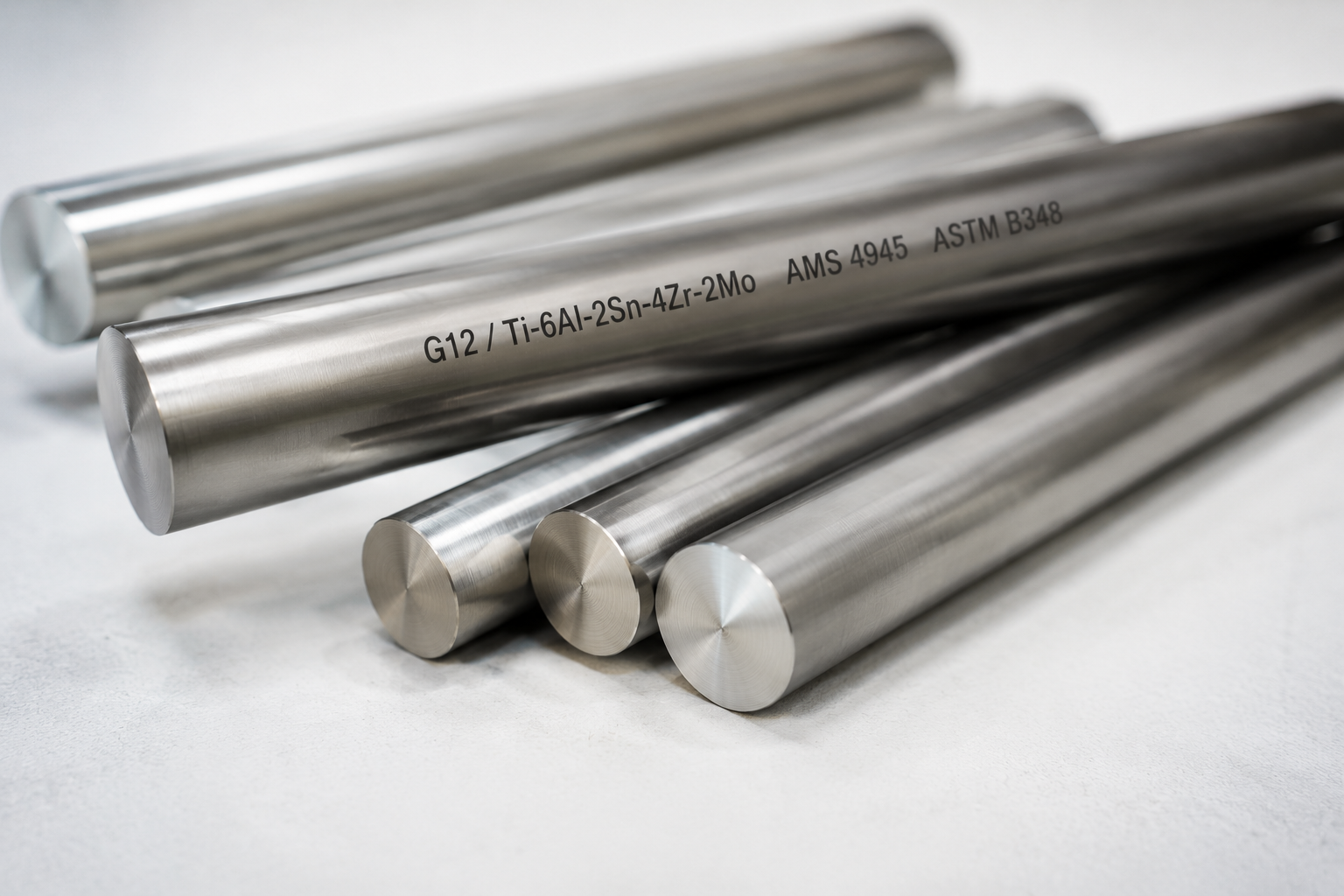
Grade 12 titanium bar is an α+β corrosion-resistant titanium alloy containing molybdenum and nickel with minor β-stabilizing elements Mo and Ni. It plays a vital role in the upgrade of corrosion-resistant materials across the global chemical, marine and high-end equipment industries. This Ti-0.3Mo-0.8Ni (wt.%) alloy features outstanding resistance to crevice corrosion and pitting corrosion, making it a preferred material for harsh corrosive environments in chemical processing, marine engineering, energy and other sectors. Compared with commercially pure titanium, Grade 12 titanium bar delivers superior stability in reducing acid media and chloride-containing environments, while retaining excellent weldability (TIG/MIG processes are recommended with strict inert gas shielding) and machinability. Cold working deformation is suggested to be controlled within 15%, with intermediate annealing applied after multiple working passes. Its unique alloy composition enables long-term stable operation at moderate temperatures, and it is particularly suitable for manufacturing critical equipment such as heat exchangers, reaction vessels and seawater desalination systems. As global manufacturing shifts toward high-end development, the market demand for Grade 12 titanium bars keeps growing, rendering it an indispensable strategic material in precision manufacturing.
I. Key Applications in the Chemical and Petrochemical Industries
1. Equipment Fabrication for Strongly Acidic Environments
Grade 12 titanium bar exhibits exceptional corrosion resistance in reducing acid media including sulfuric acid and hydrochloric acid. The synergistic effect of molybdenum and nickel greatly enhances the stability of the passive film under acidic conditions, making it an ideal choice for pickling equipment and chemical piping systems. Comparative tests show that in 10%~40% sulfuric acid solution at room temperature, the corrosion rate of Grade 12 titanium bar is reduced by more than 85% compared with 304 stainless steel, which effectively extends the service life of equipment.
2. Durability Assurance for the Chlor-Alkali Industry
Common metallic materials are prone to stress corrosion cracking in electrolytic cells, chlorine pipelines and other facilities exposed to high concentrations of chloride ions, especially under low-temperature and high-stress conditions. The nickel addition in Grade 12 titanium bar effectively inhibits hydrogen embrittlement. Per ASTM G48 test standards, its crevice corrosion resistance is over three times that of commercially pure titanium. This property makes it the prime material for core components such as anode systems and chlorine drying towers in the chlor-alkali industry.
3. Compatibility with Complex Chemical Processes
Fine chemical production often involves alternating exposure to various corrosive media. Grade 12 titanium bar maintains stable performance under alternating oxidizing and reducing environments, eliminating production downtime caused by frequent material replacement. Its favorable weldability supports the integrated fabrication of complex structures and simplifies the manufacturing processes for reaction vessels, heat exchanger tube bundles and other equipment.
Table 1: Typical Applications of Grade 12 Titanium Bars in the Chemical Industry
| Application Component | Operating Medium | Performance Advantage | Service Life Extension |
|---|---|---|---|
| Chemical Reaction Vessel | Mixed Acid Solution | Uniform Corrosion Resistance | 40% ~ 60% longer service life |
| Heat Exchanger Tube Bundle | Chloride Solution | Excellent Pitting Corrosion Resistance | 65% longer service life with reduced maintenance frequency |
| Lining for Pickling Equipment | Concentrated Sulfuric Acid / Hydrochloric Acid | Stable Passive Film | 300% longer service life (3 times the original) |
II. Core Functions in Marine Engineering and Seawater Desalination
1. Long-Term Protection for Seawater Systems
Seawater contains high levels of chloride ions and dissolved oxygen, creating a highly corrosive service environment that imposes stringent requirements on material performance. In accordance with ASTM G48 Method A (crevice corrosion test), the critical crevice corrosion temperature of Grade 12 titanium bar reaches 90 °C, much higher than 60 °C for commercially pure titanium. It delivers excellent long-term stability when used in seawater cooling systems and subsea pipelines, and prevents corrosion perforation, a common failure mode of traditional copper-nickel alloys under equivalent operating conditions. The failure data of copper-nickel alloys is recorded under the conditions of 3 mm wall thickness and 2 m/s flow velocity with a service life of 5 years.
2. Key Material for Seawater Desalination Units
Components such as high-pressure pump shafts and evaporator tube sheets in reverse osmosis seawater desalination systems endure dual challenges of high salinity and large temperature differences. Grade 12 titanium bar features uniform microstructure after precision forging and cold drawing, guaranteeing high dimensional accuracy and superior surface quality. Its outstanding resistance to stress corrosion cracking preserves structural integrity under fluctuating operating conditions and reduces unexpected equipment failure rates by 78%.
3. Structural Safety for Offshore Platforms
Risers and mooring facilities on offshore oil platforms are continuously exposed to seawater splash zones and tidal zones, where wave impact and salt fog lead to severe localized corrosion. Fasteners and connection assemblies manufactured from Grade 12 titanium bar combine superior fatigue performance and corrosion resistance. They extend the maintenance interval of critical structural joints from 3 years to over 8 years, substantially cutting operational costs for offshore activities.
Table 2: Performance of Grade 12 Titanium Bars in Marine Environments
| Application Scenario | Corrosion Type | Performance of Grade 12 Titanium Bar | Comparative Material | Test Standards and Operating Conditions |
|---|---|---|---|---|
| Deepwater Oil Production Platform | Crevice Corrosion | No Obvious Corrosion | Severe Pitting on 316L Stainless Steel | Crevice corrosion test per ASTM G48 (6% FeCl₃ solution, 50 °C); Platform operating conditions: Water depth 1500 m, sulfide-containing medium, temperature 4 °C |
| Multi-Stage Flash Desalination Unit | High-Temperature Seawater | Stable operation for over 10 years | Copper-nickel alloys fail within 5 years (2 mm wall thickness, 1.5 m/s flow velocity, salinity 35000 ppm, temperature 90 °C) | Immersion test per ASTM G31; Actual service life based on operational statistics of a seawater desalination plant in the Middle East |
| Seawater Circulating Pump Shaft | Erosion-Corrosion | Wear rate < 0.02 mm/year | Stainless steel shafts require replacement every 3 years | Wear test per ASTM G73 (droplet impact) or ASTM G32 (vibration cavitation); Medium: Natural seawater (35‰ salinity), flow velocity 5 m/s, sand content 0.1%, temperature 25 °C |
III. Strategic Value in the Energy and Power Industry
1. Reliability of Nuclear Power Plant Cooling Systems
Circulating water systems of nuclear power plants use seawater or salt lake water as cooling media, with typical operating temperatures ranging from 40 °C to 60 °C. Condenser tube bundles made of Grade 12 titanium bar possess excellent erosion resistance under high-velocity seawater flow. Their service life is 1.8 times that of titanium-palladium alloys, based on comparative tests conducted on circulating water systems of a nuclear power plant (data sourced from reports released by the Japan Titanium Association), while the overall cost is reduced by approximately 35%. This material has been successfully applied in coastal nuclear power plants in Japan and South Korea for more than 15 years.
2. Environmental Upgrade for Thermal Power Plants
Slurry pipelines and spray devices in flue gas desulfurization systems operate in strongly acidic environments (pH value 1~3) containing sulfurous acid, hydrochloric acid, chloride ions and sulfate ions. Thanks to its stable performance in mixed acid media, Grade 12 titanium bar is a preferred material for the renovation of wet flue gas desulfurization facilities. It has lower density compared with nickel-based alloys, which reduces the load on supporting structures and simplifies installation and maintenance work.
3. Adaptability for Geothermal Power Generation
Geothermal fluids generally contain corrosive gases such as hydrogen sulfide and carbon dioxide with widely fluctuating pH values. Annealed Grade 12 titanium bar maintains sound mechanical properties in such complex geochemical environments, with a yield strength of 345 MPa that meets the pressure-bearing requirements for medium and high-pressure pipelines. Grade 12 titanium piping systems deployed at geothermal power stations in Iceland and New Zealand have been in continuous service for more than 12 years without replacement, according to case studies published in the Geothermal Engineering journal in 2021.
IV. Innovative Applications in Precision Manufacturing and High-End Equipment
1. Lightweight Components for Aerospace Applications
Hydraulic systems and fuel pipelines of aircraft demand materials with high specific strength. Grade 12 titanium bar achieves refined microstructure and uniform performance after vacuum consumable electrode melting and multi-directional forging processes, with a room-temperature specific strength (tensile strength divided by density) of around 120 kN·m/kg. Cold-drawn small-diameter titanium bars are used to fabricate piston rods for hydraulic actuators. Compared with 7050-T7451 aluminum alloy, their fatigue life is increased by 4 times under the same load spectrum, satisfying the reliability requirements for commercial aircraft with a 30-year service life.
2. Biocompatibility for Medical Devices
Orthopedic implants and surgical instruments require materials with both superior corrosion resistance and qualified biosafety. After specialized surface treatment, the surface roughness (Ra) of Grade 12 titanium bar is controlled below 0.4 μm per ISO 4287 standards, with a uniform passive film that prevents allergic reactions caused by metal ion release. Spinal internal fixation systems manufactured from this material have obtained FDA and CE certifications for the European and American markets. Its fatigue performance exceeds the requirements specified in ISO 5832-3:2016 by 30%.
3. Ultra-Clean Environments for Semiconductor Equipment
Etching chambers and chemical vapor deposition equipment for wafer fabrication operate in environments with highly corrosive gases such as ultra-pure hydrogen fluoride and chlorine. Gas distribution manifolds and chamber liners made of Grade 12 titanium bar feature surface impurity content at the ppm level, preventing particle contamination that would lower wafer yield. The uniformity deviation of microhardness for annealed products is less than 5% (tested per ASTM E384 with a 200 gf load, measured at five sampling points), ensuring consistent dimensional accuracy after precision machining.
Table 3: Summary of Grade 12 Titanium Bar Applications in High-End Equipment
| Industry Sector | Typical Component | Technical Index | Economic Benefit |
|---|---|---|---|
| Aerospace Hydraulic System | Hydraulic Actuator Piston Rod | Tensile Strength ≥ 550 MPa | 15% weight reduction, 300% longer service life |
| Orthopedic Implants | Intramedullary Nails / Bone Plates | Class 5 Biocompatibility | 40% reduction in postoperative complication rates |
| Semiconductor Manufacturing | Etching Chamber Components | Particle Contamination < 0.1 particles/cm² | 2.3% increase in wafer yield |
Note: Surface particle inspection is conducted using an optical microscope (100× magnification) or laser particle counter to detect particles with a diameter ≥ 0.3 μm, in accordance with SEMI S12-0305 or ISO 14644-9. The value refers to the number of particles with a diameter ≥ 0.3 μm per square centimeter.
V. Wide Adoption in Environmental Protection and Sustainable Development
1. Long-Term Durability for Industrial Wastewater Treatment
Electroplating wastewater and comprehensive wastewater from chemical industrial parks contain heavy metal ions, organic solvents and other complex contaminants. Frameworks and aeration pipes for membrane bioreactors fabricated from Grade 12 titanium bar maintain structural stability across a wide pH range of 2 to 12 at ambient temperature. Per ASTM G30-15 testing using sulfate-reducing bacteria culture medium, its resistance to microbial corrosion is over 100 times that of carbon steel. A chemical industrial park in India adopted this material, and its wastewater treatment system operated continuously for 5 years without major overhaul, cutting overall operation and maintenance costs by 52%.
2. Technological Advancement for Flue Gas Purification Systems
SCR denitrification units operate at 300~400 °C in sulfur-containing flue gas, where catalyst supports and ammonia injection grilles are vulnerable to high-temperature sulfuric acid dew point corrosion. Grade 12 titanium bar delivers excellent thermal stability under alternating oxidizing and reducing extreme conditions. It extends the maintenance interval of related equipment from 8,000 operating hours to 25,000 hours, based on operational data of SCR denitrification systems in coal-fired power plants, and effectively improves the availability rate of environmental protection facilities in power stations.
3. Strategic Material for the Hydrogen Energy Industry
Anode plates and bipolar plates for water electrolysis hydrogen production equipment need to combine strong alkali corrosion resistance and high electrical conductivity. After surface coating modification, the contact resistance of Grade 12 titanium bar is reduced to below 5 mΩ·cm² at room temperature. After 10,000 hours of operation in 30% potassium hydroxide solution, the corrosion weight gain is only 0.3 g/m², per immersion corrosion weight loss tests complying with GB/T 16545. These superior properties make it a candidate material for proton exchange membrane electrolyzers, supporting the large-scale production of green hydrogen under carbon neutrality initiatives.
Conclusion
With outstanding performance in highly corrosive environments and versatile adaptability for multiple application scenarios, Grade 12 titanium bar has become an irreplaceable strategic material in chemical, marine, energy, precision manufacturing and other industries. As global industries advance toward high-end and green development, this alloy shows tremendous application potential in emerging fields including hydrogen energy equipment, semiconductor manufacturing and deep-sea engineering. It promotes performance upgrades for industrial equipment and optimizes the total life-cycle cost of facilities.
FAQ
Q1: What are the advantages of Grade 12 titanium bars over commercially pure titanium for seawater service?
Per ASTM G48 Method A tests, the critical crevice corrosion temperature of Grade 12 titanium bar is 30 °C higher than that of commercially pure titanium. In pitting potential tests on chloride-containing media per ASTM G61, its pitting susceptibility is reduced by more than 80%. These features make Grade 12 particularly suitable for long-term immersion applications such as seawater desalination facilities and offshore platforms.
Q2: How to guarantee welding quality when fabricating chemical equipment with Grade 12 titanium bars?
Implement TIG welding with argon shielding, and control the interpass temperature below 150 °C. The microstructure uniformity of weld zones can reach 95% of the base metal. Conduct vacuum post-weld annealing (recommended temperature: 650~750 °C, holding time: 1~2 hours) to relieve residual stress, ensuring the corrosion resistance of welded joints in mixed acid media matches that of the base material.
Q3: How to verify batch stability of material performance when purchasing Grade 12 titanium bars in bulk?
Require suppliers to provide spectral composition analysis reports for each batch (Mo and Ni content deviation ≤ 0.05 wt.%), tensile test reports (yield strength fluctuation < 8%, tested per ASTM E8), and pitting potential test results complying with ASTM G48 (30 °C, 6% FeCl₃ solution) to ensure traceability for engineering applications.
Contact Us
Baoji Titanium Valley Titanium Nickel Zirconium Material Processing Co., Ltd. is a professional manufacturer of Grade 12 titanium bars. The company is equipped with Danieli rolling production lines imported from Italy, with an annual output of over 20,000 tons of high-quality titanium bars and wires. We provide customized processing services in compliance with ASTM B348 standards, and our products are widely used in aerospace, medical devices and high-end manufacturing sectors. Please contact us via sales@titaniumvalleys.com for technical support and bulk supply solutions.
References
1.Zhang Wenyu, Li Guolu. Application and Development Trend of Titanium Alloys in Marine Engineering[M]. Beijing: Chemical Industry Press, 2019.
2.Wang Xiangdong, Liu Benren. Research on Application of Titanium Alloys in Chemical Equipment[J]. Chemical Equipment and Piping, 2015, 52(4): 1-6.
3.He Xinbo, Zhou Lian. Corrosion Resistance of Titanium Alloys and Their Applications in Chemical Equipment[J]. Chinese Journal of Corrosion and Protection, 2020, 40(3): 201-208.
4.Zhao Yongqing, Hong Quan, Ge Peng. Titanium and Titanium Alloys[M]. Beijing: Science Press, 2016.
5.ASTM G48-11(2020) Standard Test Methods for Pitting and Crevice Corrosion Resistance of Stainless Steels and Related Alloys.
6.ASTM B348-21 Standard Specification for Titanium and Titanium Alloy Bars and Billets.
7.ISO 5832-3:2016 Implants for surgery — Metallic materials — Part 3: Wrought titanium 6-aluminium 4-vanadium alloy.
8.NACE MR0175/ISO 15156-3:2020 Petroleum and natural gas industries — Materials for use in H₂S-containing environments.