
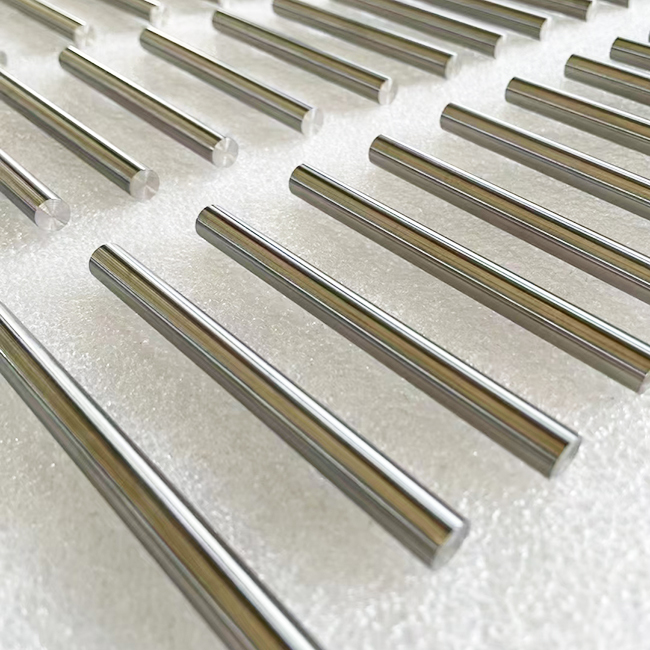
Gr5 titanium rod (Ti-6Al-4V) ranks as the most widely used titanium alloy material. It combines high strength, light weight and outstanding toughness, and delivers better overall mechanical performance than pure titanium grades. This material follows ASTM B348, the general technical standard for titanium and titanium alloy rods. It has great anti-fatigue performance, stable performance under high temperatures, good machinability and reliable welding capacity. It also keeps excellent corrosion resistance and non-magnetic features. Manufacturers make Gr5 titanium rods with vacuum heat treatment, precise dimension control, surface grinding and high-standard cleaning processes. Finished rods carry uniform internal structures, tight dimensional tolerances and stable overall performance. Factories use them widely in high-end fields including aerospace, medical implants, precision machinery and marine engineering. They provide stable material solutions for complex working conditions.
I. Analysis of Core Material Features of Gr5 Titanium Rods
1. Unique Alloy Composition and Microstructure
Gr5 titanium rods own an alpha-beta dual-phase structure. Its main alloy elements contain 6% aluminum and 4% vanadium. Aluminum works as an alpha stabilizer to lift material strength and high-temperature performance. Vanadium acts as a beta stabilizer to improve ductility and machinability. This classic element ratio stands as the optimal design in the industry, and fits the usage demands of multiple working conditions perfectly. Compared with pure titanium and single-phase titanium alloys, the alpha-beta dual-phase structure has one major advantage. The alpha phase brings strength and high-temperature stability. The beta phase improves ductility and machining performance. The two phases work together and deliver far better overall mechanical properties than pure titanium. They create the best balance between strength and plasticity.
2. Outstanding Strength-to-Weight Ratio
Gr5 titanium rods only have a density of 4.43 g/cm³, around 60% of steel density. Its room-temperature tensile strength reaches above 895 MPa, and yield strength exceeds 825 MPa. Values change under high or low temperature environments. This high specific strength makes it the perfect choice for lightweight design. Aerospace structural parts cut their total weight by 20% to 40% after switching to Gr5 rods, while they still hold sufficient structural strength.
3. Comprehensive Physical and Chemical Properties
Gr5 titanium rods have a melting point of roughly 1660 ℃ and stable thermal performance. A natural TiO₂ passivation film forms on its surface, with a thickness of 2 nm to 5 nm. This film offers long-lasting corrosion protection. Its hardness ranges from 280 HB to 340 HB, and its elongation stays above 10%. It balances hardness and ductility well. Low thermal conductivity creates one machining difficulty for Gr5 rods. Cutting heat cannot disperse quickly and burns cutting tools easily. But this feature helps structural parts keep thermal stability and reduce thermal deformation under high-temperature working environments. Its elastic modulus hits about 110 GPa, nearly half of steel’s modulus. This property lowers stress shielding effects for medical implant devices.
Property Comparison Between Gr5 Titanium Rod and Other Materials (Standard Room-Temperature Values)
| Property Index | Gr5 Titanium Rod | Stainless Steel (304/316) | Aluminum Alloy (6061-T6) | Comparison Notes |
|---|---|---|---|---|
| Density (g/cm³) | 4.43 | 7.9 | 2.7 | Gr5 weighs less than steel and more than aluminum |
| Tensile Strength (MPa) | ≥895 | 520 ~ 750 | 290 ~ 580 | Gr5 has much higher strength than aluminum and better strength than regular stainless steel |
| Specific Strength (MPa·cm³/g) | 202 | 66 ~ 95 | 107 ~ 215 | Gr5 specific strength beats steel and matches high-strength aluminum. Gr5 keeps stable strength at high temperatures, while aluminum loses most strength above 200 ℃ |
| Corrosion Resistance | Excellent | Good | Medium | Gr5 resists seawater, chloride ions, dilute acid and alkali greatly |
| Continuous Working Temperature (℃) | 400 ~ 500 | 300 ~ 400 | 150 ~ 200 | Gr5 outperforms stainless steel and aluminum alloys under high temperatures |
| Fatigue Strength (MPa, 10⁷ cycles) | 450 ~ 550 | 200 ~ 300 | 90 ~ 130 | Gr5 shows far better anti-fatigue ability than aluminum and regular steel |
| Biocompatibility | Excellent | Poor (nickel ion precipitation) | Poor | Medical-grade Gr5 fits implant production |
| Weldability | Good (inert gas shielding required) | Excellent | Good | Welding of Gr5 needs strict gas protection |
II. Performance Advantages of Gr5 Titanium Rods Under Complex Working Conditions
1. Structural Stability Under High Pressure
Gr5 titanium rods carry yield strength above 825 MPa. They run steadily for a long time under 10 MPa to 40 MPa high pressure without plastic deformation. Its dual-phase structure creates strong resistance against crack expansion. Manufacturers build key connecting parts of high-pressure vessels in petrochemical equipment with Gr5 rods. These components keep stable operation under constant high pressure.
2. Long-Term Protection Against Strong Corrosive Media
This material has natural resistance to seawater, chloride ions, acid and alkali solutions. The TiO₂ passivation film stays stable within pH 1 to 12 under normal temperature and pressure. The film repairs itself quickly even after surface damage. Factories use Gr5 rods to make core parts of seawater desalination devices in marine engineering. These parts serve more than 20 years under standard seawater environments. Service life shortens under special corrosive conditions, and Gr5 still lasts much longer than traditional stainless steel.
3. Adaptability to Alternating High and Low Temperatures
This material maintains good performance from -196 ℃ to 500 ℃. Its ductility never drops under low temperatures, and removes risks of brittle fracture. It retains over 70% of its original strength at 400 ℃ to 500 ℃. Gr5 titanium rods have a low thermal expansion coefficient at roughly 9×10⁻⁶/℃, half of steel’s value. This feature creates small volume changes during temperature shifts and lowers internal thermal stress. The material rarely develops thermal fatigue cracks under alternating temperatures. Manufacturers make compressor disks and shafts of aero-engines from Gr5 rods. These parts stand sharp temperature swings during engine startup and shutdown without thermal fatigue cracks.
4. Anti-Fatigue Performance Under Cyclic Loads
For high-cycle fatigue tests over 10⁷ load cycles, Gr5 titanium rods show fatigue strength equal to 50% to 60% of its tensile strength. This rate sits far above the 30% to 40% rate of regular steel. Its dual-phase structure disperses concentrated stress effectively and slows crack formation and expansion. Medical manufacturers produce femoral stems of artificial hip joints with Gr5 rods. These parts bear millions of cycles of human body loads without failure. Aero-engine blades and landing gear components also rely on its great anti-fatigue performance to meet aviation safety standards.
III. Manufacturing Process and Quality Control System for Gr5 Titanium Rods
1. Advanced Production Flow
Workers melt raw materials twice inside VAR vacuum consumable arc furnaces. This step removes gas impurities including hydrogen, oxygen and nitrogen, cuts inclusion defects and eliminates component segregation. Manufacturers heat forged blanks in the beta phase zone and conduct multi-direction forging in the alpha-beta phase zone. This process refines grain sizes to ASTM grade 6 to grade 8. After hot rolling or cold drawing forming, products go through vacuum annealing at 700 ℃ to 800 ℃ under argon shielding. The annealing process eliminates internal stress. Factories also run hydrogen removal treatment. They heat materials to 650 ℃ to 750 ℃ under vacuum and hold the temperature for 2 to 4 hours. This step controls hydrogen content below 0.008% and prevents hydrogen embrittlement. Workers finally turn or grind the rods to reach precise sizes.
2. Strict Quality Inspection Standards
Inspectors use spectrometers and ICP-MS devices for chemical composition analysis. They make aluminum content fall between 5.5% and 6.75%, and vanadium content stay from 3.5% to 4.5% to meet ASTM B348 rules. The factory also sets tight limits for impurity elements: O ≤ 0.20%, Fe ≤ 0.30%, C ≤ 0.10%, N ≤ 0.05%, H ≤ 0.008%. Medical-grade Gr5 rods require hydrogen content below 0.005%. Mechanical performance tests cover tensile tests, hardness tests, impact tests and fatigue tests. Ultrasonic testing checks internal defects, and eddy current testing finds surface cracks. Every production batch comes with a full Material Test Certificate (MTC), and the certificate traces all the way back to the raw material heat number.
3. Diverse Specifications and Surface Finishes
| Specification Type | Size Range | Standard Tolerance | Surface Finish | Typical Applications |
|---|---|---|---|---|
| Standard Stock Rod | φ8 ~ φ100 mm | h9 ~ h11 | Black Skin / Peeled Surface | Rough machining of structural parts |
| Cold Drawn Precision Rod | φ4 ~ φ30 mm | h7 ~ h9 | Bright Surface | Precision shafts, 3C electronic components |
| Large Forged Rod | φ100 ~ φ300 mm | h10 ~ h11 | Turned Surface | Large flanges, disk and shaft blanks |
| Ground Precision Rod | φ6 ~ φ50 mm | h6 ~ h7 | Polished Surface (Ra ≤ 0.4 μm) | Medical devices, precision molds |
| Special Shaped Rod (Square / Hexagon) | Custom sizes per drawings | ±0.05 mm or contract agreement | Custom Machined Surface | Special connecting pieces, fasteners |
IV. Application Value of Gr5 Titanium Rods in Key Industries
1. Lightweight Upgrade in the Aerospace Industry
Manufacturers build critical load-bearing parts including aircraft landing gears, engine disks, shafts and fasteners from Gr5 titanium rods. These parts cut total weight by 40% to 60% compared with steel alternatives. Gr5 rods weigh slightly more than aluminum alloys, but carry much higher strength, better anti-fatigue performance and stronger high-temperature resistance. The material holds stable performance at -55 ℃ low air temperatures and 500 ℃ engine high temperatures. It solves two common industry drawbacks: sharp strength loss of aluminum alloys under heat and excessive weight of stainless steel.

2. Biocompatibility Advantages for Medical Devices
Medical-grade Gr5 titanium rods follow ASTM F136 standards. They share the same chemical limits as industrial-grade ASTM B348 rods, but carry higher purity and stricter production rules. This material shows outstanding biocompatibility and osseointegration capacity. Factories use it widely for artificial joints, orthopedic implants and dental implants. The material carries no toxic elements and no magnetism. It never triggers human immune rejection or creates signal interference during MRI scans. After surface anodizing or sandblasting treatment, its micro rough surface speeds up bone cell adhesion and growth. The TiO₂ film on titanium surfaces creates chemical bonds with bone tissues, and brings stable clinical results.
3. Corrosion Resistant Solutions for Chemical Equipment
Factories produce stirring shafts of reaction kettles, heat exchanger tubes and valve stems from Gr5 titanium rods for pharmaceutical, electroplating and chlor-alkali industries. The material stays stable in weak sulfuric acid, nitric acid and weak hydrochloric acid. Under regular chemical environments with temperatures below 80 ℃ and medium flow rates, equipment service cycles extend from 2–3 years (stainless steel) to more than 10 years. Users need separate service life evaluation for harsh environments with high temperature, high chloride levels or fluorine content.

4. Long-Lasting Solutions for Marine Engineering
Gr5 titanium rods make key parts of seawater desalination equipment, mooring systems for offshore platforms and submersible structural pieces. This material has natural resistance to corrosion from chloride ions, sulfate and marine microbes inside seawater. It runs for decades without extra anti-corrosion coatings.

5. Performance Assurance for Precision Manufacturing
3C electronics, semiconductor equipment and precision molds need shaft parts with tight dimensional tolerance and smooth surface finish. Cold drawn and ground Gr5 titanium rods hold dimensional tolerance within ±0.02 mm and surface roughness Ra ≤ 0.4 μm. They fit precise assembly needs for mobile phone rotating shafts, drone motor shafts and motion guide shafts of semiconductor machines. The non-magnetic material avoids signal disturbance to sensitive electronic parts. Its low thermal expansion coefficient cuts thermal deformation risks, and works well for high-precision positioning equipment.
Conclusion
Gr5 titanium rods own a unique alpha-beta dual-phase structure design. Manufacturers use advanced processes such as interstitial element control and vacuum melting to balance high strength, light weight, corrosion resistance, anti-fatigue performance and high-temperature stability. Gr5 titanium rods form a complete engineering application system, covering component design, production processing, quality control and industrial usage. It acts as the top material choice for high-end fields including aerospace, medical implants, chemical anti-corrosion, marine engineering and precision manufacturing. It also guarantees system reliability under complex working conditions. New technologies such as additive manufacturing and ultra-fine grain processing keep expanding the application scope of Gr5 titanium rods. They deliver lighter, stronger and longer-lasting material solutions for high-end industrial equipment.
FAQ
1. What advantages does Gr5 titanium rod hold over pure titanium (Gr1 / Gr2)?
Gr5 titanium rod carries tensile strength above 895 MPa, 2.5 to 3 times the tensile strength of Gr2 pure titanium (≥345 MPa). It shows an even bigger gap in yield strength, so it fits heavy-load structural parts. But Gr5 only has minimum elongation of 10%. Gr2 pure titanium reaches elongation above 20%. Pure titanium forms more easily during complex cold bending and deep drawing processes. Gr5 performs well under high temperatures (400–500 ℃) and cyclic fatigue loads. It stands as the preferred material for aerospace and precision machinery. Pure titanium offers better cost efficiency for projects requiring high plasticity, heavy cold forming and top-tier corrosion resistance.
2. Does Gr5 titanium rod create big machining difficulties? Do factories need special equipment?
Gr5 titanium rod counts as hard-to-machine material. Workers must use carbide or coated cutting tools. Recommended cutting speeds sit at 20–40 m/min for dry cutting and 40–60 m/min for wet cutting with full coolant supply. Feed rates range from 0.05 mm/r to 0.2 mm/r. Machining brings several common challenges: strong titanium adhesion causes tool sticking, work hardening develops fast, metal chips break with difficulty, and large elastic springback creates trouble for dimension control. Welding needs strict shielding from inert argon gas with purity above 99.99% to avoid surface oxidation. Its total machining cost runs 2 to 4 times higher than regular steel. But manufacturers achieve efficient and stable machining through optimized cutting parameters, proper tool coatings such as TiAlN and AlCrN, and sufficient cooling liquid supply.
3. How to check if purchased Gr5 titanium rods meet quality standards?
Review the Material Test Certificate (MTC) to confirm its chemical composition and mechanical property data match ASTM B348 standards. Take samples for key inspection items: run spectrum analysis to test aluminum, vanadium and impurity elements including oxygen, hydrogen and nitrogen; conduct tensile tests to measure tensile strength, yield strength and elongation; use ultrasonic inspection to find internal defects such as inclusions, pores and cracks. Complete extra inspections for full quality control: dimensional tolerance check (outer diameter, straightness), surface quality check (roughness, scratches, oxidation stains), metallographic analysis (grain size ASTM grade 6–8, no abnormal alpha layers or beta spots). Prioritize suppliers with ISO 9001 and AS9100 (aerospace grade) certifications, and ask them to provide third-party laboratory test reports.
Need a Trusted Supplier of Gr5 Titanium Rods?
Baoji Titanium Valley Titanium Nickel Zirconium Material Processing Co., Ltd. works as a professional titanium alloy rod manufacturer. The company owns advanced production machines and a full quality management system. It provides customized Gr5 titanium rods covering all sizes from φ4 mm to φ300 mm. The firm offers stable mass supply and complete technical support. Contact our team for full technical documents and quotation plans via email: sales@titaniumvalleys.com
References
- Qu H L, Liu X H, Zhao Y Q. Research Progress on Microstructure, Properties and Processing Technology of Ti-6Al-4V Alloy[J]. Titanium Industry Progress, 2021, 38(2): 1-8.
- Li M Q, Wang K L, Peng Y H. Material Selection and Application of Titanium Alloys for Aviation[J]. Aeronautical Manufacturing Technology, 2020, 63(7): 22-30.
- Zhang W F, Sun W, Liu J R. Biocompatibility and Surface Modification Technology of Medical Titanium Alloys[J]. Rare Metal Materials and Engineering, 2019, 48(11): 3421-3429.
- Chen Y Y, Song M, Zhang X D. Application and Corrosion Protection of Titanium Alloys in Marine Engineering[J]. Chinese Journal of Corrosion and Protection, 2022, 42(4): 501-512.