
Application Cases of Gr2 Titanium Bars in Seawater Desalination and Deep-Sea Exploration Vehicles
- Gr2 Titanium Bars
1. Introduction
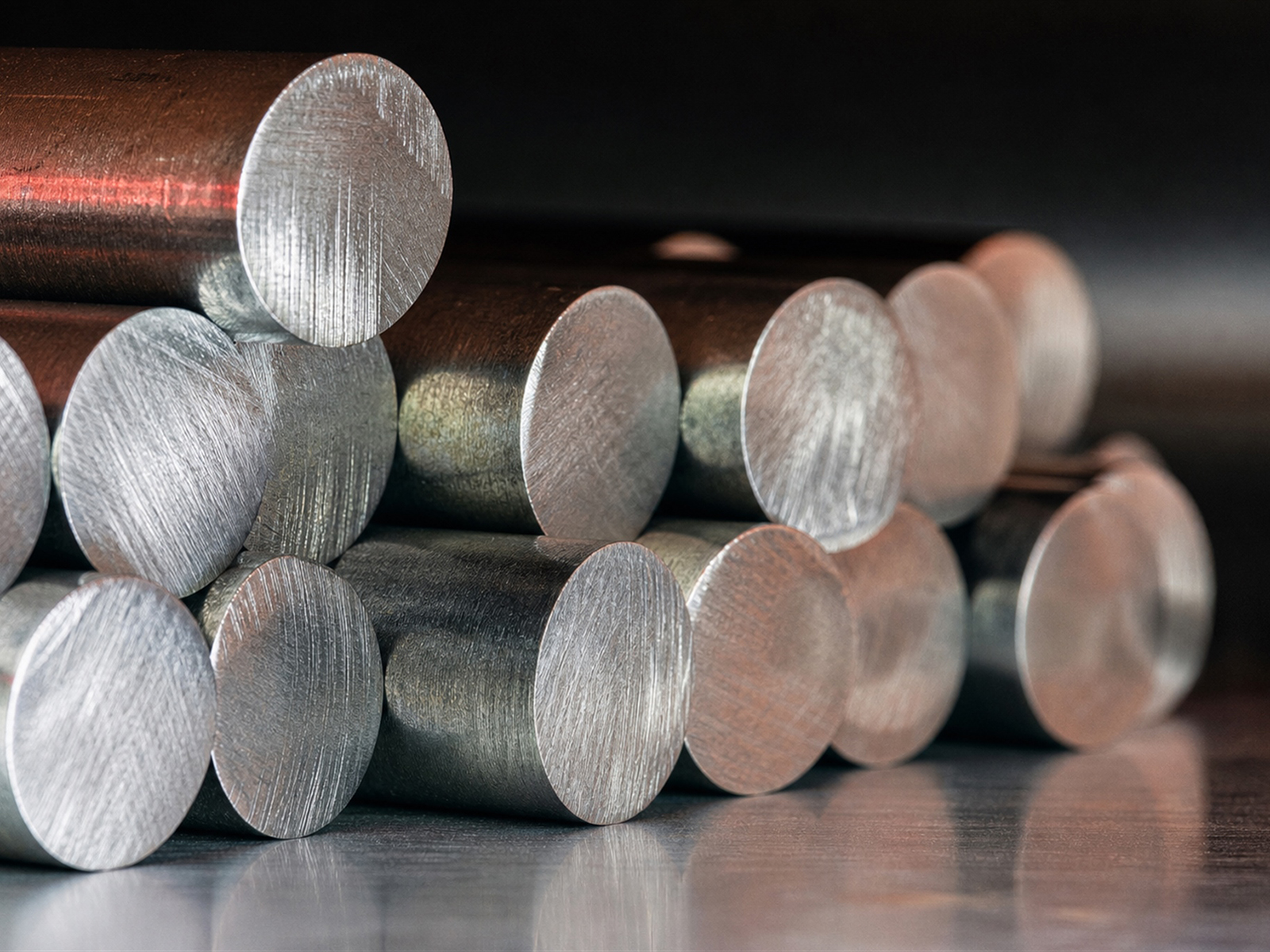
Gr2 titanium bars (Ti-0.3Mo-0.8Ni) play an irreplaceable role in two critical domains seawater desalination and deep-sea exploration, thanks to their exceptional resistance to seawater corrosion and well-balanced mechanical properties. Heat exchange tubes for seawater preheating, high-pressure pump shafts, and reverse osmosis membrane support frames in desalination plants, as well as pressure-hull frameworks and thruster components in deep-sea exploration vehicles, all demand materials capable of maintaining long-term stability under extreme corrosive environments and high-pressure conditions.
With a titanium content exceeding 99.5%, a tensile strength of 340-450 MPa, and an elongation rate of 20% or greater, Gr2 titanium bars have become the material of choice for these demanding applications. This article systematically analyzes the performance of Gr2 titanium bars in these two major fields, drawing on real-world engineering case studies.
2. Application Cases in Seawater Desalination
(1) Preheater Tubes in Multi-Stage Flash (MSF) Desalination Plants
A multi-stage flash (MSF) desalination plant in the Middle East with a daily production capacity of 50,000 metric tons originally employed copper-nickel alloy (90/10 Cu-Ni) for its seawater preheater tubes. After five years of operation, multiple leaks developed in the piping due to chloride-ion attack from seawater, resulting in annual maintenance costs of approximately USD 1.2 million. In 2018, the plant comprehensively replaced all heat exchange tubes with ones machined from Gr2 titanium bars. As of today, ten years of continuous operation, no leak incidents have occurred, saving approximately USD 1 million annually in maintenance costs. The corrosion rate of Gr2 titanium bars in seawater is below 0.001 mm/year, which is virtually negligible.
(2) Plunger Shafts of Reverse Osmosis (RO) High-Pressure Pumps
In a coastal city reverse osmosis seawater desalination project, the high-pressure pump plunger shafts were originally fabricated from duplex stainless steel 2205. After 18 months of operation in a chlorine-containing seawater environment, stress corrosion cracking (SCC) was observed. Upon replacement with Gr2 titanium bar (diameter 80 mm), the equipment has operated continuously for over eight years, requiring only one routine maintenance visit. The high yield strength of Gr2 titanium bars (greater than or equal to 275 MPa) ensures structural stability of the plunger shafts under operating pressures of up to 15 MPa.
(3) Structural Components in Concentrated Brine Discharge Pipelines
Concentrated brine produced during seawater desalination (with salinity approximately twice that of normal seawater) exerts extremely aggressive corrosive effects on pipeline materials. A desalination plant utilized connection flanges and support components machined from Gr2 titanium bars for its concentrated brine discharge pipelines. After six years of operation in an environment with chloride concentrations as high as 45,000 mg/L, no signs of corrosion were detected. By comparison, super duplex stainless steel SS2507 under identical operating conditions has an expected service life of only 5-7 years.
Table 1. Summary of Gr2 Titanium Bar Applications in Seawater Desalination
| Application Area | Specific Component | Original Material | Service Life After Switching to Gr2 Ti Bar | Cost Savings |
| MSF Preheater Tubes | Heat exchange tubes | 90/10 Cu-Ni | 10+ years | Annual maintenance savings of USD 1 million |
| RO High-Pressure Pump Shafts | Plunger shafts | Duplex Steel 2205 | 8+ years | Leakage rate reduced from 15% to 0% |
| Brine Discharge Pipelines | Flanges / Support components | SS2507 | 6+ years, no corrosion | Maintenance costs reduced by 70% |
3. Application Cases in Deep-Sea Exploration Vehicles
(1) Structural Components of the Fendouzher Manned Deep-Sea Submersible
Chinas Fendouzher (Striver) manned deep-sea submersible successfully reached the bottom of the Mariana Trench at a depth of 10,909 meters, setting a new record for Chinese deep-sea exploration. Several non-pressure-bearing structural components of this submersible, including observation window frames and robotic arm connectors, were machined from Gr2 titanium bars. The excellent comprehensive performance of Gr2 titanium bars in deep-sea conditions (low temperature of approximately 2 degrees C, extreme pressure of 110 MPa, and chloride-rich environments) ensured reliable operation of the submersible at depths exceeding 10,000 meters.
(2) Hull Frameworks of Remotely Operated Vehicles (ROVs)
An oceanographic research institute constructed the hull framework of its ROV exploration vehicle using welded Gr2 titanium bars. Compared to aluminum alloy frameworks, the titanium framework achieved a 30% weight reduction while delivering twice the structural strength. In a 3,000-meter water depth operational environment, the titanium framework exhibited no corrosion or deformation. Equipment availability increased from 72% (with aluminum alloy frameworks) to over 95%.
(3) Anchor Chain Connecting Components for Seafloor Observation Networks
In a seafloor seismic observation network deployed by the State Oceanic Administration around island perimeters, anchor chain connecting components and fixed clamping devices manufactured from Gr2 titanium bars remain permanently submerged in seawater. These components must maintain structural integrity under multiple harsh conditions, including salt spray, ocean current impact, and marine biofouling. Actual operational data demonstrate that Gr2 titanium bar connecting components achieve a service life exceeding 30 years in seawater, significantly outperforming stainless steel (5-8 years) and galvanized steel (2-3 years).
Table 2. Summary of Gr2 Titanium Bar Applications in Deep-Sea Exploration
| Deep-Sea Application | Operating Depth | Original Material | Performance with Gr2 Titanium Bars |
| Manned Submersible Structural Components | 10,909 m | Aluminum Alloy 6061 | No corrosion; sufficient strength |
| ROV Hull Framework | 3,000 m | Aluminum Alloy 5083 | Availability increased from 72% to 95% |
| Seafloor Observation Anchor Components | Permanent immersion | Galvanized Steel | Service life 30+ years |
4. Summary of Performance Advantages in Both Domains
(1) Seawater Corrosion Resistance
The corrosion rate of Gr2 titanium bars in seawater is below 0.001 mm/year. Even in seawater with flow velocities reaching 5 m/s, erosion-corrosion does not occur. The naturally formed TiO2 oxide film on the surface remains stable in seawater and possesses self-healing capability. Unlike stainless steel, Gr2 titanium bars do not suffer from pitting corrosion or crevice corrosion.
(2) High Strength-to-Weight Ratio
Gr2 titanium bars have a density of 4.51 g/cm3, only 56% that of stainless steel, yet their tensile strength is comparable. This characteristic is particularly significant for deep-sea exploration vehicles, as reducing equipment weight directly increases payload capacity and operational endurance.
(3) Non-Magnetic Properties
Gr2 titanium bars are non-magnetic materials, ensuring they do not interfere with precision instruments such as magnetometers aboard deep-sea exploration vehicles. This property also makes Gr2 titanium bars an ideal material for mine-countermeasure (MCM) equipment.
(4) Low-Temperature Toughness
Gr2 titanium bars retain good ductility at liquid nitrogen temperatures of -196 degrees C and do not experience brittle fracture in deep-sea low-temperature environments. This characteristic is especially critical for deep-sea exploration vehicles operating in polar waters.
Table 3. Comparative Performance of Gr2 Titanium Bars and Alternative Materials
| Performance Indicator | Gr2 Titanium Bar | 316L Stainless Steel | 90/10 Cu-Ni Alloy |
| Seawater Corrosion Rate (mm/year) | <0.001 | 0.1 – 0.3 | 0.01 – 0.05 |
| Density (g/cm3) | 4.51 | 8.0 | 8.94 |
| Tensile Strength (MPa) | 340 – 450 | 515 – 620 | 330 – 690 |
| Youngs Modulus (GPa) | 110 | 200 | 128 |
5. Conclusion
The application cases of Gr2 titanium bars in both seawater desalination and deep-sea exploration fully demonstrate their superior material performance and economic benefits. From large-scale desalination plants in the Middle East to manned submersibles operating at depths exceeding 10,000 meters, Gr2 titanium bars have emerged as the premier structural material for extreme marine environments, leveraging their comprehensive advantages in seawater corrosion resistance, high strength-to-weight ratio, non-magnetic properties, and low-temperature toughness.
As global seawater desalination capacity continues to expand and deep-sea exploration technologies advance, the market demand for Gr2 titanium bars is projected to grow further.
6. Frequently Asked Questions
Q1: What is the cost-effectiveness of Gr2 titanium bars in seawater desalination?
Although the initial procurement cost of Gr2 titanium bars is 3-5 times that of stainless steel, their exceptionally long service life (30+ years) and zero-maintenance requirements result in significantly lower lifecycle costs. Large-scale desalination plants utilizing Gr2 titanium bars typically recover the additional investment within 3-5 years.
Q2: Can Gr2 titanium bars be welded?
Yes. Gr2 titanium bars can be welded using both TIG (Tungsten Inert Gas) and MIG (Metal Inert Gas) welding processes, with weld joint strengths exceeding 90% of the base material. Welding must be performed under argon gas shielding to prevent high-temperature oxidation.
Q3: How does Gr2 titanium bar perform in fatigue under deep-sea conditions?
The fatigue limit of Gr2 titanium bars in seawater environments is approximately 280-320 MPa (about 70-80% of tensile strength), demonstrating excellent performance under cyclic loading conditions in deep-sea exploration vehicles. Surface shot peening treatments can further extend fatigue life.
7. Sourcing Reliable Gr2 Titanium Bar Suppliers
Baoti Titanium Valley Titanium Nickel Zirconium Material Processing Co., Ltd. is a professional manufacturer of high-end rare metal processing products. Equipped with an Italian Danieli rolling production line, the company produces over 10,000 metric tons of titanium bars annually and offers full-size customization with EN 10204 Type 3.1 certification services. Contact us immediately for technical support and quotation: sales@titaniumvalleys.com
8. References
[1] GB/T 3621-2021 Titanium and Titanium Alloy Bars [S]. Beijing: Standards Press of China, 2021.
[2] Zhao Jianguo. Application Technology of Titanium Materials in Seawater Desalination Engineering [J]. Chemical Equipment Technology, 2020, 41(4): 15-22.
[3] ASTM International. ASTM B348-22 Standard Specification for Titanium and Titanium Alloy Bars and Ingots [S]. West Conshohocken: ASTM International, 2022.
For a broader view of available grades, supply forms, and related specifications, explore our Titanium Rod category.
For product-level details and supply options, you can also review our ASTM F136 Gr5 Eli (Gr23) Titanium Rod page.