
What Value Does Zr702 Zirconium Foil Provide in Strong Acid Corrosion Environments?
- Zr702 Zirconium Foil
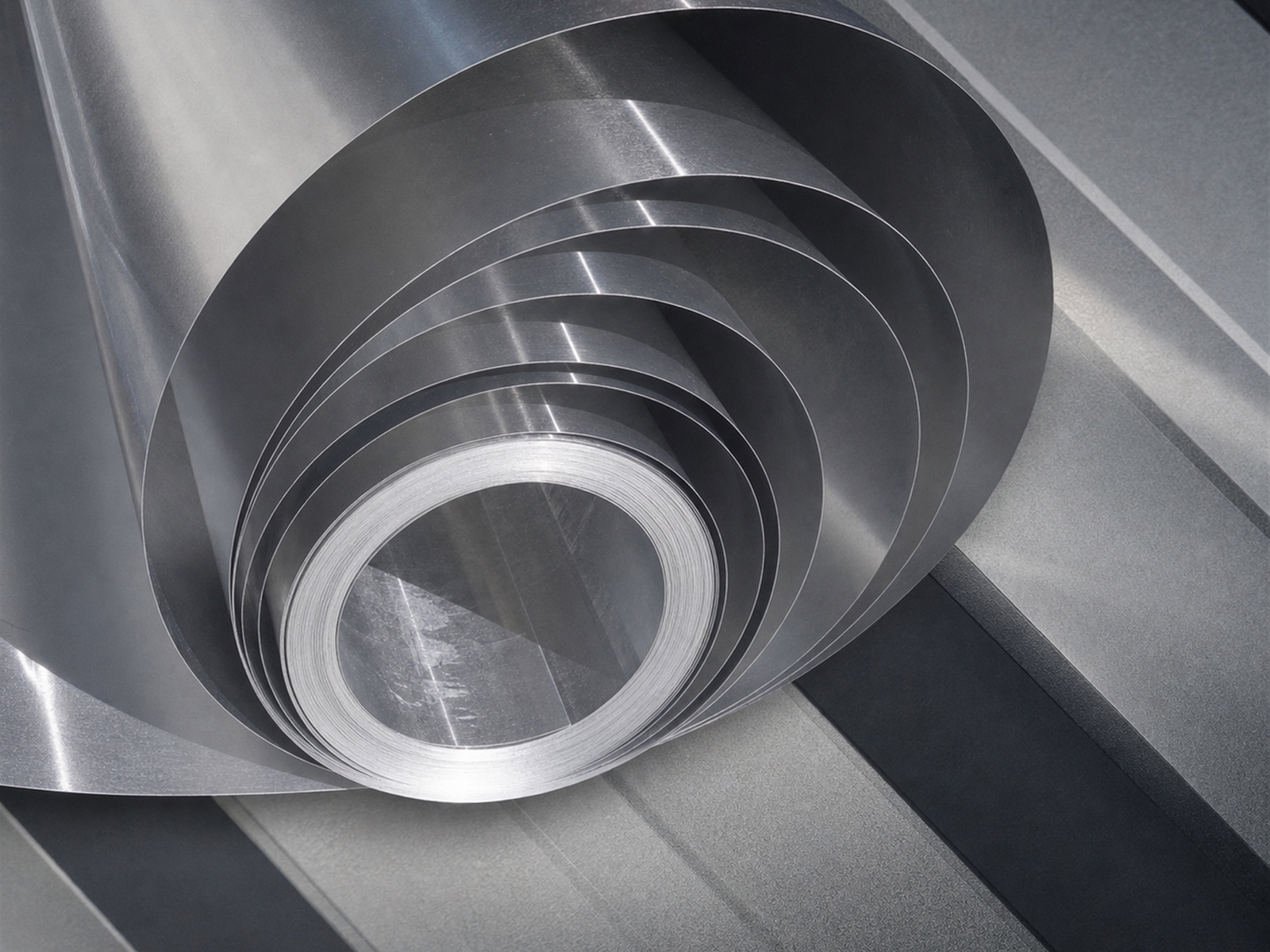
When chemical equipment is exposed to hydrochloric acid, dilute sulfuric acid, and other aggressive acid media, conventional metals can suffer pitting, perforation, or rapid wall loss. Zr702 zirconium foil, a commercially pure zirconium material with Zr+Hf >=99.2%, provides highly stable corrosion resistance in many non-oxidizing strong-acid environments, with corrosion rates that can be below 0.1 mm/year under controlled conditions. Through vacuum melting and multi-pass precision cold rolling, 0.02 to 0.8 mm thin products can be manufactured with tight thickness control. For 0.02 mm and thicker standard industrial foil, a tolerance of ±0.001 mm can be specified where process capability supports it; for 0.005 to 0.01 mm laboratory-grade ultra-thin foil, relative tolerance should be specified separately, such as ±5% or ±10%.
What Material Characteristics Define Zr702 Zirconium Foil?
How Is the Chemical Composition Controlled?
Zr702 is a commercially pure zirconium grade requiring Zr+Hf >=99.2%, with hafnium commonly limited to <=4.5%. Impurity limits such as Fe+Cr <=0.20%, O <=0.16%, N <=0.025%, and C <=0.05% help maintain corrosion resistance and formability.
Which Physical Properties Are Important?
The density is 6.51 g/cm3, between titanium alloys and nickel alloys. The melting point is approximately 1852 °C. Annealed tensile strength is typically >=380 MPa with elongation >=20%, making the material suitable for stamping, bending, and thin sealing components.
How Does Crystal Structure Affect Corrosion Resistance?
Zirconium has a hexagonal close-packed structure below 882 °C. Fine, uniform grains produced by inert-atmosphere annealing can reduce preferential grain-boundary attack and improve uniform corrosion resistance.
How Does Zr702 Resist Strong Acid Corrosion?
How Stable Is It in Hydrochloric Acid?
In 10 to 38% hydrochloric acid solutions, Zr702 can form a compact ZrO2 passive film. In boiling 37% hydrochloric acid, reported corrosion depth of Zr702 can be around 0.13 mm/year, while titanium may suffer hydrogen embrittlement and 316L stainless steel may show severe pitting.
How Should Sulfuric Acid and Mixed-Acid Service Be Described?
In sulfuric acid up to about 70%, Zr702 can maintain good stability below approximately 80 °C. In organic acids such as acetic acid and formic acid, long-term corrosion rates may be below 0.05 mm/year. For HCl-H2SO4-HNO3 mixed-acid systems, the concentration and temperature range must be specified. Dilute-acid or ambient-temperature service should not be generalized to high-concentration oxidizing mixed acids.
How Does It Compare with Competing Materials?
| Material | Corrosion Rate in Boiling 37% HCl | Corrosion Rate in 70% H2SO4 at 80 °C | Crevice-Corrosion Sensitivity in Seawater | Relative Cost Factor |
|---|---|---|---|---|
| Zr702 zirconium foil | 0.13 mm/year | <0.10 mm/year | Very low | 1.0 |
| TA2 titanium foil | Severe hydrogen embrittlement and cracking | Severe corrosion | Medium | 0.6 |
| 316L stainless steel | Pitting perforation | 3.5 mm/year | High | 0.2 |
| Nickel 200 | 1.2 mm/year | 0.8 mm/year | Low | 1.3 |
The comparison indicates why Zr702 is used in severe acid service, especially hydrochloric-acid systems. Although the initial material cost is higher, extended service life can reduce lifecycle cost.
How Is Ultra-Thin Zirconium Foil Manufactured?
How Does Twenty-High Cold Rolling Control Thickness?
A 750 mm twenty-high precision mill distributes roll stiffness through intermediate and backup rolls, reducing elastic roll deformation. For standard industrial foil at 0.02 mm and above, ±0.001 mm thickness control may be applied when verified by inspection.
Why Is Vacuum Annealing Required?
Cold rolling accumulates dislocations and residual stress. Continuous vacuum annealing with preheating around 450 °C, holding at 680 to 720 °C, and inert-gas cooling restores ductility and avoids oxygen and nitrogen contamination.
How Is Surface Cleanliness Controlled?
Ultrasonic cleaning in alkaline solution at about 40 kHz removes rolling oil and metal particles. Deionized-water rinsing and hot-air drying can reduce surface residues below 5 µg/cm2.
| Process Step | Key Parameter | Technical Challenge | Process Solution |
|---|---|---|---|
| Precision cold rolling | Thickness tolerance ±0.001 mm for applicable standard foil | Springback and flatness | Twenty-high roll-stiffness distribution model |
| Vacuum annealing | Temperature uniformity ±2 °C | Oxidation color variation | Programmed multi-zone heating |
| Surface cleaning | Residue <5 µg/cm2 | Tension control in ultra-thin foil | Floating-roll tension compensation |
| Precision slitting | Edge burr <0.02 mm | Edge cracking | Optimized circular-knife geometry |
Where Is Zr702 Zirconium Foil Used?
How Is It Used in Chemical Sealing and Protection?
In chlor-alkali electrolyzers, Zr702 zirconium foil can be made into diaphragm sealing gaskets. A more precise engineering description is that zirconium foil is used as a zirconium-clad gasket or zirconium foil composite sealing structure rather than directly replacing a soft PTFE gasket.
How Is It Used in Electrolysis and Electroplating Systems?
In high-purity electrolytic copper production, 0.1 mm Zr702 foil can be evaluated as an electrode substrate in copper sulfate electrolytes containing 10% H2SO4. After long operation, surface corrosion and bond integrity must be inspected.
How Should Battery Current-Collector Applications Be Described?
If testing is conducted over a 3.0 to 4.2 V voltage window, Zr702 foil should be described as a positive-electrode current collector or as being tested in a full-cell system. A negative-electrode current collector normally operates at much lower potential versus Li/Li+.
How Is It Used in Vacuum Electronic Equipment?
In mass spectrometers and electron-beam welding equipment, magnetic materials can interfere with electron-beam paths. A 0.08 mm Zr702 foil shield can provide nonmagnetic behavior, low outgassing, and stable sealing in ultra-high vacuum.
What Custom Production Capabilities Are Available?
What Dimensions Can Be Supplied?
Standard products cover 0.02 to 0.8 mm thickness, 350 to 670 mm width, and custom coil length. Laboratory-grade ultra-thin products of 0.005 to 0.01 mm and thicker products above 1.0 mm can be discussed separately with realistic tolerance requirements.
What Surface Conditions Are Offered?
Pickled, bright, and matte surface conditions can be supplied according to welding, coating, or electronic requirements. Roughness can be controlled in the Ra 0.2 to 0.8 µm range.
How Is Batch Consistency Controlled?
Each coil should be supplied with a material certificate and inspection report covering chemical composition, mechanical properties, grain size, dimensional accuracy, and surface condition.
| Custom Service | Specification Range | Delivery Time | Suitable Applications |
|---|---|---|---|
| Ultra-thin precision foil | 0.005 to 0.03 mm | 25 to 35 days | Laboratory research and sensors |
| Standard industrial foil | 0.02 to 0.8 mm | 15 to 25 days | Chemical sealing and electrolysis electrodes |
| Wide coil | Width >=500 mm | 20 to 30 days | Large equipment lining |
| Special surface treatment | Customized | Additional 5 to 10 days | Coating substrates and special environments |
What Is the Engineering Conclusion?
Zr702 zirconium foil provides strong acid corrosion resistance, precise dimensional control, and reliable production capability for chemical protection, electrolysis, and advanced equipment. Technical data should specify actual acid concentration, temperature, tolerance class, and electrode function so buyers can apply the material safely and accurately.
What Questions Do Buyers Commonly Ask?
How Different Is Zr702 from TA2 Titanium Foil in Hydrochloric Acid?
In boiling 37% hydrochloric acid, Zr702 may corrode at about 0.13 mm/year, while TA2 titanium can suffer severe hydrogen embrittlement and rapid failure.
Can Ultra-Thin Zr702 Foil Be Formed into Complex Seals?
Annealed Zr702 foil has useful ductility and can be stamped, drawn, or flanged with appropriate die design. Deformation rate and local thinning must be controlled.
How Can ASTM B551 Compliance Be Verified?
Suppliers should provide chemical analysis, tensile data, metallographic inspection, surface quality records, and dimensional inspection results corresponding to the standard and purchase specification.
How Can You Source Zr702 Zirconium Foil?
Baoji Titanium Valley Titanium Nickel Zirconium Material Processing Co., Ltd. supplies Zr702 zirconium foil with precision rolling equipment and annual capacity of about 300 tons. Contact sales@titaniumvalleys.com for technical data and samples.
References
1. Li Jun, Zhang Wei. Study on the Corrosion Behavior of Zirconium in Hydrochloric Acid Solutions[J]. Corrosion Science and Protection Technology, 2018, 30(4): 345-350.
2. Wang Qiang, Liu Yang. Progress in Precision Rolling Processes and Equipment for Ultra-Thin Metal Foil[J]. Rare Metal Materials and Engineering, 2019, 48(12): 4001-4006.
3. Zhao Min, Chen Gang. Analysis of Passive Film Structure and Corrosion Resistance of Commercially Pure Zirconium[J]. Titanium Industry Progress, 2020, 37(5): 28-33.