
Why Is Grade 4 Titanium Foil the Strongest Commercially Pure Titanium Grade
- Grade 4 Titanium Foil
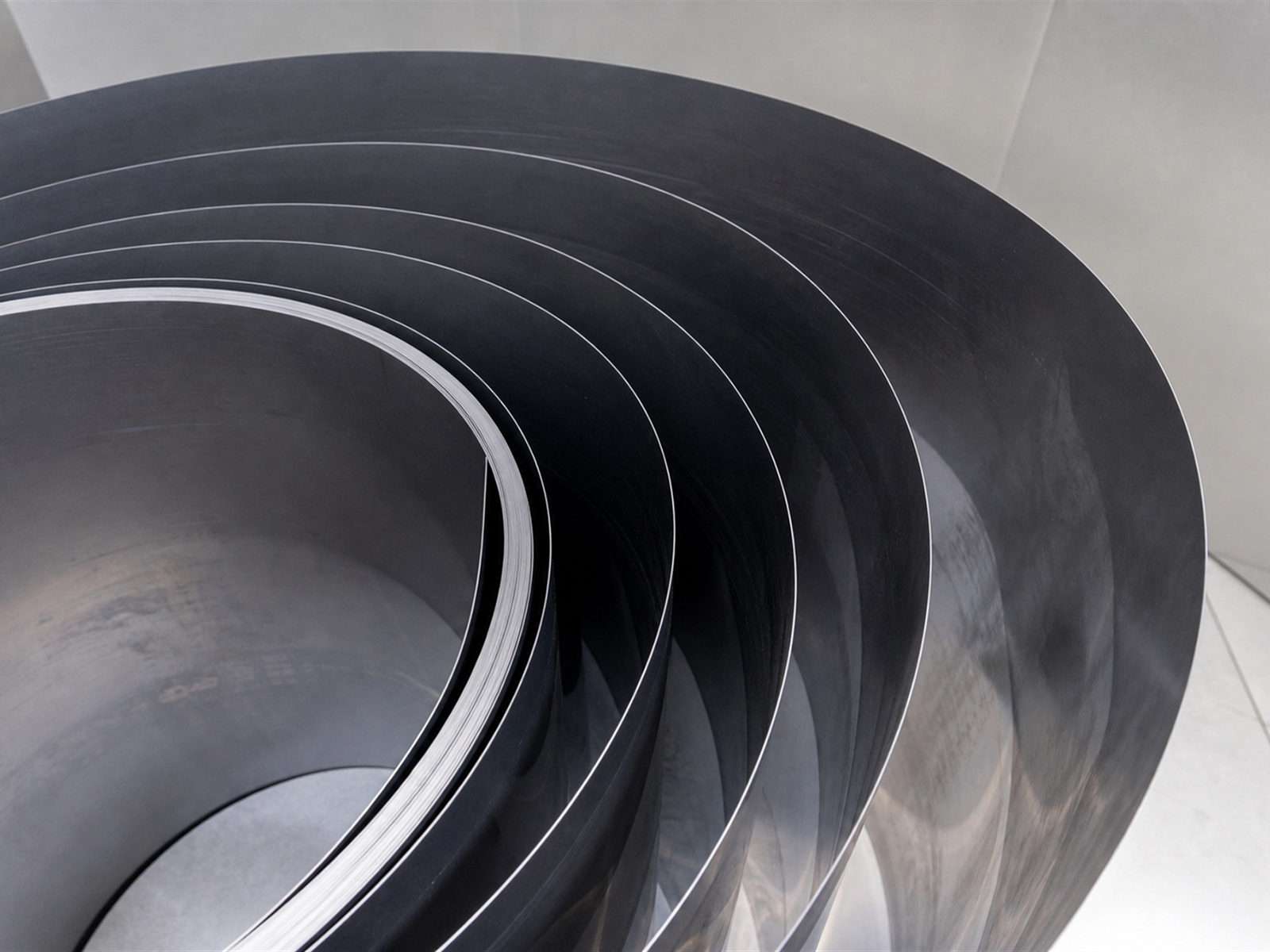
Among the commercially pure titanium (CP Ti) series, Grade 4 (Gr4) titanium foil stands out for its superior strength. Compared with Gr1, Gr2, and Gr3, Gr4 foil achieves significant solid-solution strengthening through elevated oxygen content (up to 0.40 wt%), delivering a yield strength approximately 1.6 times that of Gr2. Despite its highest strength level, Gr4 titanium foil retains the excellent corrosion resistance and adequate formability inherent to pure titanium. This article examines, across five dimensions—alloying mechanisms, mechanical properties, corrosion resistance, fabricability, and applications—why Grade 4 titanium foil holds the distinction of being the strongest commercially pure titanium grade.
1. Alloying and Strengthening Mechanisms of Gr4 Titanium Foil
Commercially pure titanium is not 100% elemental titanium; it is a titanium-based material containing small amounts of interstitial and substitutional elements. The primary distinctions among Gr1 through Gr4 lie in their oxygen, iron, and nitrogen contents. Gr4 titanium foil features the highest oxygen content, ranging from 0.20 to 0.40 wt% (Gr2: ≤ 0.20 wt%; Gr1: ≤ 0.10 wt%), and an iron content up to 0.30 wt% (Gr2: ≤ 0.30 wt%). Oxygen acts as the most potent interstitial solid-solution strengthening element. By occupying octahedral interstitial sites within the titanium crystal lattice, oxygen induces lattice distortion that substantially raises both yield and tensile strength. Research indicates that each 0.1% increase in oxygen content elevates the yield strength of Gr4 titanium foil by approximately 50–70 MPa.
2. Mechanical Properties of Gr4 Titanium Foil
Typical mechanical properties of annealed Gr4 titanium foil are as follows:
- Tensile strength: ≥ 550 MPa
- Yield strength: ≥ 450 MPa
- Elongation: ≥ 15%
In comparison, annealed Gr2 titanium foil typically exhibits tensile strength of 340–450 MPa, yield strength of 275–345 MPa, and elongation ≥ 20%. Relative to Gr2, Gr4 delivers approximately 25–40% higher tensile strength and 30–60% higher yield strength. Although ductility is somewhat reduced, the 15% elongation remains sufficient for most forming and fabrication requirements.
3. Corrosion Resistance of Gr4 Titanium Foil
Despite its higher strength, Gr4 titanium foil experiences virtually no degradation in corrosion resistance compared with Gr2. In seawater, chloride solutions, nitric acid, and organic acids, the corrosion rate of Gr4 foil is comparable to that of Gr2—both remaining below 0.001 mm/year. The solid-solution strengthening effect of oxygen does not compromise the TiO₂ passive film on the titanium surface. Consequently, the long-term reliability of Gr4 titanium foil in corrosive environments matches that of Gr2.
Corrosive Medium | Gr4 Corrosion Rate | Gr2 Corrosion Rate | 316L Stainless Steel |
Seawater | < 0.001 mm/year | < 0.001 mm/year | 0.1 mm/year |
5% HCl | 0.05–0.1 mm/year | 0.05–0.1 mm/year | 5–10 mm/year |
30% HNO₃ | < 0.001 mm/year | < 0.001 mm/year | 0.5 mm/year |
Table 1. Comparison of corrosion rates in various media
4. Fabricability and Forming Characteristics of Gr4 Titanium Foil
The cold formability of Gr4 titanium foil is slightly lower than that of Gr2, yet it remains suitable for bending, stamping, flanging, and similar operations. For complex-formed components, intermediate annealing is recommended to restore ductility between forming passes. Weldability is excellent: Gr4 titanium foil can be joined using both Gas Tungsten Arc Welding (GTAW/TIG) and Gas Metal Arc Welding (GMAW/MIG), with weld joint strengths reaching 85–90% of the base metal.
5. Typical Applications of Gr4 Titanium Foil
The high strength of Gr4 titanium foil makes it particularly well-suited for applications demanding both elevated strength and excellent corrosion resistance:
- Chemical Processing Equipment: Thin-wall linings for high-pressure reaction vessels and heat exchangers.
- Marine Engineering: High-strength structural components for seawater desalination plants.
- Medical Devices: Orthopedic implants and surgical instruments.
- Aerospace: Aircraft skin panels and interior components.
Mechanical Property Comparison Across CP Titanium Grades
Property | Gr1 Foil | Gr2 Foil | Gr3 Foil | Gr4 Foil |
Tensile Strength (MPa) | ≥ 240 | ≥ 340 | ≥ 450 | ≥ 550 |
Yield Strength (MPa) | ≥ 170 | ≥ 275 | ≥ 345 | ≥ 450 |
Elongation (%) | ≥ 24 | ≥ 20 | ≥ 18 | ≥ 15 |
Oxygen Content (%) | ≤ 0.10 | ≤ 0.18 | ≤ 0.25 | ≤ 0.40 |
Price Index | 1.0 | 1.1 | 1.2 | 1.3 |
Table 2. Mechanical property comparison across commercially pure titanium grades
Application Recommendations by Industry
Application Sector | Recommended Grade | Rationale | Expected Service Life |
Chemical Linings | Gr4 | High strength + corrosion resistance | 15+ years |
Medical Implants | Gr2 / Gr4 | Biocompatibility | Permanent implant |
Marine Engineering | Gr4 | Seawater corrosion resistance | 30+ years |
Aerospace | Gr5 | High strength + lightweight | 20+ years |
Table 3. Application recommendations by industry sector
6. Conclusion
Grade 4 titanium foil achieves its position as the strongest commercially pure titanium grade primarily through the solid-solution strengthening effect of its elevated oxygen content. While preserving the outstanding corrosion resistance characteristic of pure titanium, Gr4 foil delivers strength levels approaching those of titanium alloys. This positions Gr4 as an ideal choice for applications requiring a careful balance between strength and corrosion resistance.
FAQ
Q1: Can Gr4 titanium foil compete with Gr5 titanium alloy?
The yield strength of Gr4 (≥ 450 MPa) is approximately half that of Gr5 titanium alloy (≥ 825 MPa). However, Gr4 offers superior corrosion resistance and formability. For applications that do not demand extremely high strength, Gr4 provides better cost-effectiveness.
Q2: Can Gr4 titanium foil be strengthened by heat treatment?
No. The strength of Gr4 titanium foil is primarily achieved through oxygen solid-solution strengthening and cannot be significantly enhanced by heat treatment. Cold-work strain hardening is the only viable strengthening method.
Q3: Why is Gr4 titanium foil priced higher than Gr2?
Production of Gr4 requires more precise oxygen-content control and stricter heat-treatment processes. Coupled with relatively lower production volumes, Gr4 is typically priced 10–20% higher than Gr2.
Finding a Reliable Gr4 Titanium Foil Supplier
Baotou Titanium Valley Titanium, Nickel & Zirconium Material Processing Co., Ltd. is a professional manufacturer of high-end rare-metal processed materials. Equipped with an Danieli rolling production line imported from Italy, the company produces over 2,000 metric tonnes of titanium foil annually and offers full-size customization with EN 10204 3.1 certification. Contact us today for technical support and quotation:
References
- ASTM International. ASTM B265-21: Standard Specification for Titanium and Titanium Alloy Sheet and Plate. West Conshohocken: ASTM International, 2021.
- GB/T 3622.1-2017 Titanium and Titanium Alloys — Plates and Sheets — Part 1: Dimensions, Tolerances and Allowable Deviations. Beijing: Standards Press of China, 2017.